



| HEADLINE |

|
Maksud\'s Delineation of Consciousness
A retrospective exhibition
Published : Tuesday, 8 November, 2016 at 12:00 AM
Takir Hossain


Maksud's Delineation of Consciousness
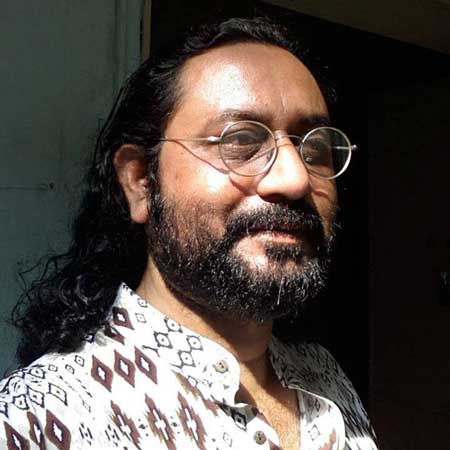 Maksudul Ahsan is one of the recognised and earnest painters who earned acknowledgment at the early 1990s. Social and urban life and its socio-economic aspects, as well as the surrounding atmosphere have made a great impact on his several periods of works. As a painter, Maksud is a workaholic, cerebral and he always feels a deep relation with the umbilical cord of the soil. His works plunge deep into childhood, nature, social and political disorder, partition of the sub-continent and after its effects, human relationships, personal loss, social injustice, gender discrimination and more.
Maksud just finished his retrospective exhibition--- a selection of works of over two decades at the National Art Gallery of Bangladesh Shilpakala Academy in the city. In his checkered career, the cerebral artist has done several series of works in varied mediums with a wide range of subjects. As a socially conscious painter, Maksud's paintings always highlight social and political turmoil, psychological disorder of human being and he also limns the moving and remarkable sights around us. The artist paints people, capturing the diverse moments of their social bindings. He portrays both pastoral and city people -- their sufferings, torments, bliss and ecstasies.
Over the years, Maksud has concentrated more on amorphous forms, vibrant hues and compositions. Serenity and mystery get the focus some of his works. "Black" is one of his notable series where he mainly experiments with the shade and some other hues for a harmonising effect. The series of work delineate dreams and illusions. The compositions are neatly organised.
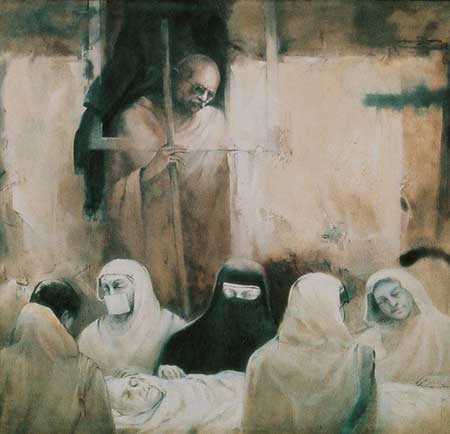 Maksud likes to make portraits of renowned man and women representing different eras in the sub-continent. These individuals have left legacies. They have reformed and reshaped the South Asian society. They are no more today but their contributions remain relevant in our daily lives. He feels that painting portraits is considered to be one of the oldest forms of art. Considering history, from ancient times this art form was predominantly used to glorify the influential and powerful in the society. He has managed to capture their unique expressions in the portraits. A number of his series plunge deep into underage marriage, religious and social bigotry, superstition, social injustice, inequality, oppression and more have also been featured in the series of works.
Some of Maksud's paintings articulate nature's unseen and unobserved beauty. In his use of colour, he has displayed a certain romantic concern for vivacious, lively hues and soulful texture. He brings in romanticism and nature in his works as well. He tries to synchronise colours and themes. His colours are often bold, which can translate the significance of the themes. Then there are times when the shades appear dreamy and romantic. He tries to express himself through simple compositions (sometimes rigid) and hues.
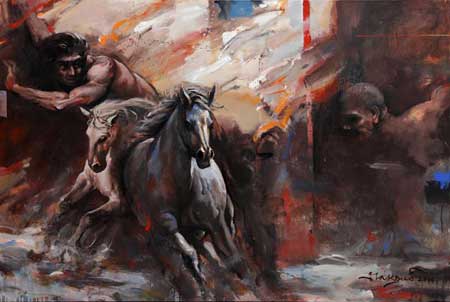
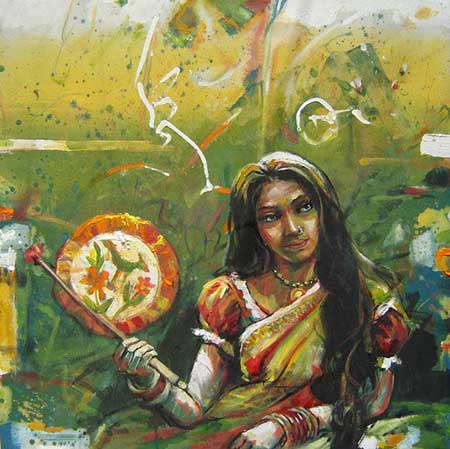 "Khepa" is an evocative series that delineates the movement of virulent bulls and horses. The animal seems potent and desperate to break free. Through the painting, Maksud wants to underscore liberty. The figures appear stimulating, and at the same time thought provoking. Figure and animal (horse, bull) movements both have captured simultaneously in some of his paintings. Not only does the artist concentrate on human movements but his works also delineate varied aspects of desire and insight of human. His drawings are engrossed with figures, which are the most central aspect of his charcoal based drawings. Maksud emblematically focuses on the strength and power. He always tries to highlight the gallantry of masses. He draws fearless figures and their bold movements. The artist uses space to increasingly interact with figures. The effective and aesthetic use of space brings about a sense of serenity in his works. Some of his works also expresses the aesthetic beauty of Bengali women, their varied moods and eternal beauty. His paintings are powerful in their tone of lines and serenity. He uses space to increasingly interact with the figures. The use of space is generous, and the artist can easily communicate with the themes.
Maksudul Ahsan is one of the recognised and earnest painters who earned acknowledgment at the early 1990s. Social and urban life and its socio-economic aspects, as well as the surrounding atmosphere have made a great impact on his several periods of works. As a painter, Maksud is a workaholic, cerebral and he always feels a deep relation with the umbilical cord of the soil. His works plunge deep into childhood, nature, social and political disorder, partition of the sub-continent and after its effects, human relationships, personal loss, social injustice, gender discrimination and more. Maksud just finished his retrospective exhibition--- a selection of works of over two decades at the National Art Gallery of Bangladesh Shilpakala Academy in the city. In his checkered career, the cerebral artist has done several series of works in varied mediums with a wide range of subjects. As a socially conscious painter, Maksud's paintings always highlight social and political turmoil, psychological disorder of human being and he also limns the moving and remarkable sights around us. The artist paints people, capturing the diverse moments of their social bindings. He portrays both pastoral and city people -- their sufferings, torments, bliss and ecstasies.
Over the years, Maksud has concentrated more on amorphous forms, vibrant hues and compositions. Serenity and mystery get the focus some of his works. "Black" is one of his notable series where he mainly experiments with the shade and some other hues for a harmonising effect. The series of work delineate dreams and illusions. The compositions are neatly organised.
Maksud likes to make portraits of renowned man and women representing different eras in the sub-continent. These individuals have left legacies. They have reformed and reshaped the South Asian society. They are no more today but their contributions remain relevant in our daily lives. He feels that painting portraits is considered to be one of the oldest forms of art. Considering history, from ancient times this art form was predominantly used to glorify the influential and powerful in the society. He has managed to capture their unique expressions in the portraits. A number of his series plunge deep into underage marriage, religious and social bigotry, superstition, social injustice, inequality, oppression and more have also been featured in the series of works. Some of Maksud's paintings articulate nature's unseen and unobserved beauty. In his use of colour, he has displayed a certain romantic concern for vivacious, lively hues and soulful texture. He brings in romanticism and nature in his works as well. He tries to synchronise colours and themes. His colours are often bold, which can translate the significance of the themes. Then there are times when the shades appear dreamy and romantic. He tries to express himself through simple compositions (sometimes rigid) and hues.
"Khepa" is an evocative series that delineates the movement of virulent bulls and horses. The animal seems potent and desperate to break free. Through the painting, Maksud wants to underscore liberty. The figures appear stimulating, and at the same time thought provoking. Figure and animal (horse, bull) movements both have captured simultaneously in some of his paintings. Not only does the artist concentrate on human movements but his works also delineate varied aspects of desire and insight of human. His drawings are engrossed with figures, which are the most central aspect of his charcoal based drawings. Maksud emblematically focuses on the strength and power. He always tries to highlight the gallantry of masses. He draws fearless figures and their bold movements. The artist uses space to increasingly interact with figures. The effective and aesthetic use of space brings about a sense of serenity in his works. Some of his works also expresses the aesthetic beauty of Bengali women, their varied moods and eternal beauty. His paintings are powerful in their tone of lines and serenity. He uses space to increasingly interact with the figures. The use of space is generous, and the artist can easily communicate with the themes. Loading...
Loading...
Also read







Editor : Iqbal Sobhan Chowdhury
Published by the Editor on behalf of the Observer Ltd. from Globe Printers, 24/A, New Eskaton Road, Ramna, Dhaka.
Editorial, News and Commercial Offices : Aziz Bhaban (2nd floor), 93, Motijheel C/A, Dhaka-1000.
Phone: PABX- 41053001-06; Advertisement: 41053012; 01793317829, 01550707291, E-mail: [email protected], [email protected] Online: email: [email protected] 41053014; 01550707297 Advertisement: 01550707296
Published by the Editor on behalf of the Observer Ltd. from Globe Printers, 24/A, New Eskaton Road, Ramna, Dhaka.
Editorial, News and Commercial Offices : Aziz Bhaban (2nd floor), 93, Motijheel C/A, Dhaka-1000.
Phone: PABX- 41053001-06; Advertisement: 41053012; 01793317829, 01550707291, E-mail: [email protected], [email protected] Online: email: [email protected] 41053014; 01550707297 Advertisement: 01550707296


