



| HEADLINE |

|
Communion With Nature
Home Fest Dhaka set to open tomorrow in city
Published : Thursday, 1 December, 2016 at 12:00 AM
Takir Hossain


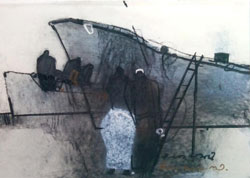
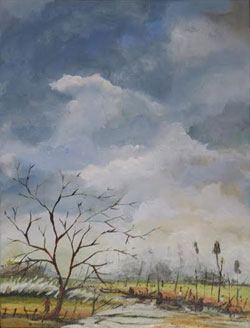
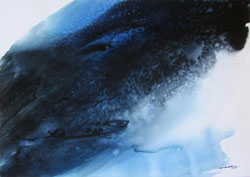 This is the second time Windmill Advertising Ltd is going to organise 'Home Fest Dhaka' at the Gulnaksha Hall of International Convention City Bashundhara (ICCB) in the city. The festival will inaugurate tomorrow. Alongside a curatorial show of a number of established artists of the country will be held at the venue. The participating artists are Anukul Chandra Majumdar, Rashed Kamal Russell, Biplob Das, Shahanoor Mamun and Sultan Ishtiaque.
 Rashed Kamal Russell emerged as a painter in the '90s -- experimenting with innovative themes and techniques. Some of these techniques successfully infused a new look in his works and thus embarked on a novel journey.
Russell, considered one of our bright painters, has a passion for portraying lonesome, hazy forms, often delving into melancholy. He believes that we are all part of the society, but some of us closely observe the society with intense passion.
It seems Russell's subjects soak up the torment, woes and unfulfilled dreams that are an integral part of our daily lives. The forms are often lanky -- sign of a hard knock life. The figures subtly hint at the many untold stories that lurk in our surroundings. Sometimes Russell revisits the world of greenery, enjoying the serene ambiance.
The USP of Anukul Chandra Majumdar's paintings is an in-depth observation of rural Bengal- simple harmonic patterns, pastoral motifs, a tranquil atmosphere and childhood nostalgia. The artist is recognised for portraying inner conflict through his remarkable paintings. The central theme of his work often focuses on facial expressions and the human body. His latest paintings depict motherhood, the six seasons and their impact on nature, childhood and rustic ambiance.
Anukul draws from his imagination rather than employing models. Figures in motion and incomplete human forms are noticeable elements in his works. His subjects have a semi-realistic and surrealistic quality about them. He also marks coarse lines with his fingers to add his sense of poetry to the paintings. He favors acrylic, oil, mixed media, pastel and charcoal medium. The colours black, blue, yellow, vermilion and crimson dominate his work.
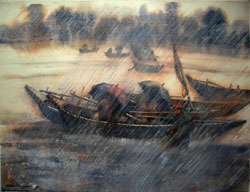 Sultan Ishtiaque is a promising realist painter and his paintings bear an in-depth analysis into Old Dhaka and the surrounding atmosphere of dockyards. He intimately observes the city's unplanned urbanisation, ruined richness of heritage, changing socio-political and economic conditions. For deeper inspiration and bringing variation in his thematic works, the artist has passionately visited different parts of Old Dhaka and other parts of the country---- Chawkbazar, Farashganj, Bara Katra, Choto Katra, banks of the Buriganga River and Shitalakhya River, Sadarghat, Keraniganj,Panam Nagar, Chandpur and many more places.
 The diverse activities in dockyards are a prominent focus in his works. He elaborately portrays the ship building process, drudgers engrossed with works, upside down ships and cargos under repair, scrap metals of ships scattered on the ground and plying ships on docks. He also portrays small and big boats in all their possible varieties as well as repairing and maintenance activities around the banks of the rivers.
Most of his works have a great tendency towards study based simultaneously with experimentation of various themes and objects. Observing his works thoroughly, one can easily feel the apparently lucid tonalities running smooth before the eye. He tries to express his feelings through simple realistic articulation, though shades differ from time to time in his works.
Biplob Kumar Das was one of the pioneer students of Narayanganj Charukala Institute. He was born and raised on the banks of the Shitalakkhya River. It is very natural that as a painter Das is greatly influenced by his surrounding ambiance. During that time, his mode of expression was purely realistic and the painter went into the details of his subjects. The quiet and serene location tremendously influenced him and he painted tranquil nature, the splendour of the river and the simple people who were really detached from the urban life. Through the paintings, Das attempted to create an atmosphere that defined the daily chores of riverine people. The use of shadowy and darker tones depicted the unchanging lives of the community.
Das enrolled in UODA (University of Development Alternative) in 2004 for his Masters Degree. Here he was introduced to some great teachers who suggested that he transform his mode of expression. Das then started to divide form and composition. This was a time for the artist's experiments with abstract expressionism. Since then colour remains a predominant aspect of his paintings.
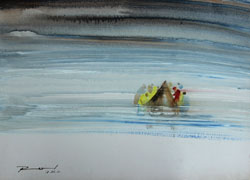
Nature has always been Shahanoor Mamun's greatest source of inspiration. He always tries to communicate with nature. The painter feels that the nature has an endless source of splendor, mystery and anonymity. He finds inspiration in the elaborate detailing of glimpses like light filtering through the leaves, sound of river's wave, the silence of nature, a drop of rain, singing crickets, dense foliage, the play of light and shadow in nature, flora and fauna as well as many others. Each of these elements contains a new story for him and an invitation to embark on a new journey.
Mamun is a nature watercolourist. His keen aptitude is to draw the philosophical aspect of nature, its volume and colour to create sensitive vibes. He has painted different types of boats in different localities of the country. The painter continues to work on this significant subject as he feels that the diminishing style of different types of traditional boats requires prominent focus. Besides these, Mamun ardently paints Old Dhaka with its vivacious activities, downtrodden people, rickshaws, traditional horse carts, narrow alleys, condensed habitations, wrecked buildings, cluttered wires scattered across roads, etc.
In his career, Mamun has developed an individual style particularly in watercolour medium. He prefers the medium firstly and foremostly for its trait of articulateness. The medium's lucidity gives him a liberty to impart his creativity smoothly. Many of his watercolours have also been done by agile brushstrokes. He possesses adequate insistence and potentials necessary for transforming visual insight of the world into a heart-rending approach. He draws pleasure from watercolour which enables him to interpret his inner thriving.
Loading...
Loading...
Also read






Editor : Iqbal Sobhan Chowdhury
Published by the Editor on behalf of the Observer Ltd. from Globe Printers, 24/A, New Eskaton Road, Ramna, Dhaka.
Editorial, News and Commercial Offices : Aziz Bhaban (2nd floor), 93, Motijheel C/A, Dhaka-1000.
Phone: PABX- 41053001-06; Advertisement: 41053012; 01793317829, 01550707291, E-mail: [email protected], [email protected] Online: email: [email protected] 41053014; 01550707297 Advertisement: 01550707296
Published by the Editor on behalf of the Observer Ltd. from Globe Printers, 24/A, New Eskaton Road, Ramna, Dhaka.
Editorial, News and Commercial Offices : Aziz Bhaban (2nd floor), 93, Motijheel C/A, Dhaka-1000.
Phone: PABX- 41053001-06; Advertisement: 41053012; 01793317829, 01550707291, E-mail: [email protected], [email protected] Online: email: [email protected] 41053014; 01550707297 Advertisement: 01550707296


