



| HEADLINE |

|
Roving Romania - 2
Bran castle and beyond...
Published : Thursday, 1 December, 2016 at 12:00 AM
Shahriar Feroze


(From the previous issue)
The scene a vampire biting a beautiful woman's neck, perhaps, suits no other country other than Romania. For this country is no short of beautiful women. Groomed at par with western world standards and with less arrogant attitude, they are seen in attractive shapes and complexions. Beauty may be in the eye of the beholder, but be it dark or blonde hair, brown or blue eyes following a slim and slender physique - Count Dracula couldn't have found a better place to hunt for his birds of prey.
 Nonetheless , for those who have grown tired of my Dracula obsession, in reality, this part of the country is equally tempting for exploring medieval churches, painted monasteries and pristine unexploited landscapes. Opposed to demons, gods, deities and mythical figures, its history is filled with tales of heroic princes battling fierce Ottoman warriors, legends more of recent times as well as more realistic. Fascinatingly enough, the real life legend Vlad Tepes first fought against the Turkish Sultan and on the second occasion had sided with him to establish his rule.
My readers , by now , should have known that this writer usually tends to follow the tracks of his favourite authors, landscapes , historical events and political upheavals and that's why he now decides to climb down to Brasov for catching the next bus to Bucharest. Since Brasov is located at the foot of Mount Tampa, it offers several hiking trails that begin at the edge of the Old Town. With extra load on my back i went for the shortest route or the half mile long red triangle hike. Though Brasov (pronounced Bras'hov) offers dazzling Saxon, gothic, baroque and renaissance architecture, following a wealth of historical attractions, but my focus was on the capital city Bucharest. The bus leaving in half an hour would land me there in about three hours and only this time the room was booked in advance in one of the low-priced hotels in the city outskirts.
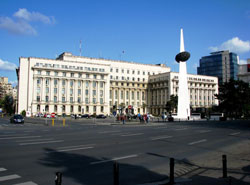
Succumbing to my juvenile temptation, and before even checking in the hotel i got into the local bus heading for one of my most wanted places in Bucharest - the Piata Revolutiei or the Revolution Square - it's nothing medieval, has no links with Romanian art or literature but a very significant political landmark in the history of Romania. In particular, one newspaper photo, taken during the time of the 1989 revolution at the square has been forever etched in my mind.
It was a cold December morning at Dhaka. After the annual exams our school was closed. Like almost every morning, the old maid working at our house had placed the newspaper on top of the dining table. Having picked it up, my eyes were right away glued at the photo published at the front page of the then Bangladesh Observer, the brand newspaper of that time. Shot through a broken window the photo showed, a row of soviet made T-tanks with their crews on top, a scattered crowd perhaps a fraction of the protesters following a thin dark smoke coming out from a nearby damaged heritage building facing the square. It was taken against the backdrop of a cold and cloudy day. The lead title of the report said something similar to 'Ceausescu is overthrown, faces trial, the revolution succeeds'. My earliest memory of a globally publicized revolution witnessed from several thousand miles away. The revolution and the dictator's execution made the front page lead in almost all the Bengali dailies at that time. Unable to hide an unending curiosity, I was regularly following many of them. In one of them it was also reported that the dictator had never wore the same suit twice.
What an irony of fate, it's the same square which marked the highest point in Ceausescu's popularity, when he openly condemned the invasion of Czechoslovakia and started pursuing a policy of independence from Kremlin in august 1968. And a little over two decades later, it was here where he was publicly condemned. The square is also the site of an old building at a corner which was once the seat of the Central Committee of the Romanian Communist Party, and it was from this roof from where Nicolae Ceausescu and his wife fled in a white helicopter, only to be captured outside of the city a few hours later.
On the far side of the square stands the former Royal Palace, now home to the National Art Museum, the stunning Romanian Athenaeum and the historic Athenee Palace Hotel. At the south end of the square, pompously stands the small, but beautiful, Kretzulescu Church. May be the presence of divinity nearby worked as a pre-condition behind the revolution's success. However, The Square gained worldwide notoriety when TV stations around the globe broadcasted Nicolae Ceausescu's final moments in power on that fateful day of December 21, 1989.
Anyhow, the touristy Bucharest was not in my list to explore. The Romanian capital has been discovered, re-discovered, painted, sketched and written by countless. Furthermore, my travel sojourns are not meant to serve as travel guides too.
With a different plan in mind, i was set to discover the hidden gems of the country's Deep South, much along the off beaten paths - its coastline near the Black Sea; Its eastern ports, the Danube delta and coastal towns; its beaches, discos and blondes coming together with sweeping views to the Black Sea. To me, they serve as Romania's somewhat, tacit answer to West Europe's French Riviera.
No matter what, first things first, the night in Bucharest will have to be lived to the full. Of all the wonderful things that Bucharest has to offer, nightlife is not the least of them. Dotted with trendy bars, Irish pubs to hedonistic clubs to live music clubs, almost all options are there. But for this writer, the most rewarding path to the heart of a country is not through architecture, history or its women but its gourmet dishes.
Despite good restaurants, food was a problem at Brasov, now it's time to make up those missed meals. To put it accurately, at least I would say, there is nothing such as '100% authentic Romanian cuisine'. Most of the times the dishes are sumptuous but almost all of them are borrowed heavily from the neighbouring countries - Germanic, Turkish, Hungarian, Slavic and Greek. The same dish may vary in taste from one region to another. Moreover, i may be sometimes compromising with alcoholic drinks but not with pork and exactly right here the topic of comfort food comes. The country's de facto national dish is called sarmale (occasionally seen on menus as s?rm?lu?e). These are cabbage rolls, stuffed with spiced pork and rice. All you need to do is act a little cleaver to convince the waiter to prepare it with either lamb, beef or chicken.
My recommendation, without even travelling to Hungary, would be the Hungarian Goulash soup. A beef dish cooked with onions, Hungarian paprika spice, tomatoes and some green pepper, and the confusing part is the Hungarian goulash is neither a soup nor a stew, it's somewhere in between though in Hungary it's branded as a soup. A simple declaration about Romanian sweet dishes is - the country amazingly excels at strudels and cakes. Since so much have been said about food why should drinks be left aside, few are aware of that Romania too, has its own clear and colorless liquid with a kick, and it's actually the country's national beverage. This strong spirit is called Tuica. Essentially, Tuica is fermented and distilled plums. Regrettably this writer is not a connoisseur of wine or spirits but he knows for sure that almost all restaurants have half to one litre of red or white wine - aka house wine in their drinks menu.
Instead of recommending on what to do , where to go and what to see this writer earnestly desires his readers to look for what they want in this city of plenty to offer.
The night is getting deeper, I yet don't know what coastal Romania kissing the Black Sea has to offer , but I am fast falling for this much less talked about jewel of a country. It is more than just romancing Romania�
To be continued...
The writer is a freelance journalist
The scene a vampire biting a beautiful woman's neck, perhaps, suits no other country other than Romania. For this country is no short of beautiful women. Groomed at par with western world standards and with less arrogant attitude, they are seen in attractive shapes and complexions. Beauty may be in the eye of the beholder, but be it dark or blonde hair, brown or blue eyes following a slim and slender physique - Count Dracula couldn't have found a better place to hunt for his birds of prey.
Nonetheless , for those who have grown tired of my Dracula obsession, in reality, this part of the country is equally tempting for exploring medieval churches, painted monasteries and pristine unexploited landscapes. Opposed to demons, gods, deities and mythical figures, its history is filled with tales of heroic princes battling fierce Ottoman warriors, legends more of recent times as well as more realistic. Fascinatingly enough, the real life legend Vlad Tepes first fought against the Turkish Sultan and on the second occasion had sided with him to establish his rule.My readers , by now , should have known that this writer usually tends to follow the tracks of his favourite authors, landscapes , historical events and political upheavals and that's why he now decides to climb down to Brasov for catching the next bus to Bucharest. Since Brasov is located at the foot of Mount Tampa, it offers several hiking trails that begin at the edge of the Old Town. With extra load on my back i went for the shortest route or the half mile long red triangle hike. Though Brasov (pronounced Bras'hov) offers dazzling Saxon, gothic, baroque and renaissance architecture, following a wealth of historical attractions, but my focus was on the capital city Bucharest. The bus leaving in half an hour would land me there in about three hours and only this time the room was booked in advance in one of the low-priced hotels in the city outskirts.
Succumbing to my juvenile temptation, and before even checking in the hotel i got into the local bus heading for one of my most wanted places in Bucharest - the Piata Revolutiei or the Revolution Square - it's nothing medieval, has no links with Romanian art or literature but a very significant political landmark in the history of Romania. In particular, one newspaper photo, taken during the time of the 1989 revolution at the square has been forever etched in my mind.
It was a cold December morning at Dhaka. After the annual exams our school was closed. Like almost every morning, the old maid working at our house had placed the newspaper on top of the dining table. Having picked it up, my eyes were right away glued at the photo published at the front page of the then Bangladesh Observer, the brand newspaper of that time. Shot through a broken window the photo showed, a row of soviet made T-tanks with their crews on top, a scattered crowd perhaps a fraction of the protesters following a thin dark smoke coming out from a nearby damaged heritage building facing the square. It was taken against the backdrop of a cold and cloudy day. The lead title of the report said something similar to 'Ceausescu is overthrown, faces trial, the revolution succeeds'. My earliest memory of a globally publicized revolution witnessed from several thousand miles away. The revolution and the dictator's execution made the front page lead in almost all the Bengali dailies at that time. Unable to hide an unending curiosity, I was regularly following many of them. In one of them it was also reported that the dictator had never wore the same suit twice.
What an irony of fate, it's the same square which marked the highest point in Ceausescu's popularity, when he openly condemned the invasion of Czechoslovakia and started pursuing a policy of independence from Kremlin in august 1968. And a little over two decades later, it was here where he was publicly condemned. The square is also the site of an old building at a corner which was once the seat of the Central Committee of the Romanian Communist Party, and it was from this roof from where Nicolae Ceausescu and his wife fled in a white helicopter, only to be captured outside of the city a few hours later.
On the far side of the square stands the former Royal Palace, now home to the National Art Museum, the stunning Romanian Athenaeum and the historic Athenee Palace Hotel. At the south end of the square, pompously stands the small, but beautiful, Kretzulescu Church. May be the presence of divinity nearby worked as a pre-condition behind the revolution's success. However, The Square gained worldwide notoriety when TV stations around the globe broadcasted Nicolae Ceausescu's final moments in power on that fateful day of December 21, 1989.
Anyhow, the touristy Bucharest was not in my list to explore. The Romanian capital has been discovered, re-discovered, painted, sketched and written by countless. Furthermore, my travel sojourns are not meant to serve as travel guides too.
With a different plan in mind, i was set to discover the hidden gems of the country's Deep South, much along the off beaten paths - its coastline near the Black Sea; Its eastern ports, the Danube delta and coastal towns; its beaches, discos and blondes coming together with sweeping views to the Black Sea. To me, they serve as Romania's somewhat, tacit answer to West Europe's French Riviera.
No matter what, first things first, the night in Bucharest will have to be lived to the full. Of all the wonderful things that Bucharest has to offer, nightlife is not the least of them. Dotted with trendy bars, Irish pubs to hedonistic clubs to live music clubs, almost all options are there. But for this writer, the most rewarding path to the heart of a country is not through architecture, history or its women but its gourmet dishes.
Despite good restaurants, food was a problem at Brasov, now it's time to make up those missed meals. To put it accurately, at least I would say, there is nothing such as '100% authentic Romanian cuisine'. Most of the times the dishes are sumptuous but almost all of them are borrowed heavily from the neighbouring countries - Germanic, Turkish, Hungarian, Slavic and Greek. The same dish may vary in taste from one region to another. Moreover, i may be sometimes compromising with alcoholic drinks but not with pork and exactly right here the topic of comfort food comes. The country's de facto national dish is called sarmale (occasionally seen on menus as s?rm?lu?e). These are cabbage rolls, stuffed with spiced pork and rice. All you need to do is act a little cleaver to convince the waiter to prepare it with either lamb, beef or chicken.
My recommendation, without even travelling to Hungary, would be the Hungarian Goulash soup. A beef dish cooked with onions, Hungarian paprika spice, tomatoes and some green pepper, and the confusing part is the Hungarian goulash is neither a soup nor a stew, it's somewhere in between though in Hungary it's branded as a soup. A simple declaration about Romanian sweet dishes is - the country amazingly excels at strudels and cakes. Since so much have been said about food why should drinks be left aside, few are aware of that Romania too, has its own clear and colorless liquid with a kick, and it's actually the country's national beverage. This strong spirit is called Tuica. Essentially, Tuica is fermented and distilled plums. Regrettably this writer is not a connoisseur of wine or spirits but he knows for sure that almost all restaurants have half to one litre of red or white wine - aka house wine in their drinks menu.
Instead of recommending on what to do , where to go and what to see this writer earnestly desires his readers to look for what they want in this city of plenty to offer.
The night is getting deeper, I yet don't know what coastal Romania kissing the Black Sea has to offer , but I am fast falling for this much less talked about jewel of a country. It is more than just romancing Romania�
To be continued...
The writer is a freelance journalist
Loading...
Loading...
Also read





Editor : Iqbal Sobhan Chowdhury
Published by the Editor on behalf of the Observer Ltd. from Globe Printers, 24/A, New Eskaton Road, Ramna, Dhaka.
Editorial, News and Commercial Offices : Aziz Bhaban (2nd floor), 93, Motijheel C/A, Dhaka-1000.
Phone: PABX- 41053001-06; Advertisement: 41053012; 01793317829, 01550707291, E-mail: [email protected], [email protected] Online: email: [email protected] 41053014; 01550707297 Advertisement: 01550707296
Published by the Editor on behalf of the Observer Ltd. from Globe Printers, 24/A, New Eskaton Road, Ramna, Dhaka.
Editorial, News and Commercial Offices : Aziz Bhaban (2nd floor), 93, Motijheel C/A, Dhaka-1000.
Phone: PABX- 41053001-06; Advertisement: 41053012; 01793317829, 01550707291, E-mail: [email protected], [email protected] Online: email: [email protected] 41053014; 01550707297 Advertisement: 01550707296


