



| HEADLINE |

|
Anthropocene and the New Trumpian Age
Fragments of Reality
Published : Saturday, 3 December, 2016 at 12:00 AM
Dr Kanan Purkayastha


 The Anthropocene is considered as a new geological epoch. The current epoch is known as Holocene, which in fact demonstrated last 12000 years of stable climate since the last ice age. Early 20th century shows the acceleration of carbon dioxide emission, sea level rise, transformation of land by deforestation and industrial development. This is the starting point of Anthropocene. But the President-elect of United States Donald Trump seems ignorant about issues surrounding the Anthropocene in general and climate science in particular. This is because in a pre-election debate when journalist asked Donald Trump to express his views on climate change, and how his administration would act on those views Trump referred to 'climate change' with quotation marks and said he believes-as he has asserted in the past-that 'human-caused global warming is a hoax.' He has vowed to withdraw from the Paris climate accord and suggested that 'our limited financial resources are best spent on clean water and anti-malaria efforts'. It appears that Trump is not aware of the fact that the success of getting clean water and eradicating malaria also depends on how climate change is addressed in the Anthropocene.
The term Anthropocene was coined only in the year 2000, by the Nobel prize-winning scientist Paul Crutzen, who believes that the change of new geological epoch is overdue. He said, "This name change stresses the enormity of humanity's responsibility as stewards of the Earth." Other experts also suggest that this should be declared now because of impact of human on the earth is enormous. One suggestion is that this new epoch should begin about the time when atom bomb was exploded and radioactive materials were dispersed in the environment. Other suggested that this should be the time when first plastic products were used. Crutzen's personal view is that the starting date should be 1784, the year that James Watt patented the steam engine, a symbolic of the start of the industrial revolution and the carbonification of our atmosphere by the burning of coal extracted from the lithosphere.
 Signals of Anthropocene that scientists are trying to explore further are as follows: current extinction rate of animals and plants are far above the long term average. If this trend continues, then 75 per cent of species will extinct in the next few centuries; carbon dioxide in the atmosphere is raising at the fastest rate and level is going up from 280 parts per million (ppm) before the industrial revolution to 400 ppm today; level of microplastic particles in the earth waterways and oceans are such that it is now available everywhere; and a permanent layer of airborne particulates such as black carbon from fossil fuel burning in sediment and glacial ice are clearly evident.
Prof Jan Zalasiewicz, chair of the Anthropocene working group (WGA) suggests "The significance of the Anthropocene is that it sets a different trajectory for the Earth system, of which we of course are part." Prof Chris Ripley, a climate scientist at University College London said: "The Anthropocene marks a new period in which our collective activities dominate the planetary machinery." Ripley added that 'Since the planet is our life support system - we are essentially the crew of a largest spaceship - interference with its functioning at this level and on this scale is highly significant.' Martin Rees, the astronomer royal and former president of the Royal Society, said that 'the dawn of the Anthropocene was a significant moment. The darkest prognosis for the next millennium is that bio, cyber or environmental catastrophes could foreclose humanity's immense potential, leaving a depleted biosphere,' However Martin Rees is optimistic that 'Human societies could navigate these threats, achieve a sustainable future, and inaugurate eras of post-human evolution even more marvellous than what's led to us.'
It is clear that the evidence of human impacts on our planet is overwhelming and this requires a different epoch to identify this in a geological timescale. One of the criticisms of Anthropocene is that in geological term epoch is tens of millions of year but this is not the case for Anthropocene. However scientists suggest that changes during the proposed epoch is irreversible. Recently scientists have voted in favour of formally designating the Anthropocene. Now WGA is working to determine which signals are the strongest that can determine the start of the Anthropocence. Geological divisions are not defined by dates but by a specific boundary between layers of rock or, boundary between two ice layers.
Even though starting point of Anthropocene has not yet been established, it is clear that we are living in a new geological epoch, which requires a different environmental management approach. But Donald Trump already threats to cut funding for climate science, and his campaign rhetoric toward dismissing climate change are cause for concern. This is also a reason to redouble efforts. I do not think that people will shelve their products or research because of Trump's comment, but his budget decisions will surely dictate priorities, raising the profile of some aspects of research while chilling other areas. A science policy expert, named Roger Pielke, at the University of Colorado said, 'For an early career researcher passionate about a topic-in any area of science-I say stay the course. Your passion will outlive the politics of the US election cycle.'
Trump has talked about dissolving the Environmental Protection Agency (EPA) and has planned to appoint a climate denier to run the transition at the agency. A researcher at John Hopkins University said that they heavily rely on observations of atmospheric pollutants collected by the EPA's extensive network of air quality sensors. Question in scientist's mind is that if budget cut proceed as it has been declared, then EPA will no longer have the resources to systematically monitor air quality for the purpose of ensuring that our air is clean and complies with the Clean Air Act. Other agencies like NASA, which have been heavily invested in earth science research funding in recent time could see their priorities shifted, making them less desirable places to work.
Jeremy Hoffman a climate specialist at the Science Museum of Virginia said the election has led him to redouble his effort to think about new ways to talk about climate change and bring it to a wider audience. Other suggests that science funding might not even be the biggest concern rather Trump's social policies that could have the most immediate impact of scientists and the society as a whole. As an example anti-immigration policies were one of the pillars of Trump's successful campaign. This kind of stance will have a chilling effect on attracting foreign students and scientists. Critics suggest that 'every cloud has a silver lining'. This means that Trump's approach of governance might reduce the productivity and that could lead to less emission in the atmosphere. However, American Physical Society recently issued a press release congratulating Trump on his victory and encouraging him to 'make sustained and robust funding of scientific research a top priority.'
Above all, in the Trumpian age it is possible to recognise that we are in a new geological era known as Anthropocene and carry out climate science as it has been doing by scientist now without normalizing Trump's current view. Progress of a country is never free of politics. However it requires expert in science and science need collaborative work such as in climate science. Trump has already declared heavy investment in infrastructure development. Hope his financial decision would not be networked in the wrong way and his administration will recognise this sooner rather than later. r
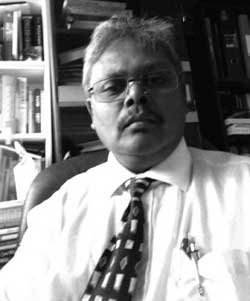
Dr Kanan Purkayastha teaches Chemistry and Environmental Sciences in United Kingdom. He is a Fellow of the Institution of Environmental Sciences in UK
Loading...
Loading...
Also read




Editor : Iqbal Sobhan Chowdhury
Published by the Editor on behalf of the Observer Ltd. from Globe Printers, 24/A, New Eskaton Road, Ramna, Dhaka.
Editorial, News and Commercial Offices : Aziz Bhaban (2nd floor), 93, Motijheel C/A, Dhaka-1000.
Phone: PABX- 41053001-06; Advertisement: 41053012; 01793317829, 01550707291, E-mail: [email protected], [email protected] Online: email: [email protected] 41053014; 01550707297 Advertisement: 01550707296
Published by the Editor on behalf of the Observer Ltd. from Globe Printers, 24/A, New Eskaton Road, Ramna, Dhaka.
Editorial, News and Commercial Offices : Aziz Bhaban (2nd floor), 93, Motijheel C/A, Dhaka-1000.
Phone: PABX- 41053001-06; Advertisement: 41053012; 01793317829, 01550707291, E-mail: [email protected], [email protected] Online: email: [email protected] 41053014; 01550707297 Advertisement: 01550707296


