



| HEADLINE |

|
Sculptures inspired by Freedom Movement
Published : Friday, 16 December, 2016 at 8:28 PM
Takir Hossain


 Sculpture is a three-dimensional art form and it draws quick attention. It reflects culture, history and time. The main purpose of erecting a sculpture is to demonstrate one's artistic faculties through highlighting a certain theme.
Sculpture is considered to be one of the longest lasting genres of art. However, the trend of modern sculpture started here in the East Pakistan era, back in 1950s. Novera Ahmed first achieved prominence in this field and she has popularised the medium in our country. In the 1950s and mid '50s, Novera Ahmed had several sculpture exhibitions. Sculptures had, by this time, started to catch on in the local art scene. Despite many objections on erecting sculptures at public places, it was increasingly gaining popularity.
The Sculpture Department at the Institute of Fine Arts (now Faculty of Fine Arts, Dhaka University) was founded in 1965. Abdur Razzaque was the founder teacher of the department. Later on Anwar Jahan, Hamiduzzaman Khan and Shamim Shikdar joined the department as teachers. After the Liberation War, sculptures in Bangladesh mainly focused on the theme of independence movement. Many significant sculptures were built in the mid '70s and early '80s. Here are some of the most remarkable sculptures on the
 theme Liberation War at a glance:
"Jagroto Chowrongi"
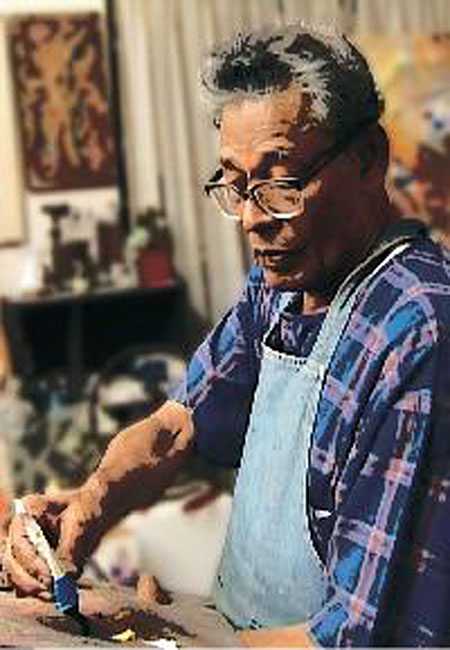
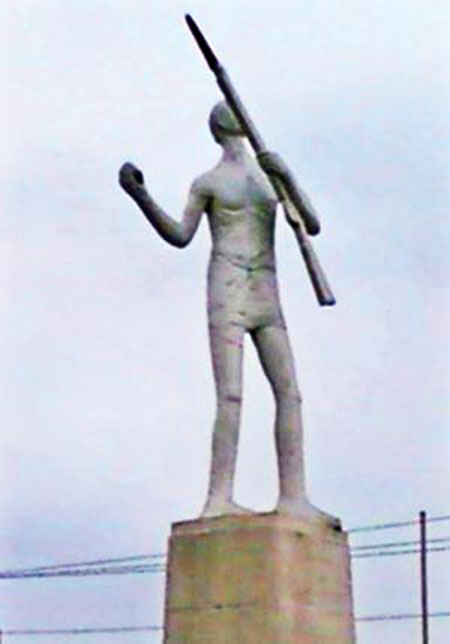
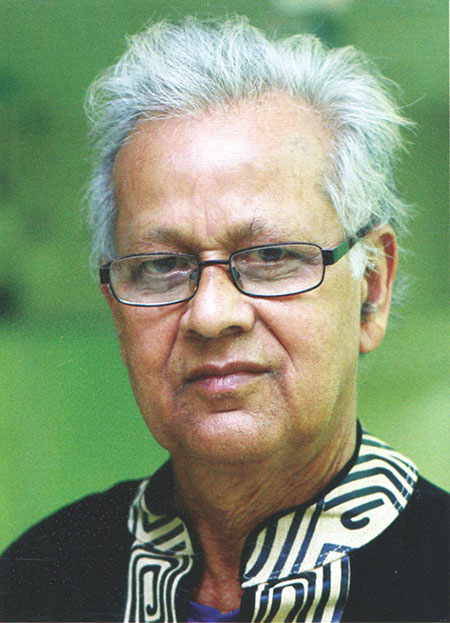
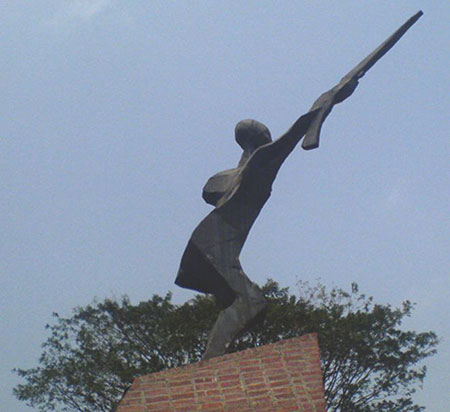
Abdur Razzaque is regarded as one of the greatest sculptors of the country. He was the first artist to take up sculpture in independent Bangladesh. His "Jagroto Chowrongi" is considered one of the best sculptures in Bangladesh, considering both form and theme, by art critics. Located in Joydebpur, and built in 1973, it is the first post-Liberation War sculpture. It depicts a freedom fighter with a grenade in his right and a rifle in his left hand. The sculpture is an 18 feet high concrete piece on a 24 feet pedestal.
A versatile individual in arts, Razzaque was not only immersed in the sculpture medium, but print making and painting were also among his favourite media of expression. He showed outstanding evidence in both creativity and skill in each branch. Even on the day prior to his death, he was silently involved in his work. He was 73 when he passed away in 2005. He died in Jessore where he had conducted a drawing workshop. The participants were his former students.
With a long and chequered life, Razzaque gradually transformed himself into an abstract expressionist painter. This avant-garde painter was associated with modern art movement in Bangladesh from its very early days. Razzaque was
 the student of the second batch of the Dhaka Art College (now the Faculty of Fine Arts, University of Dhaka).
 Razzaque always tried to articulate the inner essence of nature in many of his works. He also did figurative work - rural men, goldsmith, his companions, his parents, boatman, hard working people, boats, crows, indigenous flowers, people at leisure, and other facets.
The sculptural works by Razzaque at Joydevpur and other locations are largely figure-based. He also did many semi-abstract and purely abstract pieces which were also acclaimed by art enthusiasts. Always willing to experiment, he had a passion for creating art that was fresh and novel. These vary in media, materials and size. As mediums he has used cement, stone, steel, iron, bronze and wood. In metals he has used both the welding technique and casting. Wood, one of his favourite mediums, has been carved and shaped to give a touch of his adroit hand. In his figure-based works, Razzaque adds outstanding force and an animated quality.
"Aparajeyo Bangla"
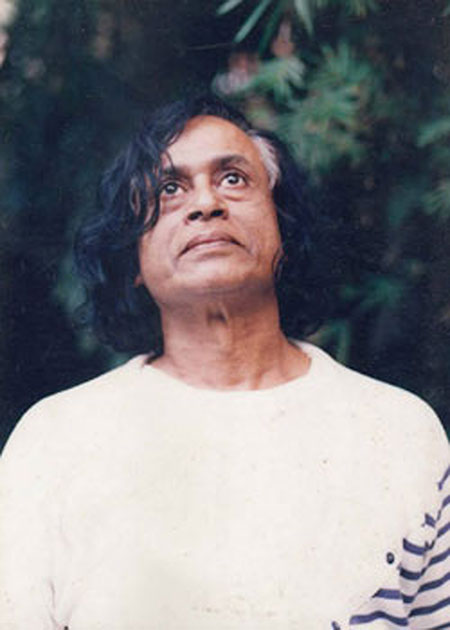
Syed Abdullah Khalid is a multitalented artist. Khalid has not only excelled in sculpture but also made an impression with his paintings.
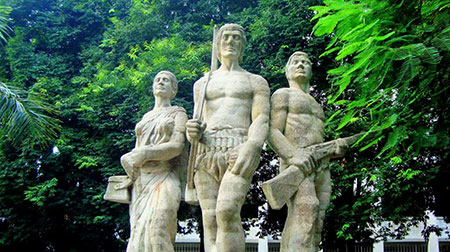
Khalid's "Aparajeyo Bangla" on Dhaka University campus has become an icon. The sculpture is a reflection of the Bengali vigilance and indomitable yearning for freedom. The project was launched in 1973 when this artist was a young teacher at the Department of Fine Arts, Chittagong University. Throughout the making of the sculpture, Khalid had to face opposition from religious fanatics.
Hasina Ahmed, Syed Hamid Moksood and Badrul Alam Benu, who are very close to Khalid, modelled for "Aparajeyo Bangla". The artist closely observed the models' personalities and his close association with them enabled him to do justice with his portrayal. On August 15, 1975, the work suddenly came to a halt because of the heinous murder of Bangabandhu Sheikh Mujibur Rahman. Political instability and the arrest of the then Vice-chancellor of Dhaka University, Abdul Matin Chowdhury, also disrupted the work.
The project remained incomplete till the end of 1978. Some fundamentalist groups tried to demolish the sculpture in 1977. However, the brave students of Dhaka University fiercely guarded the work. After a long hiatus, the work began once more in the beginning of 1979 -- with a new vision. At last the project was finished on December 16, 1979. The sculpture was inaugurated by wounded freedom fighters.
There are monuments recognised and commissioned by the government, and then there are those made by the people. "Aparajeyo Bangla" falls in the latter category. I wanted to do doing something for my country and fellow citizens. After the Liberation War, I contemplated a plan to create a symbol which would inspire generations of Bangladeshis, asserted Khalid.
"Shongshoptok"
Hamiduzzaman Khan started his career not as a sculptor but a painter. On careful examination of his works, one will see that Khan endeavours to mix architectural or geometrical shapes with local materials found in his surroundings. His prime concerns are form and theme. In his form-oriented works, one finds Western influence.
One of his most moving creations is "Shongshoptok". It stands 28 feet high, including the base. It is constructed of steel armature and brass steel. The work has been placed in front of the Central Library, Jahangirnagar University. It depicts a freedom fighter with a hand missing, yet ready to fight against the Pakistani forces. The fighter carries a rifle in his hand. It is a sign of the freedom fighters' valour and their dedication to the country.
Loading...
Loading...
Also read



Editor : Iqbal Sobhan Chowdhury
Published by the Editor on behalf of the Observer Ltd. from Globe Printers, 24/A, New Eskaton Road, Ramna, Dhaka.
Editorial, News and Commercial Offices : Aziz Bhaban (2nd floor), 93, Motijheel C/A, Dhaka-1000.
Phone: PABX- 41053001-06; Advertisement: 41053012; 01793317829, 01550707291, E-mail: [email protected], [email protected] Online: email: [email protected] 41053014; 01550707297 Advertisement: 01550707296
Published by the Editor on behalf of the Observer Ltd. from Globe Printers, 24/A, New Eskaton Road, Ramna, Dhaka.
Editorial, News and Commercial Offices : Aziz Bhaban (2nd floor), 93, Motijheel C/A, Dhaka-1000.
Phone: PABX- 41053001-06; Advertisement: 41053012; 01793317829, 01550707291, E-mail: [email protected], [email protected] Online: email: [email protected] 41053014; 01550707297 Advertisement: 01550707296


