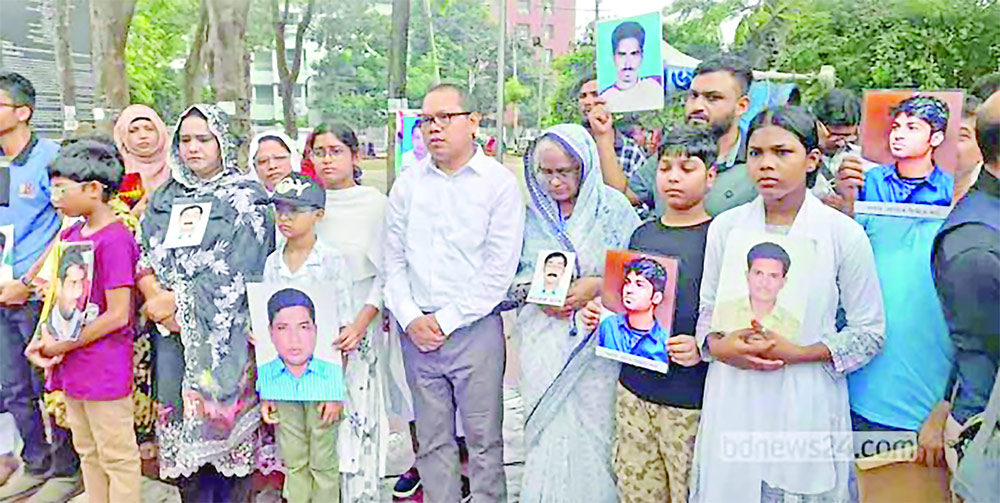
The air was heavier than ever at the Central Shaheed Minar in the capital on Friday morning. Family members of the victims of enforced disappearances during the 15-year of Sheikh Hasina regime for the first time could gather in an open space to narrate their long-held agonies and place their demands.
Holding pictures, banners, and placards of the missing individuals, family members and relatives formed a human chain at the base of Central Shaheed Minar, organised by 'Mayer Dak' marking the International Day of the Victims of Enforced Disappearances.
They urged the interim government to trace and return their loved ones as soon as possible and free them in 'newly independent Bangladesh.'
They demanded former Prime Minister Sheikh Hasina, her security Adviser Tarique Ahmed Siddique, Maj Gen Ziaul Hasan and those behind the 'Ayna Ghor' to be brought to trial.
A number of protesters were seen breaking into tears while some could barely hold their sobs.
Those who had returned shared their terrifying experiences and also demanded compensation for the ordeal.
In a somber voice, Anisha Islam said she had stood on roads carrying her father Ismail Hossain Baten's photo many times during the last five years.
"My younger brother used to wait every night for our father's return," she said.
Ismail Hossain Baten disappeared from a business organisation adjacent to Mirpur Shah Ali Shrine on June 19, 2019.
Anisha said, "It is said that the country has attained independence for a second time. I want my father back in this independent country. I want to answer the queries of my brother. I want everyone to know what happened to my father."
"You can visit the graves of those who died. But we're such destitute people that we don't even know if our father is alive or dead. I can't have my father sign any of my school documents. I can't even write 'late' in front of his name," she said.
Ishraq Ahmed, 20, went missing from near the Star Kabab Restaurant at Dhanmondi on August 25, 2017. He was a student at McGill University in Canada and went missing while on holiday in Dhaka.
Ishraq's father Jamal Uddin Ahmed said he went to file a general diary with the Dhanmondi Police Station at 10:00pm after his son went missing. Surprisingly RAB men visited his house at 10:30pm.
Later he went to meet RAB-2 officer Maj Ataur. The next day, RAB visited his house again and took away his son's laptop. They returned the laptop after a month but never returned his son, Jamal Uddin said.
He continued, "We've been waiting for the last eight years and ran here and there, but I never got my son back. I urge the new government to bring my son home. We're still waiting."
"My younger brother has been missing for 11 years," said Rehana Akter Munni, sister of missing student leader Selim Reza Pintu, who was the President of the Chhatra Dal's Sutrapur Police Station unit.
She said Pintu was taken away by men 11 years ago who claimed they were from the administration.
"They all were armed. I haven't heard anything about him for 11 years," said Rehana.
"For the past 11 years, we've had no joy or festivities. Who gave Hasina the audacity to forcibly disappear the independent citizens of Bangladesh?" she asked.
Pallabi Chhatra Dal General Secretary Tariqul Islam Tara went missing in 2012.
Tara's father Nurul Islam alleged that his son was abducted due to a 'political vengeance'.
Nurul Islam said some people tried to pick him up too whenever he tried protest enforced disappearance of his son.
"I'm helpless after losing my child. I demand the new government send my son back to me unscathed," he said.
Mahfuza Akter Mukta said a group of people claiming to be intelligence agents in plainclothes picked up her father Chowdhury Alam on June 24, 2010, from Dhaka's Farmgate area.
She said, "As many as 650 people became victims of enforced disappearance over the last fourteen and a half years. Now we have a new hope. We urge the new government to return our loved ones to us."
Michael Chakma, an organiser of the United People's Democratic Front, UPDF, a regional political party based in the Chittagong Hill Tracts, went missing on April 9, 2019.
After the fall of Sheikh Hasina, he was blindfolded and left beside a road in Chattogram on August 6.
Michael said, "There was no democracy in the last 15 years during the rule of Sheikh Hasina. There were no human rights, no security for the people. There should be fair trials and justice for all the enforced disappearances and killings in the last 15 years of the Hasina government."
The International Day of the Victims of Enforced Disappearances was observed in the country and elsewhere around the globe on Friday.
The International Convention for the Protection of All Persons from Enforced Disappearance, which came into force in December 2010, declared August 30 as the International Day of the Victims of Enforced Disappearances.
Bangladesh signed the convention on August 29 this year.
Non-government human rights organisations Ain O Salish Kendra (ASK) and Human Rights Support Society (HRSS) in separate statements demanded that all citizens be protected from enforced disappearances. ASK also called for an immediate tracing and return of all missing persons to their families.
At the same time, the HRSS demanded that those responsible for the disappearance be identified and punished.
Meanwhile, Mayer Dak, an organisation of the victims' families, released a list of more than 700 people missing during Sheikh Hasina's 16-year rule.
The coordinators of the organisation said that most of the people who were made to disappear using the state machinery and organisations, are political opponents of the Awami League.
Subsequently, the Anti-Discrimination Student Movement demanded reforms of the law enforcement agencies to prevent these disappearances.
The interim government set up a commission last week to investigate every incident of disappearance by security forces during Hasina's regime.





