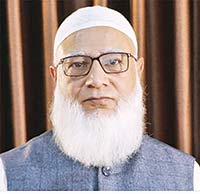
Bangladesh Jamaat-e-Islami Ameer Dr Shafiqur Rahman said on Thursday that the country's youth and women are increasingly embracing Islam, expressing confidence that the impact of this trend will become visible in the years ahead.
Speaking at a public rally for the Dhaka-15 constituency at the Police Convention Centre in Mirpur, Dr Shafiqur highlighted the growing trust in Jamaat's student wing - Islami Chhatra Shibir - among students of major public universities. He noted that recent student elections at three universities, including one held Thursday at Rajshahi University, demonstrated consistent support for the organisation among both young men and women.
"We are witnessing, with great pride, that two sections of society are embracing Islam deeply - our youth and our mothers," he said. "So far, elections have been held at three public universities, and the picture is the same everywhere: women trust Chhatra Shibir; youth trust Chhatra Shibir. The nation will see the reflection of this in the future, Insha'Allah."
Dr Shafiqur underscored Jamaat's commitment to protecting the dignity of mothers in a Muslim-majority nation.
"In a country where 91 percent of people are Muslims, our mothers' honour is often neglected both at home and outside. Bangladesh Jamaat-e-Islami, guided by the Qur'an and the life of the Prophet (peace be upon him), aims to restore mothers to their rightful dignity," he said. He added that women, alongside men, should contribute to nation-building according to their needs and abilities.
On governance and social harmony, he pledged that Jamaat would respect all citizens regardless of religion, party affiliation, ethnicity, or region. "Faith and belief are not for us to judge. We will respect every citizen of this country - whether they live in the hills or on the plains - as our brothers, sisters, and fellow Bangladeshis," he said.
Addressing national priorities, Dr Shafiqur identified key areas of reform: restoring the economy, uprooting corruption, and ensuring capable professionals lead in all sectors - irrespective of their political or religious background. "We want to build an inclusive society. Whoever is most competent - whether from our party or not, Muslim or otherwise - should be entrusted with responsibility," he said. Calling for accountable leadership, he remarked that rulers should apologise for their failures instead of seeking praise or slogans.





