



| HEADLINE |

|
Yunus-led Admin’s Tenure ‘Difficult Period’
BNP, Armed Forces supported me during interim govt: President
Published : Tuesday, 24 February, 2026 at 12:00 AM
Staff Correspondent


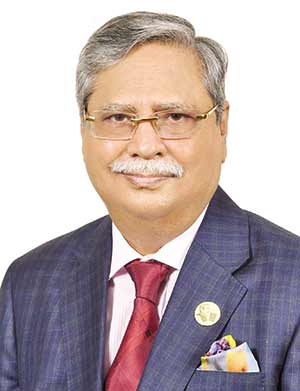 President Md. Shahabuddin expressed his deep anguish and resentment over activities and decisions of the interim government, led by Chief Adviser Dr. Mohammad Yunus. He termed the interim government's term as a "difficult period."
President Shahabuddin, who took office on April 24, 2023 during the Awami League regime of Sheikh Hasina, highly appreciated the role of BNP and Armed forces who gave support and cooperation to him as Head of State during the interim government's period. "I received "100 per cent support" from BNP during the "dificult period" of the interim government.
He said he could withstand Dr. Yunus-led interim government's pressure to remove him with assurances by BNP leaders and Armed Forces.
"The Chiefs of the three services told me that commander-in-Chief of the Armed Forces, my removal would mean the defeat of the Armed Foces. They would not allow it" he said.
In an interview with Bangla Daily Kaler Kantho, published on Monday, President Shahabuddin said that the Muhammad Yunus-led interim administration had attempted to remove him from office, blocked his foreign visits and removed his photographs from diplomatic missions abroad.
"Overnight, my photographs were taken down from all high commissions around the world. A long-standing practice was ended in a single night," he said.
Shahabuddin said he faced an "extraordinary situation" 16 months into his tenure after the government fell in the face of a student-led mass uprising in 2024 and then-prime minister Sheikh Hasina left the country.
Although the Hasina administration collapsed, Shahabuddin remained at Bangabhaban. He dissolved parliament and administered the oath to the interim government led by Dr Yunus. He also signed ordinances formalising decisions made by the interim administration. After the election, he sworn in the new government led by Prime Minister BNP chief Tarique Rahman.
The President claimed that during the interim period, there were attempts to create a "constitutional vacuum" and remove him through unconstitutional means.
"I remained firm in my decision. No conspiracy succeeded," he said.
Referring to protests demanding his resignation and marches towards Bangabhaban, Shahabuddin described the night of Oct 22, 2024, as "terrifying". He said that crowds had attempted to surround and possibly loot the presidential residence.
According to him, the Army's Ninth Division provided three layers of security and helped bring the situation under control.
He said he was assured of support from BNP's top leadership at the time.
"They clearly told me they wanted constitutional continuity to be preserved. I can say without hesitation that the BNP's support was total," he said, describing Tarique as "very cordial".
Shahabuddin also alleged that after political efforts to remove him failed, there were attempts from within the interim government to replace him with a former chief justice through unconstitutional means. He added that the judge declined, saying he could not assume the presidency unlawfully.
'Yunus did not coordinate with me'
Shahabuddin said Yunus neither contacted him nor took a position during the attempts to remove him from office, adding that he did not seek assistance from the former chief advisor either.
"In that situation, I did not receive any phone call from Yunus. And I did not ask him for any help," the president said.
He added that members of the diplomatic community were opposed to any unconstitutional removal of the president.
"They did not want me to be removed in an unconstitutional and unlawful manner. That was also a source of strength," he said, reiterating that BNP and its allies "stood firm" in support of constitutional continuity.
'No constitutional coordination'
Asked whether the chief advisor coordinated with him on state matters, Shahabuddin said that constitutional procedures were not followed.
"The Constitution says that whenever the chief advisor travels abroad, upon returning he must meet the president and inform him of the outcome in writing," he said.
"He travelled abroad perhaps 14 or 15 times. Not once did he inform me. Not once did he come to see me."
Responding to a question about whether he had been informed of the most recent agreement signed with the United States before the election, the president said: "No, I know nothing about it."
He noted that previous heads of government had always informed the president about such agreements, describing it as a constitutional obligation.
"But he did not do so, neither verbally nor in writing," Shahabuddin said.
'I was sidelined'
The president said he had initiated the process that led to the formation of the interim government, but claimed that Yunus later failed to maintain coordination.
"He did not come to see me even once. He tried to keep me completely sidelined," Shahabuddin said.
He also alleged that two of his foreign visits were blocked.
Describing one instance, he said the Emir of Qatar had invited him to attend a summit where he was scheduled to deliver an address. However, he received a draft letter from the foreign ministry stating that he was "extremely busy with state affairs" and therefore unable to attend.
"They asked me to sign that letter," he said.
Laughing, he questioned whether a president could be "that busy" under the Constitution.
Instead of signing it, he said he sent a reply expressing strong objection to what he termed discourteous conduct by the foreign ministry.
"They did not respond," he said, adding that he was later unaware of whether further invitations had been received.
Shahabuddin also said that his participation in domestic events, including university convocations which presidents traditionally attend, had been obstructed during the interim period.
The president also described another "humiliating" episode when his photographs were removed from Bangladesh missions abroad during the interim period.
He said an advisor, while visiting a foreign country, objected to seeing his photograph displayed at a Bangladesh High Commission.
"The President represents the state. For years, from consulates to high commissions around the world, the President's photograph has been displayed," Shahabuddin said.
"An Advisor saw my photo there and rebuked the head of the mission, asking why it was displayed. Then overnight, my photographs were removed from all embassies and high commissions across the world. I came to know about it through the media."
The President said the incident made him suspect it could be the "first step" towards removing him from office.
"I felt this might be the first stage of removing me. So I had to prepare myself," he said, adding that he remained firm "to preserve constitutional continuity".
Shahabuddin also alleged that the Chief Advisor's Office removed the press wing of President's office.
He said the DRU committee had visited him after their election, and photographs of the meeting were published in several newspapers the next day.
According to the President, the chief advisor's press wing reacted negatively and sought to identify who at Bangabhaban had facilitated the coverage.
He added that his press secretary, deputy press secretary and assistant press secretary were subsequently withdrawn, along with two long-serving photographers.
"The entire press wing was taken away. We cannot issue press releases from here. Even if the Bangladesh cricket team wins somewhere, we cannot issue a congratulatory message. We have been made completely disabled," he said.
Shahabuddin said he had repeatedly contacted senior government officials, including the cabinet secretary and principal secretary, but received no response. �"bdnews24
Loading...
Loading...
Also read



Editor : Iqbal Sobhan Chowdhury
Published by the Editor on behalf of the Observer Ltd. from Globe Printers, 24/A, New Eskaton Road, Ramna, Dhaka.
Editorial, News and Commercial Offices : Aziz Bhaban (2nd floor), 93, Motijheel C/A, Dhaka-1000.
Phone: PABX- 41053001-06; Advertisement: 41053012; 01793317829, 01550707291, E-mail: [email protected], [email protected] Online: email: [email protected] 41053014; 01550707297 Advertisement: 01550707296
Published by the Editor on behalf of the Observer Ltd. from Globe Printers, 24/A, New Eskaton Road, Ramna, Dhaka.
Editorial, News and Commercial Offices : Aziz Bhaban (2nd floor), 93, Motijheel C/A, Dhaka-1000.
Phone: PABX- 41053001-06; Advertisement: 41053012; 01793317829, 01550707291, E-mail: [email protected], [email protected] Online: email: [email protected] 41053014; 01550707297 Advertisement: 01550707296


