



| HEADLINE |

|

Onion Imports Plunge as Bangladesh Nears Self-Sufficiency
Published : Wednesday, 22 April, 2026 at 12:00 AM
Mohosinul Karim


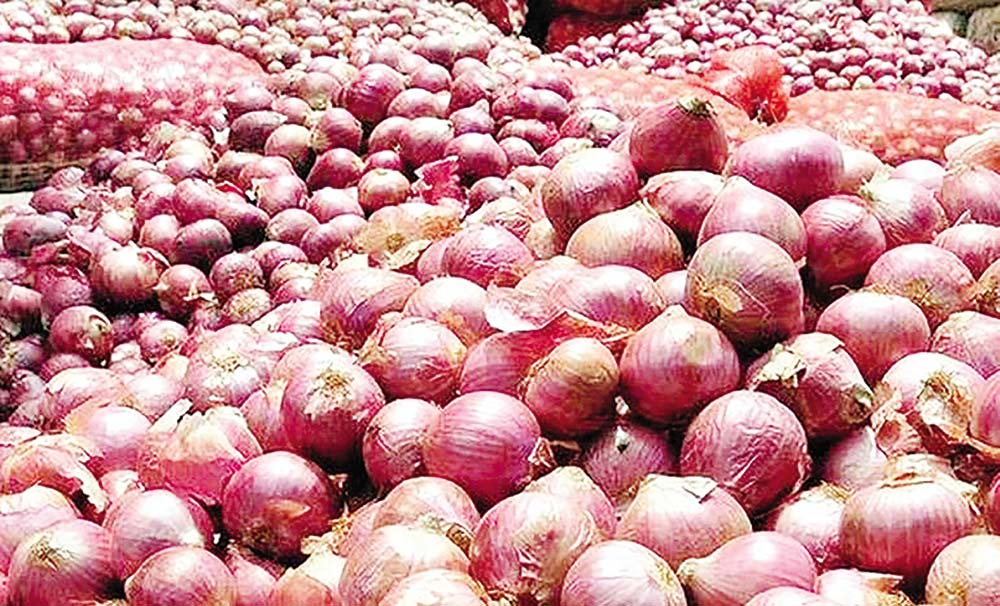 Bangladesh is edging decisively towards onion self-sufficiency, as a bumper harvest across key growing belts has slashed import dependence to its lowest level on record-signalling a structural shift in the country's agri-economy.
Production reached 4.25 million tonnes in FY 2024-25, cultivated across 280,100 hectares. The upward trajectory is expected to continue, with the government setting a target of 4.264 million tonnes from 286,300 hectares in the last ten months of the current fiscal year-firmly positioning the country within striking distance of full self-reliance.
In the fertile plains of Faridpur, the transformation is already visible. Farmers are reporting record yields, stronger price expectations and improved profitability, underscoring a rare alignment of production gains and market optimism.
At Banmalipur village in Boalmari upazila, farmer Partha Kumar Mondol described an exceptional season. With disease pressure low and weather conditions highly favourable, yields have exceeded expectations, prompting him to store much of his harvest in anticipation of higher prices later in the year.
Neighbouring farmer Sadhan Hira echoed the trend, noting a sharp rise in output per decimal of land-from around two maunds last year to nearly three and a half maunds this season. Like many others, he has opted to hold back supply, betting on a stronger market ahead.
The scale of the harvest has even reshaped rural life. Local schoolteacher Subrata Biswas observed that nearly every household in the area has erected makeshift storage facilities, with courtyards now filled with stacked onions under improvised sheds-an unmistakable sign of abundance.
Long-term import data further underline the shift. Bangladesh imported over one million tonnes of onions in FY 2019-20, with volumes remaining elevated in subsequent years. The steady decline since then-culminating in this year's record low-marks a decisive break from chronic import dependence.
Officials say the next frontier lies in tackling post-harvest losses, which still account for a significant drain on supply. The government estimates that 25 to 30 per cent of onions are lost annually due to inadequate storage-an inefficiency that continues to distort market stability.
To address this, modern storage solutions are being rolled out. Project Director at the Department of Agricultural Marketing, Helal Uddin, said newly introduced model storage units can preserve onions for several months, each capable of holding up to 300 maunds and designed for shared use among farmers.
Agriculture Secretary Dr Rafiqul I Mohammad confirmed that a broader national preservation initiative is under active consideration, with key decisions expected at a high-level meeting in early May.
Meanwhile, Agriculture Minister Mohammad Aminur Rashid has highlighted the transformative potential of advanced air-flow preservation technology, which could cut losses to as low as 2 to 4 per cent while extending storage life to up to nine months.
Supporting this push, the Housing and Building Research Institute has developed a specialised storage design integrating tin, bamboo, steel and concrete. Equipped with multi-tier racks, ventilation systems, temperature-control fans and weather protection, each unit-costing around Tk 450,000-can keep onions fresh for six to nine months while serving multiple farmers.
Taken together, rising production, collapsing imports and emerging storage innovations point to a pivotal moment for Bangladesh's onion sector. What was once a chronic vulnerability in the country's food supply chain is now rapidly turning into a story of resilience, efficiency and near self-sufficiency.

Loading...
Loading...
Also read



Editor : Iqbal Sobhan Chowdhury
Published by the Editor on behalf of the Observer Ltd. from Globe Printers, 24/A, New Eskaton Road, Ramna, Dhaka.
Editorial, News and Commercial Offices : Aziz Bhaban (2nd floor), 93, Motijheel C/A, Dhaka-1000.
Phone: PABX- 41053001-06; Advertisement: 41053012; 01793317829, 01550707291, 01550707296
E-mail: [email protected], [email protected]. [email protected], [email protected], [email protected], [email protected], Online-email: [email protected]


