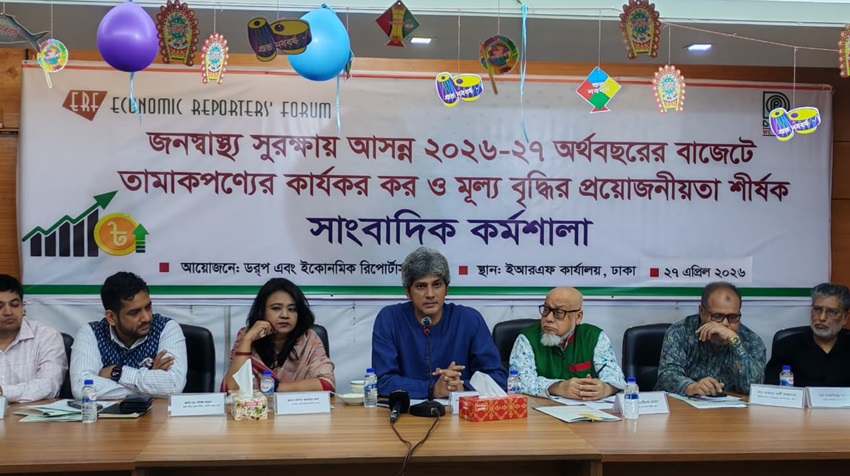
State Minister for Planning Zonayed Abdur Rahim Saki said that raising tobacco prices alone is not enough, the increase in tax must outpace inflation and income growth to meaningfully reduce health risks.
He made these remarks at a journalists’ workshop on Monday, jointly organised by the Development Organisation of the Rural Poor (DORP) and the Economic Reporters’ Forum (ERF) at the ERF office in Dhaka, ahead of the FY2026-27 national budget.
Saki said the easy availability of tobacco products is pushing smoking rates sharply higher among young people and low-income communities, calling it a serious public health threat.
Bangladesh already holds the highest tobacco use rate in South Asia at 35.3%. Nearly two lakh people die prematurely each year from tobacco-related diseases, and health and environmental losses from tobacco reached TK 87,000 crore in 2024, more than double the sector’s revenue of TK 40,000 crore, said former secretary Md Azhar Ali Talukdar.
Md Mashiur Rahman, first secretary (Vat Policy) of the National Board of Revenue, said that the current tax structure costs the government around TK 44,000 crore in potential annual revenue.
He noted that such a large amount could significantly improve the education, health and social security sectors. He added that effective tobacco taxation is a powerful policy tool that can reduce smoking, protect public health and simultaneously increase government revenue.
Dhaka University’s Institute of Health Economics Director Prof Dr Shafiun Nahin Shimul presented the keynote paper.
He stated that cigarettes are currently sold in four price tiers in the market: low, medium, high and premium. Nearly 90% of cigarette sales are concentrated in the low and medium tiers. Although adult per capita cigarette sales have remained almost unchanged in recent years, sales in these two tiers have increased. For the upcoming fiscal year, he proposed merging the low and medium tiers into one category, creating a new three-tier structure. Under the proposal, prices of 10-stick cigarette packs would be set at TK 100, TK 150 and TK 200, respectively. He also recommended maintaining the existing 67 percent supplementary duty on all tiers and imposing a specific tax of TK 4 per pack.
In her welcome speech, Daulat Akhtar Mala, President of the Economic Reporters’ Forum, said that before every budget, tobacco companies spread the false claim that increasing tobacco tax and prices would boost smuggling.
She described the claim as baseless, saying cigarette prices in Bangladesh remain much lower than in neighbouring countries, leaving little scope for smuggling.
She added that the Economic Reporters’ Forum would continue to play an active role in the media against such tactics, fears of revenue loss and rumours about counterfeit products.
DORP founder and chief executive AHM Noman said that effective taxation could discourage over 3 lakh 72 thousand young people from taking up smoking and prevent more than 1 lakh 85 thousand premature deaths in the long run.
The session was moderated by Abul Kashem, General Secretary of the Economic Reporters’ Forum. Among others present were Md Mostafizur Rahman, former chairman of Bangladesh Chemical Industries Corporation (BCIC); Jeba Afroza; and journalists from various media outlets.
NRE