Bangladesh's celebrated Mobile Financial Services (MFS) revolution is facing its gravest credibility crisis, as weak regulatory enforcement, fake account openings and increasingly sophisticated cybercrime networks turn the country's fastest-growing fintech platform into a lucrative hunting ground for fraudsters.
What was once hailed as a financial lifeline for millions is now emerging as a parallel shadow channel for organised digital theft.
The scale of abuse is deeply disturbing. A recent study found that 6.3 per cent of individual MFS users and 17 per cent of agents have already fallen victim to fraud, while the sector is increasingly being used for illegal transactions ranging from money laundering to online betting and illicit fund transfers.
Financial crime analysts estimate that over the years digital scams linked to MFS tools have siphoned off nearly Tk 21,000 crore, exposing severe structural weaknesses in Bangladesh's financial inclusion drive.
The danger is no longer confined to primitive PIN theft or fake SMS traps.
Fraud has entered a far more sinister phase.
A late-night call from a familiar voice, a story of death, illness or sudden hospitalisation, and an urgent plea for help - this is how criminals are now weaponising human emotion through the country's digital payment system. In these scams, mobile wallets are merely the transfer route; the real weapon is psychological manipulation.
A recent case involving a senior journalist reveals the frightening sophistication of the new fraud architecture.
Near midnight, he received a call from a local number. The caller introduced himself as a close relative living in London and claimed that his wife had suddenly died while he himself had been admitted to hospital. Citing an emergency, he asked the journalist to connect him with his son, a doctor in the UK.
When the son returned the call, the same voice desperately sought immediate financial help to clear hospital bills and supplied a Nagad number, claiming it belonged to his sister.
Within days of the money being transferred, the truth surfaced: the relative had never travelled abroad, his wife was alive, and the entire episode was a meticulously staged fraud.
Investigators say such emotionally engineered deception - built on family trust, fear, urgency and sympathy - is now becoming one of the most successful fraud formulas inside the MFS ecosystem.
The backdrop to this explosion, according to law enforcers and central bank officials, is years of regulatory neglect.
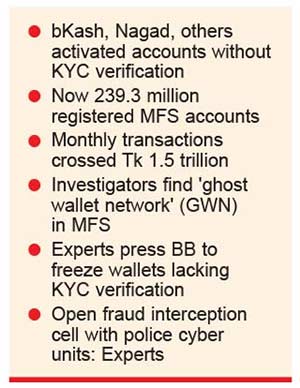
Police investigators said a huge number of MFS accounts were opened without proper Know Your Customer (KYC) verification, allowing fraudsters to operate through false, rented or unverifiable identities. Several accounts under platforms including Nagad, bKash and others were reportedly activated with incomplete documents, photocopied NID papers or fabricated credentials at the agent level.
This Correspondent has learnt that during the Covid-19 shutdown, when digital transactions surged sharply, thousands of new accounts were opened hurriedly to capture the exploding customer base, while compliance scrutiny remained dangerously weak.
"Had proper KYC been enforced, the beneficial owners behind these wallets could have been traced quickly. But many accounts are either fake, borrowed or insufficiently verified, making investigation extremely difficult," said a senior Bangladesh Bank official.
As a result, investigators now describe a vast "ghost wallet network" inside the MFS industry - anonymous or weakly verified accounts used as temporary receiving points before stolen money is instantly dispersed through multiple layers, erasing the audit trail.
The stakes are enormous.
Bangladesh now has 239.3 million registered MFS accounts, while monthly transactions have climbed to well above Tk 1.5 trillion, making mobile wallets one of the country's largest retail financial arteries.
But the very scale that made digital finance a national success story has also multiplied its vulnerability.
More alarmingly, cybercrime experts warn that organised fraud rings are no longer relying only on phone deception. They are increasingly using advanced software, cloned caller IDs, synthetic voice tools and artificial intelligence to mimic voices, alter facial images during video calls and create near-authentic emergency narratives capable of deceiving even educated users.
This technological leap, analysts say, marks a dangerous transition from conventional mobile fraud to AI-assisted financial impersonation - a threat that could severely undermine public trust in digital transactions if left unchecked.
Bangladesh Bank has repeatedly issued instructions on KYC compliance and suspicious transaction reporting, yet enforcement at the field level remains patchy, while operators continue to depend heavily on agent-driven onboarding. Meanwhile, suspicious financial transaction reports across the broader system have risen sharply, prompting the central bank to move toward automated real-time monitoring.
Cybersecurity analysts and financial governance experts are now calling for an emergency clean-up of the sector.
They say Bangladesh Bank must immediately order all MFS operators to freeze or suspend wallets lacking full KYC verification, audit agent registrations, deploy AI-based transaction surveillance, and create a rapid-response fraud interception cell jointly with police cyber units.
"Issuing directives alone will not suffice; implementation must be ensured," one financial governance expert said, warning that operators who ignored compliance obligations must also be held accountable.
For ordinary citizens, however, the damage is already painfully real.
Working people lose daily earnings, families lose life savings, remittance recipients lose emergency funds - and with every vanished taka, confidence in digital finance bleeds further. Bangladesh's MFS boom once symbolised inclusion, speed and convenience.
Today, unless regulators move faster than the fraudsters, that same revolution risks mutating into one of the country's most dangerous financial blind spots - where trust itself has become the easiest currency to steal.





