



| HEADLINE |

|
Addl tax on dividends less than 30pc proposed
Published : Wednesday, 10 June, 2026 at 2:49 PM
Observer Online Report



The government is planning to introduce a new tax policy aimed at encouraging listed companies to distribute higher dividends to shareholders.
Under the proposed FY2026-27 budget, listed companies may be required to distribute at least 30 per cent of their after-tax net profit as dividends.
Companies that fail to meet this threshold could face an additional 10 per cent tax on the shortfall amount. However, banks, insurance companies, leasing firms and other financial institutions are expected to be exempt from the provision.
Under the proposal, a company with an after-tax net profit of Tk 100 crore, would be required to distribute at least Tk 30 crore in dividends. If it distributes only Tk 20 crore, the remaining Tk 10 crore shortfall would be subject to an additional 10 per cent tax. If the tax is not paid within the stipulated period, the tax authority would have the power to assess and impose the tax after providing the company with an opportunity to be heard.
The proposed measure would replace the existing tax framework on retained earnings by directly linking taxation to dividend distribution levels.
Companies that declare stock dividends exceeding cash dividends or distribute only stock dividends, may also be required to pay a 10 percent tax. As with the dividend distribution rule, banks, insurance companies, and other financial institutions are likely to remain outside the scope of this provision. Existing corporate tax rates for other listed companies would remain unchanged.
According to economic agents, the initiative could put pressure on companies that have long retained substantial profits while paying low dividends to adopt more shareholder-friendly policies. It may also discourage the widespread practice of issuing excessive stock dividends.
However, opinions remain divided on the proposed mandatory dividend policy. According to Saiful Islam, President of the DSE Brokers Association of Bangladesh, international practice generally leaves dividend decisions to company boards and shareholders. He noted that growing companies often reinvest a significant portion of their profits to support expansion. Nevertheless, he believes that, given the current realities of Bangladesh’s capital market, the proposal to impose additional tax on low-dividend-paying companies could help protect investors’ interests.
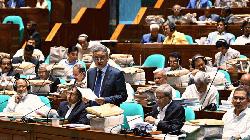
The proposed national budget is scheduled to be presented in Parliament on June 11 by Amir Khasru Mahmud Chowdhury. The measure is expected to be formally introduced through proposed amendments to the Income Tax Act during the budget speech.
Under the proposed FY2026-27 budget, listed companies may be required to distribute at least 30 per cent of their after-tax net profit as dividends.
Companies that fail to meet this threshold could face an additional 10 per cent tax on the shortfall amount. However, banks, insurance companies, leasing firms and other financial institutions are expected to be exempt from the provision.
Under the proposal, a company with an after-tax net profit of Tk 100 crore, would be required to distribute at least Tk 30 crore in dividends. If it distributes only Tk 20 crore, the remaining Tk 10 crore shortfall would be subject to an additional 10 per cent tax. If the tax is not paid within the stipulated period, the tax authority would have the power to assess and impose the tax after providing the company with an opportunity to be heard.
The proposed measure would replace the existing tax framework on retained earnings by directly linking taxation to dividend distribution levels.
Companies that declare stock dividends exceeding cash dividends or distribute only stock dividends, may also be required to pay a 10 percent tax. As with the dividend distribution rule, banks, insurance companies, and other financial institutions are likely to remain outside the scope of this provision. Existing corporate tax rates for other listed companies would remain unchanged.
According to economic agents, the initiative could put pressure on companies that have long retained substantial profits while paying low dividends to adopt more shareholder-friendly policies. It may also discourage the widespread practice of issuing excessive stock dividends.
However, opinions remain divided on the proposed mandatory dividend policy. According to Saiful Islam, President of the DSE Brokers Association of Bangladesh, international practice generally leaves dividend decisions to company boards and shareholders. He noted that growing companies often reinvest a significant portion of their profits to support expansion. Nevertheless, he believes that, given the current realities of Bangladesh’s capital market, the proposal to impose additional tax on low-dividend-paying companies could help protect investors’ interests.
The proposed national budget is scheduled to be presented in Parliament on June 11 by Amir Khasru Mahmud Chowdhury. The measure is expected to be formally introduced through proposed amendments to the Income Tax Act during the budget speech.
Loading...
Loading...
Also read








Editor : Iqbal Sobhan Chowdhury
Published by the Editor on behalf of the Observer Ltd. from Globe Printers, 24/A, New Eskaton Road, Ramna, Dhaka.
Editorial, News and Commercial Offices : Aziz Bhaban (2nd floor), 93, Motijheel C/A, Dhaka-1000.
Phone: PABX- 41053001-06; Advertisement: 41053012; 01793317829, 01550707291, E-mail: [email protected], [email protected] Online: email: [email protected] 41053014; 01550707297 Advertisement: 01550707296
Published by the Editor on behalf of the Observer Ltd. from Globe Printers, 24/A, New Eskaton Road, Ramna, Dhaka.
Editorial, News and Commercial Offices : Aziz Bhaban (2nd floor), 93, Motijheel C/A, Dhaka-1000.
Phone: PABX- 41053001-06; Advertisement: 41053012; 01793317829, 01550707291, E-mail: [email protected], [email protected] Online: email: [email protected] 41053014; 01550707297 Advertisement: 01550707296


