Bangladesh has crossed a symbolic economic frontier�"but at a moment when the underlying pace of expansion is losing momentum.
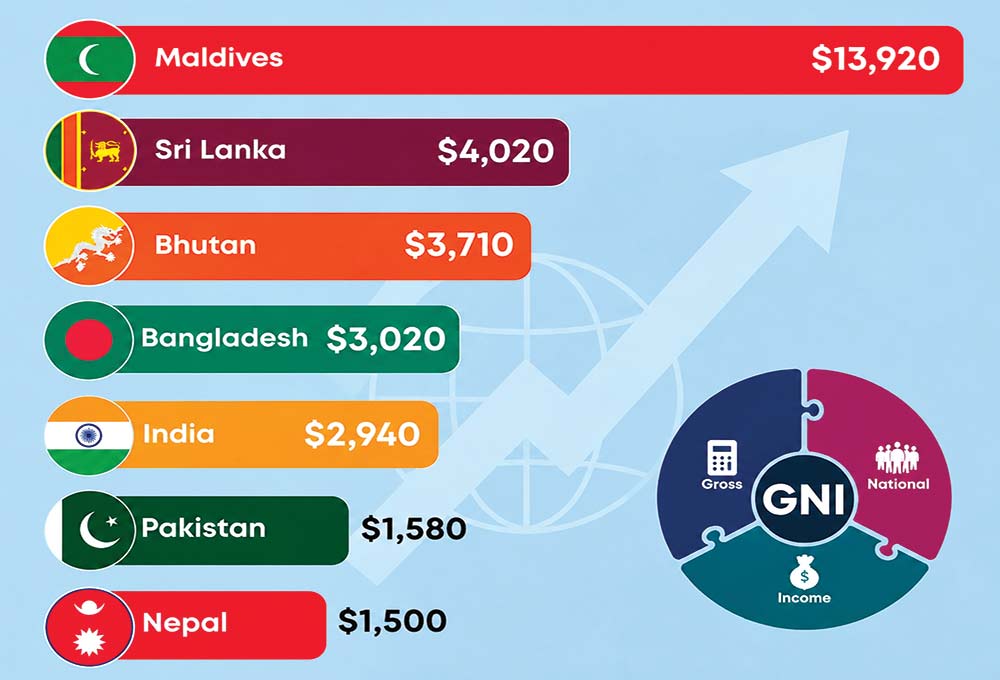
Despite stubborn inflation, weak private investment, subdued industrial activity and an unsettled global environment, the country has for the first time pushed its per capita Gross National Income (GNI) beyond the $3,000 mark, reaching $3,020 in FY2025�"26, according to the Bangladesh Bureau of Statistics.
The milestone places Bangladesh ahead of India ($2,940), Pakistan ($1,580) and Nepal ($1,500) in South Asia. Only the Maldives ($13,920), Sri Lanka ($4,020) and Bhutan ($3,710) now rank higher in the region.
For a country born in 1971 amid war-time devastation, however, the figure carries undeniable historical weight. It reflects five decades of structural change driven by export-oriented manufacturing, remittances from overseas workers, rural enterprise, and the steady expansion of a mass consumption economy.
At the same time, Bangladesh has entered another symbolic bracket: the size of the economy has climbed to $501.1 billion (Tk 61.2 trillion), placing it firmly in the group of half-trillion-dollar economies and reinforcing its long-standing ambition of becoming a $1 trillion economy by 2034.
Crossing the $3,000 threshold and the $500 billion economy mark is therefore less an endpoint than a transition signal as the macroeconomic picture beneath these milestones is far more restrained.
Real GDP growth recovered marginally to 4.14 per cent in FY2025�"26, up from 3.49 per cent a year earlier, yet remained well below the government’s 5.5 per cent target and significantly under the pre-pandemic growth trajectory that once defined Bangladesh’s economic narrative.
The weakness is most visible in industry. Manufacturing and industrial output�"the core of export-led growth�"expanded by only 2.86 per cent, constrained by soft global demand, cautious investment and competitiveness pressures.
Multilateral forecasts had already signalled moderation: the IMF projected 4.7 per cent growth, the World Bank 3.9 per cent, and the Asian Development Bank 4.0 per cent.
Officials point to resilient agriculture, a stabilising services sector and steady domestic consumption as the main contributors to growth resilience. Yet economists argue that resilience is not the same as dynamism.
“The headline is impressive, but the structure behind it is still fragile,” said one leading economist. “Bangladesh is growing�"but not yet transforming at the pace required for upper-middle-income transition.”
That concern is now central to the next phase of policy debate.
How much of the rise in national income reflects productive expansion versus remittance inflows? Is income growth broadening across households or concentrating in limited segments of the economy? And whether financial deepening�"particularly the rapid expansion of mobile financial services�"has translated into sustained productivity gains remains an open question.
These structural issues are sharpening as the government sets an ambitious 6.5 per cent growth target for the coming fiscal year. Achieving it will require a decisive acceleration in private investment, export diversification, job creation and institutional reform.
Yet headwinds persist. Inflation continues to erode real purchasing power, credit growth remains subdued, and business confidence has yet to fully recover. External risks, from global demand volatility to geopolitical uncertainty, further complicate the outlook.
Still, Bangladesh’s long-term transformation remains one of the most significant in the developing world. Per capita GDP has nearly tripled since 2010, and the country now firmly outperforms several South Asian peers in income rankings.
But the nature of the challenge is changing.
The era of expansion driven by low-cost labour and rising external demand is gradually giving way to a more complex phase�"one that demands productivity growth, institutional strength, technological upgrading and deeper capital formation.
Crossing the $3,000 threshold and the $500 billion economy mark is therefore less an endpoint than a transition signal.
Bangladesh has entered a new economic league. The question that now defines its future is whether it can convert scale into sophistication�"and growth into lasting, inclusive prosperity.





