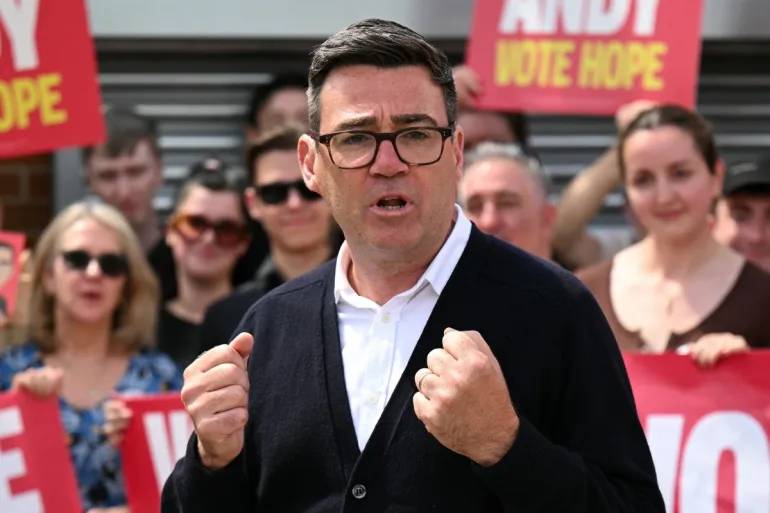
With Keir Starmer’s resignation triggering a Labour leadership race, the former Mayor of Greater Manchester emerges as the frontrunner, carrying a decade of executive experience, a populist brand, and significant unresolved questions.
When British Prime Minister Keir Starmer announced his resignation on June 22, 2026, political attention shifted almost immediately toward Andy Burnham.
Within hours, the newly elected Member of Parliament for Makerfield, who had stepped down as Mayor of Greater Manchester just days earlier, announced his intention to contest the Labour Party leadership. The contest, according to observers, already resembled a coronation rather than an open race.
Burnham, born in 1970 and educated at Cambridge, brings an unusually broad political resume to the leadership contest. He served as a Labour MP for Leigh from 2001 to 2017, holding cabinet positions under both Tony Blair and Gordon Brown, most recently as Secretary of State for Health from 2009 to 2010. That ministerial experience gave him direct familiarity with the machinery of central government, a credential many regional leaders lack.
From 2017 until his departure last week, Burnham served as Mayor of Greater Manchester, a tenure that forged the political identity he now carries into the national contest. His most prominent moment came during the COVID-19 pandemic, when he publicly clashed with the then UK PM Boris Johnson over financial support for Greater Manchester during local lockdowns.
That confrontation, widely televised, elevated his national profile and cemented his reputation as a champion of northern England against what he characterised as an indifferent London establishment.
Central to Burnham’s pitch is what has been termed the “Manchester Model”, a governance philosophy centred on regional devolution, preventative healthcare, and community-based public services. Under his mayoralty, Greater Manchester pursued integrated transport systems, social prescribing within GP practices, and active travel infrastructure.
He championed the Daily Mile programme in schools and pushed exercise referral as a mainstream NHS intervention rather than an afterthought. Data from Sport England’s Active Lives survey indicated that 76.4 per cent of adults in Greater Manchester exercised for at least 30 minutes per week under his tenure.
Burnham has consistently argued that preventative healthcare cannot be effectively mandated from Westminster, but must instead emerge from bottom-up leadership in local communities. As Prime Minister, however, he would possess national levers, including the ability to reform the GP contract and the Quality Outcomes Framework, that were unavailable to him as a metro mayor. Whether the model that succeeded at regional scale can be transposed to a national system of significantly greater complexity remains an open and consequential question.
The Electoral Argument
Burnham’s supporters argue that his greatest asset is electability. His convincing by-election victory in Makerfield on 19 June 2026 by securing nearly 25,000 votes against a strong Reform UK candidate was cited as evidence that he can hold Labour’s traditional working-class heartlands that have drifted toward Nigel Farage’s party.
Labour lost control of 35 councils and nearly 1,500 council seats in the 2026 local elections, underscoring the scale of the party’s structural challenge.
Makerfield is a predominantly white British, post-industrial constituency that voted heavily to leave the European Union in 2016, precisely the demographic terrain that Labour has struggled to hold. Burnham’s performance exceeded pre-election polling projections, providing Labour strategists with cautious optimism that the party can reconnect with those voters before the next general election.
Despite the momentum, significant unknowns surround a potential Burnham premiership. Analysts note that his specific policy positions at a national level remain imprecise. Jonathan Tonge of the University of Liverpool observed, as reported by BBC, that “the simple truth is we don’t know what an Andy Burnham premiership will look like.” A Conservative MP dismissed him as “Keir Starmer with a Northern accent”, a charge that, while partisan, touches on a legitimate question about the degree of policy differentiation Burnham would actually deliver.
Writing in the Financial Times in May 2026, commentator Stephen Bush noted that Burnham’s stated policy positions as a prospective leader appeared further to the left than the policies he had actually implemented as mayor, which were themselves to the right of the Starmer government’s programme. This raises questions about whether his political positioning reflects genuine conviction or tactical calculation for a leadership contest.
On foreign policy and international relations, including the UK’s posture toward the Trump administration and the ongoing volatility in the Middle East, Burnham’s positions remain underdeveloped.
He has warned against the UK adopting American-style politics, but the contours of how he would manage the transatlantic relationship, or the United Kingdom’s role in European security, remain largely unspecified.
Starmer confirmed he would remain as caretaker Prime Minister throughout the summer while Labour organises its leadership process.
The contest carries substantial stakes- Labour’s defeat in the 2026 Senedd election ended a century of Labour governance in Wales, while the Scottish party has been similarly weakened.
The party faces a potentially resurgent Reform UK on its right flank, and a growing Green and Liberal Democrat challenge from the centre-left.
Burnham’s executive experience, personal brand, and demonstrated ability to win in contested territory constitute a credible argument for his candidacy.
His track record in Greater Manchester suggests genuine administrative competence and a capacity to deliver at scale. The more demanding question, whether the skills that made him an effective regional mayor translate into effective national leadership in a deeply volatile political environment, is one that no leadership contest alone can answer.
Source: This analysis draws on reporting by
BBC News.