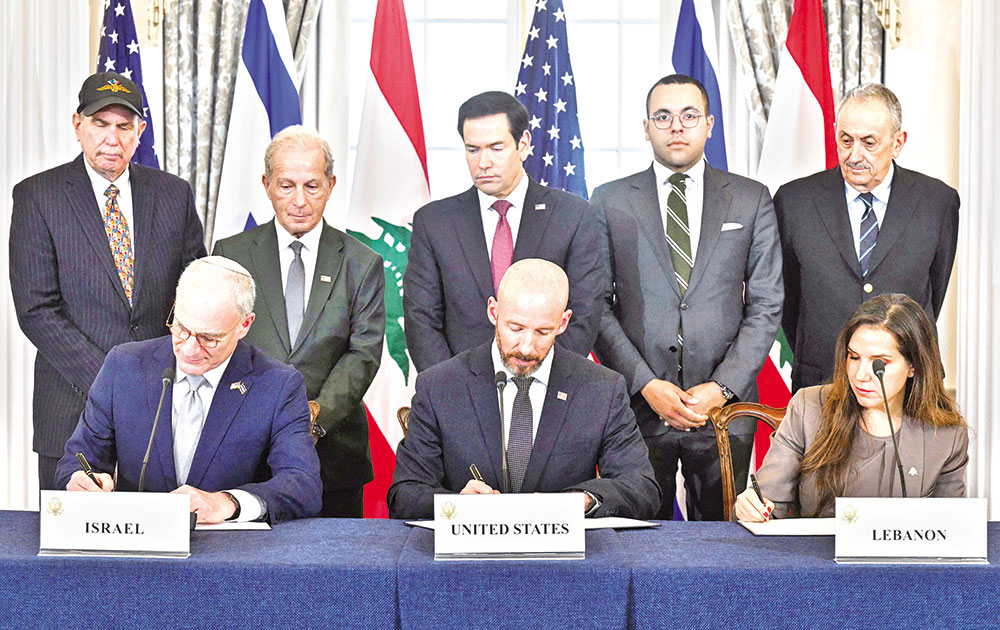
WASHINGTON, Jun 27: Lebanon, Israel and the United States on Friday signed a trilateral framework agreement aimed at paving the way for a peace deal between the two long-time Middle East adversaries.
The agreement -- which includes a pilot effort in which Lebanese soldiers take control of two areas occupied by Israel, as well as a process aimed at disarming Hezbollah -- is the result of five rounds of talks in the US capital.
The deal "begins to put in place a framework for lasting peace and security," US Secretary of State Marco Rubio said at the signing ceremony, noting: "It's the beginning of the beginning. There's a lot of work ahead."
Lebanon's ambassador to Washington, Nada HamadehMoawad, said the accord "is a first step on the road to restoring Lebanese sovereignty and territorial integrity, securing a permanent and final cessation of hostilities (and) enabling our people to go back to their land."
And Israel's US envoy, Yechiel Leiter, said that under the deal, "Iran is out, Hezbollah is out, and the road to peace between Israel and Lebanon is in."
Lebanese "authorities will be unable to impose the implementation of the agreement signed in Washington unless they go, with American support, to civil war," said Hezbollah lawmaker Hassan Fadlallah, whose party has long rejected the direct Israel-Lebanon talks.
He added that "what happened in Washington is an attempt to disrupt the Islamabad path, and without the resistance (Hezbollah) nothing will pass," referring to the initial agreement between the US and Iran on halting the Middle East war, which includes Lebanon.
The following are highlights of the 14-point agreement signed in the US capital:
Israel and Lebanon, with US support, "affirm their shared goal of achieving lasting peace and security," the agreement begins.
The neighboring states "declare their intent to conclusively end the conflict, address its underlying causes, and to therewith formally conclude any state of war between them."
The framework determines to make "irreversible progress" towards resolving all issues between Israel and Lebanon, while doing so is to be achieved through "direct bilateral talks, with the mediation and support of the United States."
The Lebanese Armed Forces (LAF) "will restore effective sovereignty over all Lebanese territory, pending the verified disarmament of non-state armed groups and dismantlement of associated infrastructure."
This will enable the Israel Defense Forces (IDF) to "progressively redeploy out of the Lebanese territory." The framework will set out the steps and verification mechanisms to advance this process.
The LAF will "gradually assume full and effective security responsibility in pilot zones, which will serve as the mechanism for phased and verified redeployments of the IDF and the deployments of the LAF."
Two initial zones have been agreed to by both sides, and future pilot zones will be agreed by mutual consent.
Upon confirmation of the disarmament of non-state armed groups, notably the Iran-backed Hezbollah, the LAF will assume full security responsibility in these zones.
"Internationally supported reconstruction efforts will begin, and Lebanese civilians will be able to safely return to these areas under the exclusive control of Lebanese state authorities," the agreement states. "The United States intends to work closely with both countries to verify and support this process."
Lebanon's government under the deal reaffirms its commitment to restoring full sovereignty over its territory. It will "rebuild the State's monopoly on the use of force, achieve the complete and verified disarmament of all non-state armed groups, and ensure that such groups will have no military or security role and no armed capabilities anywhere in Lebanon."
Lebanon asks for the support of international and particularly Arab partners, under the leadership of the United States, to do this.
Israel and Lebanon also are to establish "working groups to draft the full comprehensive peace and security agreement" between them, the framework says, and "immediately establish complementary tracks of ongoing direct engagement, facilitated by the United States."
Israel for its part states that its military actions in Lebanon "are solely a consequence of the attacks, threat posed by, and hostile intent of non-state armed groups, particularly Hezbollah."
"Termination of this threat," notably through disarmament of such non-state groups and "additional security arrangements to be agreed upon between the two countries," will eliminate any future necessity for IDF military action or presence in Lebanon, it said.
It also stressed that "the Government of Israel declares that it has no territorial ambitions in Lebanon."�"AFP





