



| HEADLINE |

|

Local government offices to come under rooftop solar power


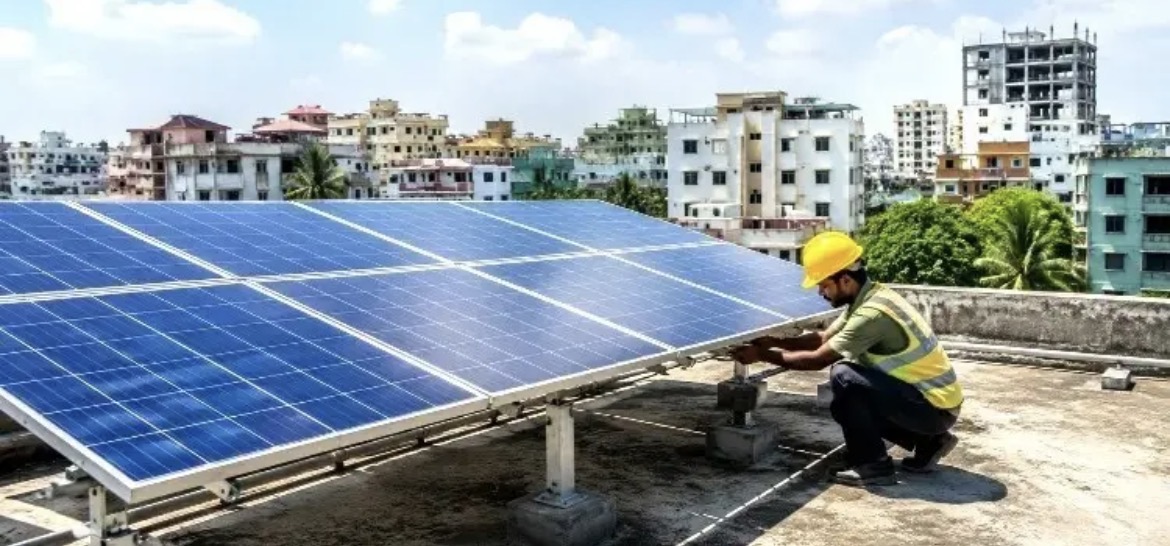
The government has decided to gradually install rooftop solar power systems at central and field-level offices under the Local Government Division, with surplus electricity to be supplied to the national grid through net metering.
Local Government, Rural Development and Cooperatives State Minister Mir Shahe Alam disclosed the decision after a meeting at the Secretariat on Monday. The meeting was held to implement a Cabinet Division directive issued on August 10 to increase the use of solar power in government offices.
He said rooftop solar systems would initially be installed according to the electricity requirements of individual offices. If an office generates more electricity than it needs, the surplus will be supplied to the national grid through net metering.
The minister said local government institutions, including union parishads, municipalities, district councils and city corporations, would generally be able to bear the cost. Those unable to meet the expense could receive additional funding from the Local Government Division.
Two committees have been formed to implement the initiative. One will be headed by an additional secretary of the Local Government Division and the other by an additional secretary of the Rural Development and Cooperatives Division. The committees will consult solar power companies to determine the required systems and costs for different offices.
The Local Government Division oversees 13 city corporations, 61 district councils, 503 upazila parishad complexes, 330 municipalities and 4,528 union parishads. The plan also covers 526 dak bungalows and 163 auditoriums under district councils, as well as regional offices, community centres and auditoriums operated by city corporations.
According to the minister, a 5.5-kilowatt solar system can be installed for around Tk 3.5 lakh without batteries. Adding a battery may cost another Tk 40,000�"50,000.
Under the proposed net-metering arrangement, an office generating more electricity than it consumes can supply the surplus to the national grid and receive payment at the applicable rate.
The initiative is expected to reduce electricity costs for local government institutions while creating an additional source of revenue and reducing pressure on the national grid.
Several private companies, including Walton, PRAN-RFL and Grameen Shakti, have already made presentations to the government about their solar power capabilities. The minister said the initiative would be implemented gradually, beginning with head offices and later extending to field-level offices.
SKS









Published by the Editor on behalf of the Observer Ltd. from Globe Printers, 24/A, New Eskaton Road, Ramna, Dhaka.
Editorial, News and Commercial Offices : Aziz Bhaban (2nd floor), 93, Motijheel C/A, Dhaka-1000.
Phone: PABX- 41053001-06; Advertisement: 41053012; 01793317829, 01550707291, E-mail: [email protected], [email protected] Online: email: [email protected] 41053014; 01550707297 Advertisement: 01550707296


