



| HEADLINE |

|

Denmark to provide Tk 4,500cr for Saidabad water project
Published : Tuesday, 25 August, 2026 at 2:15 PM
Observer Online Report


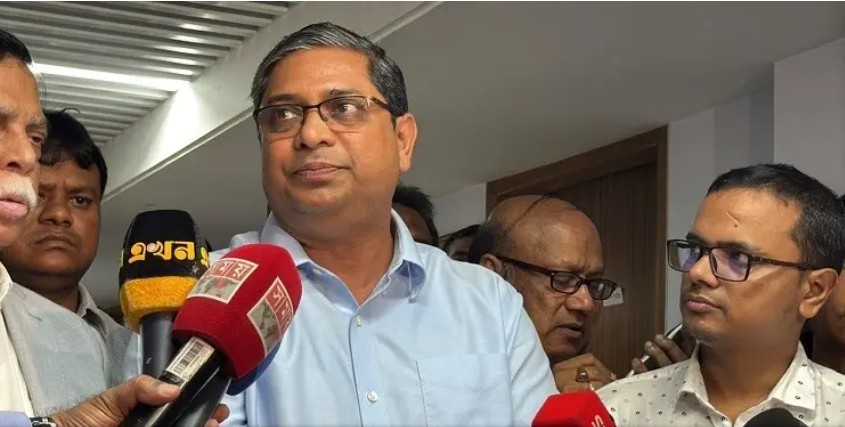
Denmark will provide around Tk 4,500 crore in grants and soft loans to help complete the final phase of Dhaka WASA’s Saidabad Water Treatment Plant project, Local Government Minister Mir Shah Alam said on Tuesday.
Of the amount, around Tk 1,500 crore will be provided as a grant and about Tk 3,000 crore as a soft loan at an interest rate of 1.5 to 2 per cent, he said.
The minister made the disclosure after a meeting between Local Government, Rural Development and Cooperatives Minister Dr Abdul Moin Khan and Danish Ambassador to Bangladesh Christian Brix Moller at the Secretariat.
Mir Shah Alam said the meeting discussed major Danish investment in Dhaka WASA’s water supply system.
Dhaka’s daily water demand is around 325 million litres, while WASA supplies approximately 295-305 million litres from underground and surface water sources, leaving a daily shortfall, he said.
The government is also bringing water from the Meghna River to meet the capital’s growing demand. Once the Gandharpur project becomes operational, it is expected to supply around 500 million litres of water a day to Dhaka.
Under the Saidabad project, water from the Meghna will be treated at a treatment plant and supplied to the capital. The project is expected to produce 950 million litres of water a day.
The project, which began in 2015, has a total estimated cost of around Tk 16,000 crore. It was originally scheduled for completion by 2030, but the government now aims to complete it by 2029.
Work worth around Tk 11,000-12,000 crore has already been completed, while the Danish assistance will finance the final phase. The soft loan will be repayable over 20 years, the minister said.
Denmark is also providing around Tk 100 crore for water treatment and supply and other activities in Rohingya camps, he said.
The two sides also discussed renewable energy and waste management. Denmark has expressed interest in investing in solar power in Bangladesh, while the government has sought Danish support for waste management and waste-to-energy projects. The areas of cooperation will be determined after feasibility studies.
The government is also planning a major desalination project to reduce Dhaka’s dependence on groundwater. Currently, around 74 per cent of Dhaka WASA’s water comes from groundwater and 24 per cent from surface water, while international practice recommends keeping groundwater use within 30 per cent of a city’s total supply, Mir Shah Alam said.
He said continued excessive extraction of groundwater could have serious environmental impacts, particularly amid climate change.
The Prime Minister has directed authorities to conduct feasibility studies for large-scale desalination projects at two coastal locations, including Chandpur and Mongla, he said. The Economic Relations Division will assist with financing the projects.
The government is also considering a nationwide pipeline network to distribute desalinated water to districts and upazilas, similar to the national gas and electricity grids, the minister said.
SKS

Loading...
Loading...
Also read







Editor : Iqbal Sobhan Chowdhury
Published by the Editor on behalf of the Observer Ltd. from Globe Printers, 24/A, New Eskaton Road, Ramna, Dhaka.
Editorial, News and Commercial Offices : Aziz Bhaban (2nd floor), 93, Motijheel C/A, Dhaka-1000.
Phone: PABX- 41053001-06; Advertisement: 41053012; 01793317829, 01550707291, E-mail: [email protected], [email protected] Online: email: [email protected] 41053014; 01550707297 Advertisement: 01550707296
Published by the Editor on behalf of the Observer Ltd. from Globe Printers, 24/A, New Eskaton Road, Ramna, Dhaka.
Editorial, News and Commercial Offices : Aziz Bhaban (2nd floor), 93, Motijheel C/A, Dhaka-1000.
Phone: PABX- 41053001-06; Advertisement: 41053012; 01793317829, 01550707291, E-mail: [email protected], [email protected] Online: email: [email protected] 41053014; 01550707297 Advertisement: 01550707296


