



| HEADLINE |

|

Negative Capital, Tk 6t Bad Loans Threaten Nation’s Financial System
Published : Monday, 7 September, 2026 at 12:00 AM
Faruk Ahmed


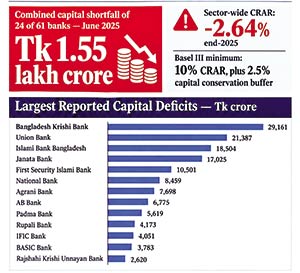 Bangladesh’s banking sector is plunging deeper into a capital and confidence crisis, with the industry’s capital adequacy ratio sinking into negative territory, exposing a potentially dangerous weakness in banks’ ability to absorb further losses.
The combined capital shortfall of 24 out of 61 operating banks reached Tk1.55 trillion at the end of June 2025, sharply up from Tk1.10 trillion three months earlier. Although this is not the latest sector-wide capital-deficit figure, it illustrates the scale of the capital erosion that has accompanied the surge in bad loans.
Non-performing loans (NPLs) surged to Tk606,555 crore by the end of June 2026, putting roughly one-third of the banking sector’s total loans into the danger zone. The unprecedented accumulation of toxic assets has severely weakened banks’ balance sheets and intensified concerns over financial stability.
The sector-wide Capital-to-Risk-Weighted-Asset Ratio (CRAR) fell to minus 2.64 per cent at the end of 2025, dramatically below the 10 per cent minimum regulatory requirement under the Basel III framework.
A negative aggregate CRAR represents an extraordinary warning signal. It indicates that, taken as a whole, the banking sector lacks sufficient capital buffers against the risks embedded in its assets, leaving lenders increasingly vulnerable to further defaults and losses.
The deterioration has been driven by years of politically influenced lending, weak corporate governance, related-party transactions, loan evergreening, repeated rescheduling and inadequate recovery of defaulted loans. Tougher central bank scrutiny and more rigorous recognition of distressed assets have now brought much of the previously concealed damage onto banks’ balance sheets.
The crisis has also exposed a widening divide between financially resilient lenders and institutions struggling to absorb mounting losses. While some banks continue to maintain substantial capital cushions, weaker lenders are facing severe pressure to raise fresh capital, improve recovery and strengthen governance.
CRAR is one of the key indicators of a bank’s financial strength. It measures the amount of capital available to absorb losses against assets weighted according to their level of risk. A higher ratio generally indicates greater capacity to withstand financial shocks, while a negative ratio signals an extreme erosion of loss-absorbing capacity.
The banking sector’s capital crisis is unfolding alongside a striking liquidity paradox. Excess liquidity surged to around Tk4.08 trillion at the end of June 2026, as deposit growth continued while demand for bank credit remained weak.
Private-sector credit growth has fallen to around 4.5 per cent, close to a historic low, leaving banks awash with cash but reluctant or unable to channel sufficient funds into productive investment.
The result is a dangerous mismatch: banks are sitting on a mountain of liquidity while businesses are struggling to secure affordable credit.
Weak investment demand, high borrowing costs, fragile business confidence and heightened concerns over loan quality have combined to make banks increasingly cautious about lending. Much of their surplus funds are therefore being parked in relatively safer government securities rather than flowing into businesses and productive sectors.
The deposit side of the banking system, meanwhile, has remained considerably more resilient. Total deposits have continued to expand, supported by government deposits and steady remittance inflows. But the headline growth masks a major change in depositor behaviour, with customers increasingly favouring institutions perceived to be financially stronger and better governed.
This emerging “flight to quality” threatens to deepen the divide within the banking system. Stronger lenders may continue attracting deposits, while weaker institutions could face growing pressure as customers become more selective about where they keep their savings.
Another worrying development is the rise in cash held outside the banking system. Currency held by the public climbed to a record Tk3.36 trillion at the end of June 2026, suggesting that uncertainty over the financial system may be encouraging some households and businesses to keep more money in physical cash.
The authorities have responded with the most sweeping banking-sector restructuring in years. The central bank and government have initiated bank-resolution measures aimed at protecting depositors, containing systemic risks and preventing troubled institutions from dragging down the wider financial system.
Five distressed Shariah-based private banks have already been consolidated into a new state-backed institution, Sammilito Islami Bank, in an unprecedented restructuring exercise. The authorities have put safeguards in place to protect retail depositors and ensure access to their principal funds.
The World Bank has also approved $450 million in financing to help Bangladesh strengthen financial-sector stability, including deposit protection, central-bank supervision, emergency liquidity support and bank-resolution mechanisms.
Yet the scale of the challenge remains immense.
With bad loans above Tk6 trillion, a negative sector-wide CRAR, a Tk1.55 trillion capital shortfall recorded among 24 banks and excess liquidity above Tk4 trillion, Bangladesh’s banking crisis has moved far beyond the problem of individual defaulting borrowers.
It has become a systemic crisis of capital, governance and confidence.
Unless the toxic-loan mountain is aggressively recovered, weak banks are restructured and governance is fundamentally overhauled, the country risks entering a vicious cycle in which depleted capital restricts lending, weak lending suppresses investment and sluggish economic activity generates yet more financial stress.
Bangladesh’s banking sector is no longer merely battling bad loans�"it is fighting to rebuild the capital and public confidence needed to keep the financial system standing.

Loading...
Loading...
Also read



Editor : Iqbal Sobhan Chowdhury
Published by the Editor on behalf of the Observer Ltd. from Globe Printers, 24/A, New Eskaton Road, Ramna, Dhaka.
Editorial, News and Commercial Offices : Aziz Bhaban (2nd floor), 93, Motijheel C/A, Dhaka-1000.
Phone: PABX- 41053001-06; Advertisement: 41053012; 01793317829, 01550707291, 01550707296
E-mail: [email protected], [email protected]. [email protected], [email protected], [email protected], [email protected], Online-email: [email protected]


