



| HEADLINE |

|

Maiden UNGA Address
PM calls for dialogue to resolve global conflicts
Published : Saturday, 26 September, 2026 at 12:00 AM
Mamunur Rashid & Jahid Biplob from New York


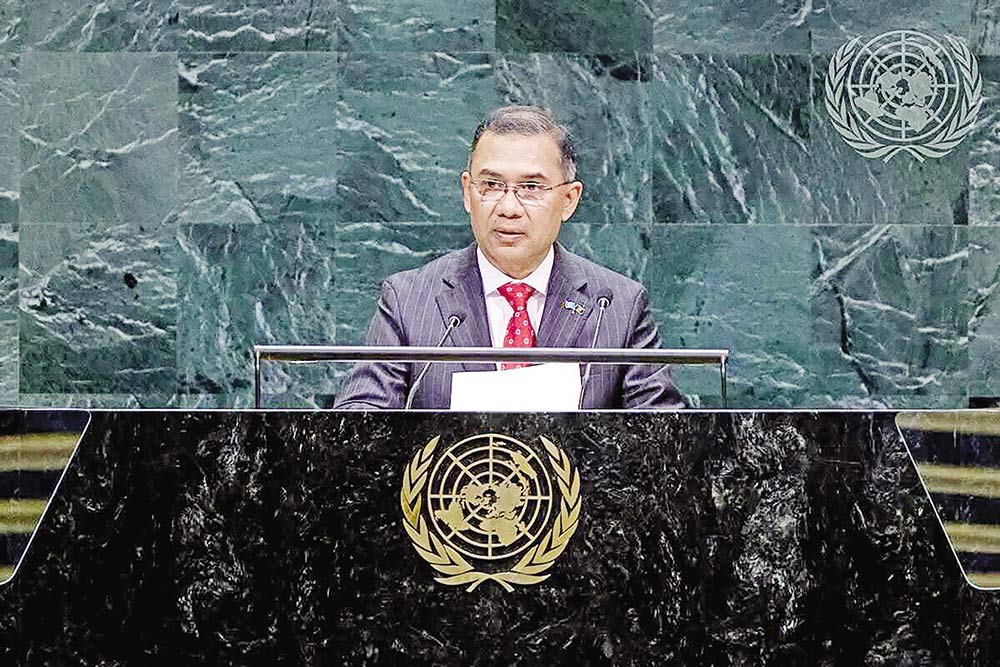 Prime Minister Tarique Rahman has called for dialogue, diplomacy and mutual cooperation to resolve global conflicts, urging countries to base bilateral and multilateral relations on equality, justice, mutual interests, respect and dignity.
“Any conflict should be resolved through dialogue, diplomatic processes and mutual cooperation,” he said while addressing the general debate of the 81st session of the United Nations General Assembly at the UN headquarters in New York on Thursday.
Delivering his maiden UNGA address in Bangla, Tarique outlined Bangladesh’s positions on global peace and security, the Palestinian issue, the Rohingya crisis, climate change, migration and multilateral cooperation. He also presented his government's plans for economic reconstruction, employment generation, human resource development, women's empowerment, education, healthcare and technological advancement.
He called for diplomacy, education and humanity to replace weapons of destruction as instruments of change, while reaffirming Bangladesh's commitment to disarmament, nuclear non-proliferation and arms control.
A FAMILY LEGACY AT THE UN
The speech marked a significant moment for Bangladesh as Tarique became the third member of his family to address the UN General Assembly from the same podium.
His father, Shaheed President Ziaur Rahman, and mother, former Prime Minister Khaleda Zia, had also addressed the UNGA.
At the outset, Tarique paid tribute to the martyrs of the Liberation War and those who sacrificed their lives in struggles for democracy, justice and people's rights. He also remembered those killed and injured during the July-August 2024 mass uprising.
Bangladesh's Foreign Minister Dr Khalilur Rahman was in the chair during the address. Bangladesh had previously held the UNGA presidency in 1986.

'A MORE EFFECTIVE UN'
Expressing concern over wars and instability, Tarique said conflicts in one part of the world increasingly affect people and economies elsewhere by disrupting energy supplies, trade and global supply chains while deepening humanitarian crises.
He called for a more effective United Nations as the central institution for international cooperation and a consensual world order.
STRONGER SUPPORT FOR PALESTINE
Tarique reaffirmed Bangladesh's support for the legitimate rights of the Palestinian people, including their right to self-determination and an independent Palestinian state.
He also highlighted Bangladesh's contribution to UN peacekeeping operations and particularly the participation of Bangladeshi women, describing it as part of the country's commitment to the Women, Peace and Security agenda.
'ROHINGYA SOLUTION LIES IN MYANMAR'
The Prime Minister gave significant attention to the Rohingya crisis, saying Bangladesh had been hosting more than 1.2 million forcibly displaced Rohingyas from Myanmar for more than nine years.
"The Rohingya crisis originated in Myanmar, and its solution also lies there," he said, stressing that safe, dignified and sustainable repatriation was the only lasting solution.
He urged the UN and international community to strengthen efforts for repatriation and continue humanitarian assistance until their return becomes possible. He also called for justice and accountability for the Rohingya people.
CLIMATE JUSTICE AND AMBITIOUS TARGETS
Highlighting Bangladesh's vulnerability to climate change despite its low contribution to global emissions, Tarique called for stronger international action on climate finance, technology transfer and adaptation support.
He said Bangladesh plans to plant 250 million trees over the next five years and excavate 20,000 kilometres of canals to strengthen flood and drought management. He also highlighted the Teesta Master Plan and Padma Barrage Project.
He expressed hope that COP31 would deliver greater opportunities for climate finance, technology and capacity building.
THREE-R PLAN FOR 'NEW BANGLADESH'
A major part of the address focused on Bangladesh's domestic transformation. Tarique said his government was pursuing a 3-R strategy - Recovery, Restoration and Reconstruction - to rebuild the country and create new economic and social opportunities.
He said the government was working to turn Bangladesh's working-age population into skilled human resources, expand employment and develop the country into a manufacturing hub.
The government has also allocated $50 million in the current fiscal year for startup initiatives involving young entrepreneurs, researchers and innovators.
WOMEN, EDUCATION AND HEALTHCARE
Tarique identified women's education, employment and entrepreneurship as priorities, including greater financing opportunities for women entrepreneurs and free education for women up to the undergraduate level.
He also said education spending would gradually rise to 5% of GDP over the next five years, alongside greater emphasis on technical and practical education.
On healthcare, youth and technology, he stressed the need to prepare Bangladesh for rapid advances in artificial intelligence and biotechnology.
"Today's digital divide must not become tomorrow's artificial intelligence divide," he said, calling for technology transfer, skills development and affordable access to modern technologies in developing countries.
MIGRATION AND LDC GRADUATION
The Prime Minister reaffirmed Bangladesh's commitment to safe, regular and orderly migration and called for stronger international cooperation to protect migrants' rights and dignity.
He called for greater regional trade, connectivity and cooperation among developing countries, while stressing the need to strengthen their capacity to produce vaccines, medical supplies and diagnostic equipment.
'BANGLADESH FIRST: BANGLADESH FOR ALL'
Concluding his address, Tarique said his government wanted to build a prosperous, self-reliant and welfare-oriented democratic Bangladesh where people, regardless of political affiliation, religion or identity, would enjoy equal rights, respect and dignity.
He said the government wanted young people to pursue their dreams safely, women to move forward with confidence and every child to realise their potential.
Reaffirming Bangladesh's commitment to the principles and values of the United Nations, he called for stronger international cooperation to build a just, peaceful and prosperous world.

Loading...
Loading...
Also read



Editor : Iqbal Sobhan Chowdhury
Published by the Editor on behalf of the Observer Ltd. from Globe Printers, 24/A, New Eskaton Road, Ramna, Dhaka.
Editorial, News and Commercial Offices : Aziz Bhaban (2nd floor), 93, Motijheel C/A, Dhaka-1000.
Phone: PABX- 41053001-06; Advertisement: 41053012; 01793317829, 01550707291, E-mail: [email protected], [email protected] Online: email: [email protected] 41053014; 01550707297 Advertisement: 01550707296
Published by the Editor on behalf of the Observer Ltd. from Globe Printers, 24/A, New Eskaton Road, Ramna, Dhaka.
Editorial, News and Commercial Offices : Aziz Bhaban (2nd floor), 93, Motijheel C/A, Dhaka-1000.
Phone: PABX- 41053001-06; Advertisement: 41053012; 01793317829, 01550707291, E-mail: [email protected], [email protected] Online: email: [email protected] 41053014; 01550707297 Advertisement: 01550707296


