



| HEADLINE |

|

Rooppur power generation faces fresh delays



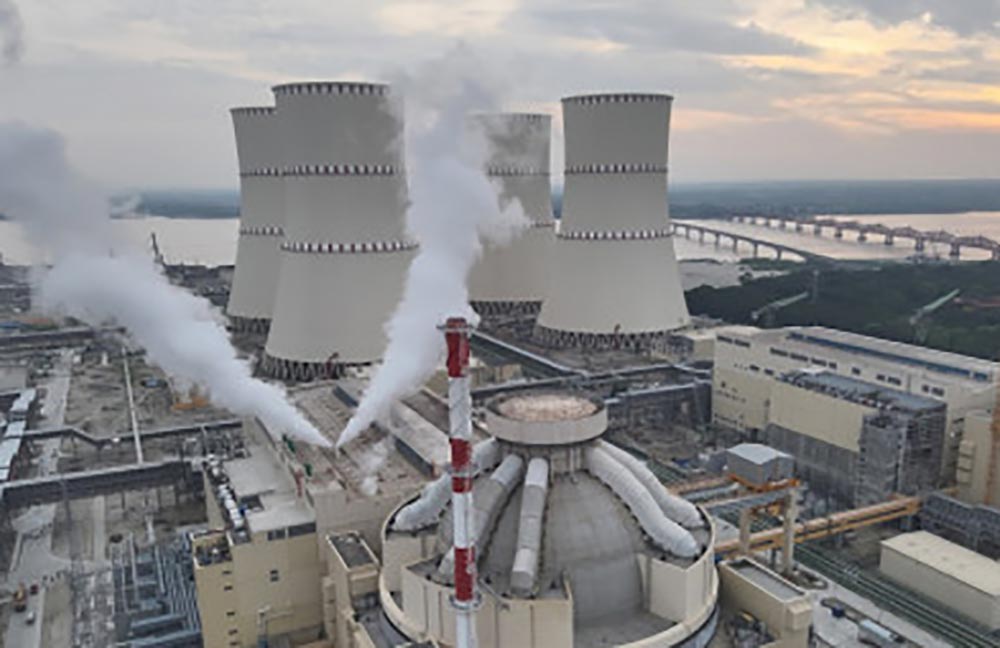 Russian contractor Atomstroyexport, engaged in commissioning the country’s maiden nuclear power plant at Rooppur, has not supplied the mandatory annual Level-2 schedule since December 2022, according to a report by the Implementation Monitoring and Evaluation Division (IMED) under the Ministry of Planning.
The IMED report said technical faults, equipment shortages, inadequate staffing and unfinished supporting infrastructure continued to threaten the plant’s readiness to generate electricity.
“The Rooppur Nuclear Power Plant project has no realistic, integrated timetable for starting commercial power generation,” the report said.
During hot-state testing of Unit 1, a Pressuriser Pilot Operated Relief Valve failed to open at the specified pressure to release excess pressure. The reactor was subsequently returned to a stop-for-repair or cold state so that the defect could be investigated and corrected, the report said.
* A relief valve failed during hot-state testing
* Project completion deadline pushed to June 2028
* Recruitment, training remain incomplete
* Revised cost increased up 22.63pc
A root-cause analysis was conducted and corrective measures taken, but the problem delayed the contractor’s schedule between fuel loading and grid synchronisation, it added.
A team led by IMED Monitoring and Evaluation Sector-7
Director General Md Manzurul Islam and Director Mohammad Ilias Miah inspected the Rooppur Nuclear Power Plant site in Ishwardi, Pabna, on August 13-14. The team submitted its report, which was distributed among several government agencies on September 21.
The first unit has missed several rescheduled deadlines for starting power generation, while the second unit is also unlikely to become operational by its December 2026 target, according to the report.
IMED asked the project director to obtain time-bound plans from Atomstroyexport for manpower deployment, materials procurement and ancillary works and prepare an integrated implementation schedule to expedite power generation.
It also asked the Ministry of Science and Technology to closely monitor implementation while ensuring the quality of the remaining work.
The project had achieved cumulative physical progress of 82.14 percent and financial progress of 77.77 percent as of July 31, according to information provided by the project office.
The high level of physical progress, however, has not translated into readiness for power generation, as Unit 1 encountered technical problems during hot-state testing after completing nuclear fuel loading.
Fuel loading for Unit 1 began in April this year, with all 163 fuel assemblies loaded into the reactor. The 90 tests prescribed under commissioning sub-stage B-1 were also completed.
UNIT 1 PROBLEMS HIT
UNIT 2
IMED officials said technical problems in Unit 1 had also delayed Unit 2, as several components originally allocated to the second reactor were transferred to the first after equipment malfunctioned during testing and commissioning.
Although Atomstroyexport is contractually required to replace the transferred equipment at no additional cost, supply disruptions linked to the Russia-Ukraine war have slowed deliveries, resulting in equipment shortages and delays in installation, testing and pre-commissioning work for Unit 2, the report said.
The two units were originally scheduled to begin operations 12 months apart. However, pre-commissioning of Unit 2 began in October 2025, about 31 months after that of Unit 1.
The report said Atomstroyexport had proposed June 2027 for loading nuclear fuel into Unit 2 and its provisional takeover within that year.
However, the contractor had not submitted the start-up and adjustment programmes for several commissioning stages.
IMED considered the proposed takeover within 2027 impractical, citing the experience of commissioning Unit 1, the progress of Unit 2 and the remaining equipment installation, testing and commissioning work.
The inspection also highlighted a shortage of trained personnel needed to safely operate and maintain the two reactors.
The Preliminary Safety Analysis Report prescribed 2,090 personnel for the operation, maintenance and management of the units, but recruitment remained incomplete.
IMED called for urgent recruitment and training of the remaining personnel, particularly technical workers required for Unit 2.
Bangladesh Atomic Energy Commission began implementing the Rooppur Nuclear Power Plant project in July 2016 at an estimated cost of Tk1,13,093 crore, financed partly by a Russian loan of Tk91,040 crore.
The Executive Committee of the National Economic Council approved the first revision of the project in January this year, raising the total cost to Tk1,38,685 crore, 22.63 percent higher than the initial estimate.
The project deadline was also extended by another two and a half years to June 2028 from the original December 2025 completion date.

Loading...
Loading...
Also read



Editor : Iqbal Sobhan Chowdhury
Published by the Editor on behalf of the Observer Ltd. from Globe Printers, 24/A, New Eskaton Road, Ramna, Dhaka.
Editorial, News and Commercial Offices : Aziz Bhaban (2nd floor), 93, Motijheel C/A, Dhaka-1000.
Phone: PABX- 41053001-06; Advertisement: 41053012; 01793317829, 01550707291, E-mail: [email protected], [email protected] Online: email: [email protected] 41053014; 01550707297 Advertisement: 01550707296
Published by the Editor on behalf of the Observer Ltd. from Globe Printers, 24/A, New Eskaton Road, Ramna, Dhaka.
Editorial, News and Commercial Offices : Aziz Bhaban (2nd floor), 93, Motijheel C/A, Dhaka-1000.
Phone: PABX- 41053001-06; Advertisement: 41053012; 01793317829, 01550707291, E-mail: [email protected], [email protected] Online: email: [email protected] 41053014; 01550707297 Advertisement: 01550707296


