



| HEADLINE |

|
Goods Out, Drugs In [Part-I]
Rakhine war reshapes cross-border smuggling



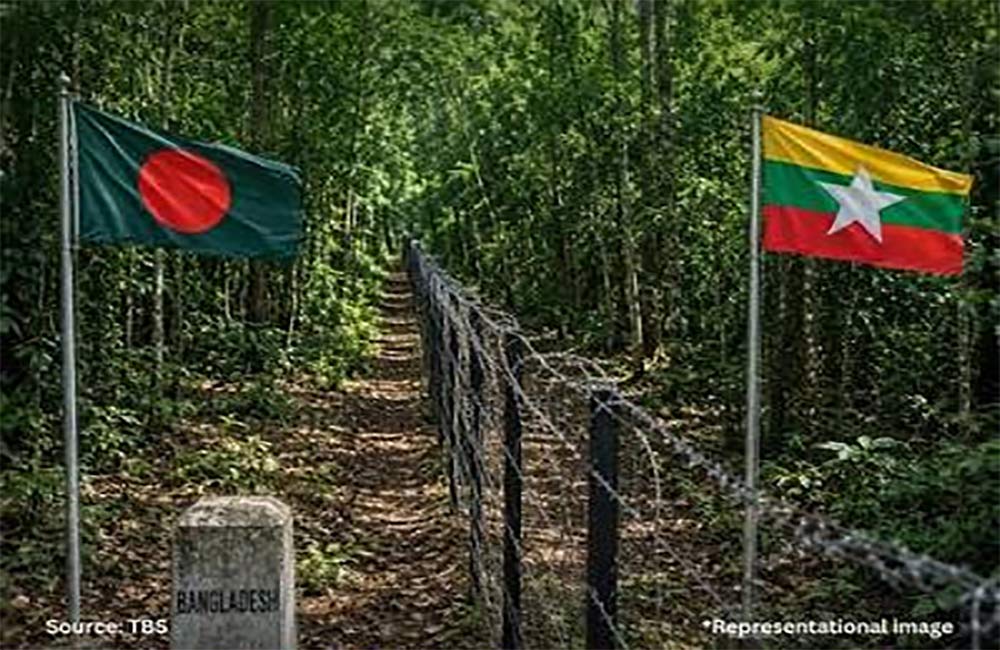 The conflict in Myanmar’s Rakhine State is reshaping the long-running Bangladesh-Myanmar smuggling trade, with criminal networks increasingly sending essential goods into Rakhine and bringing yaba, crystal methamphetamine commonly known as ice, and other narcotics back into Bangladesh.
The illicit trade, once concentrated around the Naf River and the Teknaf border, is increasingly shifting to maritime routes in the Bay of Bengal, with smugglers using fishing boats, cargo vessels and other watercraft to evade law enforcement.
A high official of the Department of Narcotics Control (DNC) told The Daily Observer that cement, rice, fertiliser, medicines, fuel and other essential commodities are being smuggled into Myanmar, while narcotics are brought back.
In some cases, investigators suspect that cash transactions have been replaced by a barter-like system in which drugs effectively serve as payment for goods, creating what can be described as a “narco-currency” in the cross-border illicit economy.
Mazharul Islam, deputy director of the DNC in Chattogram, said shortages caused by the conflict were being exploited by organised smuggling networks.
“The war in Rakhine has created shortages of various essential commodities. International smuggling networks are exploiting the situation through a goods-for-goods exchange system,” he said.
He said the Coast Guard, Border Guard Bangladesh (BGB) and the DNC had seized large quantities of cement, food, household goods and medicines allegedly being transported out of Bangladesh.
According to officials, smugglers subsequently attempt to bring yaba and ice into Bangladesh in exchange for the goods.
The conflict between Myanmar's military and the Arakan Army intensified in November 2023, severely disrupting transportation and supply networks across Rakhine. Fighting and restrictions have affected the movement of goods from central Myanmar into the state, worsening shortages in local markets.
As legitimate supply channels have become increasingly disrupted, supplies from neighbouring countries have become more important.
The disruption has also created an opportunity for criminal networks to profit from sharp price differences on the two sides of the border.
Cement has emerged as one of the most attractive commodities for smugglers because of shortages and high prices in Rakhine.
In February, the Coast Guard seized 1,600 sacks of cement from two vessels near St Martin's Island and detained 18 people. Days later, another operation in the same area resulted in the seizure of 1,140 sacks of cement, along with garlic, chickpeas, potatoes and 7,080 energy drinks. Nineteen people were detained.
On June 4, Coast Guard personnel detained 52 people and seized 1,450 sacks of cement from five fishing boats near St Martin's. During preliminary questioning, the detainees reportedly said the cement was destined for Rakhine.
Two days earlier, another operation in the same area resulted in the seizure of 1,700 sacks of cement and the detention of 20 people. The detainees reportedly told investigators they planned to sell the cement in Rakhine at a higher price.
Officials said a 50kg sack of cement costing around Tk500 in Bangladesh could fetch about 100,000 Myanmar kyats in Rakhine, equivalent to roughly Tk5,800 at the cited exchange rate.
The substantial price gap offers smugglers a strong incentive to risk maritime routes despite the possibility of interception.
On July 29, the Coast Guard intercepted a cargo boat near Ganguria Char, adjacent to Bhasan Char in Noakhali, and seized 24,000kg of urea fertiliser, 3,700kg of chickpeas and 6,850kg of gram. The goods were allegedly destined for Sittwe in Rakhine.
BGB officials said increased surveillance along the Ukhia-Teknaf border had prompted smugglers to seek alternative maritime routes.
Maheshkhali, Banshkhali, Kutubdia, Anwara and Kuakata have emerged as coastal routes of concern, according to BGB information.
Lt Commander Sabbir Alam Sujon, an official of the Coast Guard headquarters' media wing, said the force had seized large quantities of Bangladeshi goods during anti-smuggling operations.
"After these goods are taken to Myanmar, smugglers attempt to bring narcotics back in exchange," he said, adding that large quantities of yaba and ice had also been seized during such operations.
Instead of a largely one-way flow of narcotics from Myanmar into Bangladesh, the trade is increasingly becoming a two-way illicit supply chain - with essential goods moving out and drugs coming back in.
As the Rakhine conflict continues to disrupt legitimate trade and deepen shortages, criminal networks are exploiting the widening economic gap, expanding their routes and turning the region's instability into a lucrative cross-border narcotics and commodity trade.
Loading...
Loading...
Also read



Editor : Iqbal Sobhan Chowdhury
Published by the Editor on behalf of the Observer Ltd. from Globe Printers, 24/A, New Eskaton Road, Ramna, Dhaka.
Editorial, News and Commercial Offices : Aziz Bhaban (2nd floor), 93, Motijheel C/A, Dhaka-1000.
Phone: PABX- 41053001-06; Advertisement: 41053012; 01793317829, 01550707291, E-mail: [email protected], [email protected] Online: email: [email protected] 41053014; 01550707297 Advertisement: 01550707296
Published by the Editor on behalf of the Observer Ltd. from Globe Printers, 24/A, New Eskaton Road, Ramna, Dhaka.
Editorial, News and Commercial Offices : Aziz Bhaban (2nd floor), 93, Motijheel C/A, Dhaka-1000.
Phone: PABX- 41053001-06; Advertisement: 41053012; 01793317829, 01550707291, E-mail: [email protected], [email protected] Online: email: [email protected] 41053014; 01550707297 Advertisement: 01550707296


