



| HEADLINE |

|

Boats: Only lifeline for people in 25 Rajarhat chars
Students, patients and residents face daily hardship as river travel remains their only means of communication
Published : Tuesday, 6 October, 2026 at 12:00 AM
Our Correspondent


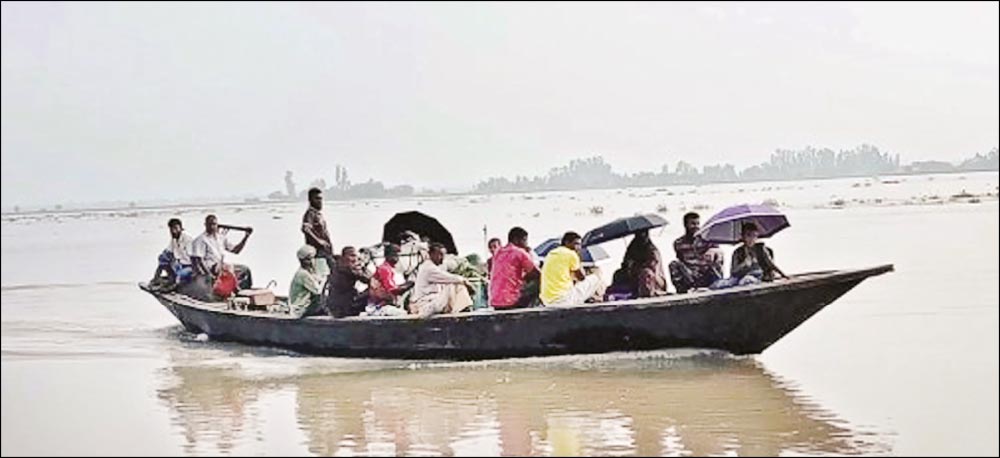 RAJARHAT, KURIGRAM, Oct 5: For people living in around 25 chars in Rajarhat Upazila, boats are their only means of communication. Whether for education, medical treatment or buying daily necessities, they have to travel nearly eight kilometres by river.
Surrounded by water, sand and vast croplands, the char areas become cut off from the mainland during the monsoon. When the water level and current of the Teesta rise, travelling by boat becomes even more risky and uncertain.
On days when no boat is available, students have to miss school, while families of emergency patients are left anxious.
Residents of Char Bidyananda, Char Tayebkha, Char Haybatkha, Char Paramoula, Char Chatura, Char Hansadhar and Char Ramhari under Bidyananda Union, and Char Khitabkha, Char Gotiyasham, Char Bogura Para, Char Nakhenda, Shaolar Char, Char Namabhart, Majher Char, Char Bardarga, Char Burirhat, Char Barua Para and Char Jummar Para under Ghariyaldanga Union are among those facing the problem.
Although there are two primary schools in the char areas, students have to travel long distances to attend secondary schools. From Majher Char, it takes around two hours to reach a secondary school, including an eight-kilometre boat journey. Crossing the river alone takes about an hour.
The situation becomes more difficult during the monsoon when the water level and current rise, causing severe hardship for hundreds of people who need to travel every day.
Local resident Anwar Hossain said students from the char areas attend several educational institutions on the other side of the river, including Char Dushmara Government Primary School, Bogura Para Government School, Khitabkha Government Primary School, Burirhat Abdus Samad Mondal Dakhil Madrasa, Sarkarbari Secondary School and Sarishabari Alim Madrasa.
“Because these institutions are across the river and communication is so poor, many students cannot attend classes regularly,” he said.
Students often have to wait for long periods due to a shortage of boats, strong currents and problems at landing points, particularly during the monsoon. This affects their studies.
Sumaiya, a student from Char Gotiyasham, said she leaves home around 8:30am but sometimes cannot get a boat until 9 or 10am.
“After crossing the river, it takes until around 11:30am or noon to reach school. It would make things much easier if a high school were built here. The river also needs to be dredged to protect our homes from erosion,” she said.
Mst Arjina Khatun, a ninth-grader, said travelling to school was a daily struggle.
“Sometimes there is no boat, and then we cannot attend school that day. Because there are not enough educational facilities in the chars, many parents marry off their daughters at an early age. We have dreams, but it becomes difficult to fulfil them,” she said.
Healthcare is another major concern. There are no hospitals or doctors nearby, forcing residents to travel several kilometres by river to reach healthcare facilities on the mainland. Taking emergency patients for treatment becomes particularly difficult when the river current is strong.
Abu Taher, a resident of Majher Char, said they had to travel nearly eight kilometres by river to reach the nearest market.
“Daily necessities are not readily available here. So we have to buy several days' supplies at a time. We cannot get everything we need nearby,” he said.
Shahidul Islam, a former union parishad member from Char Gotiyasham, said residents often needed assistance, particularly during floods.
“During floods, people are provided with relief, clothes, safe drinking water, tubewells and sacrificial meat, among other assistance,” he said.
Residents demanded permanent communication links, safe boat services, a boat ambulance, two secondary schools and healthcare facilities.
Rajarhat Upazila Nirbahi Officer Ms Tanzila Tasnim said the administration was working to improve living conditions in the char areas.
“We are working with the deputy commissioner and taking officials from different departments to the chars to assess how the living conditions can be improved. We will identify their problems and consult higher authorities on possible solutions,” she said.

Loading...
Loading...
Also read



Editor : Iqbal Sobhan Chowdhury
Published by the Editor on behalf of the Observer Ltd. from Globe Printers, 24/A, New Eskaton Road, Ramna, Dhaka.
Editorial, News and Commercial Offices : Aziz Bhaban (2nd floor), 93, Motijheel C/A, Dhaka-1000.
Phone: PABX- 41053001-06; Advertisement: 41053012; 01793317829, 01550707291, E-mail: [email protected], [email protected] Online: email: [email protected] 41053014; 01550707297 Advertisement: 01550707296
Published by the Editor on behalf of the Observer Ltd. from Globe Printers, 24/A, New Eskaton Road, Ramna, Dhaka.
Editorial, News and Commercial Offices : Aziz Bhaban (2nd floor), 93, Motijheel C/A, Dhaka-1000.
Phone: PABX- 41053001-06; Advertisement: 41053012; 01793317829, 01550707291, E-mail: [email protected], [email protected] Online: email: [email protected] 41053014; 01550707297 Advertisement: 01550707296


