



| HEADLINE |

|

Dumuria fishermen turning loans into livelihoods
Small loans, regular savings and new businesses helping 85 members build secure life
Published : Wednesday, 7 October, 2026 at 12:00 AM
Our Correspondent


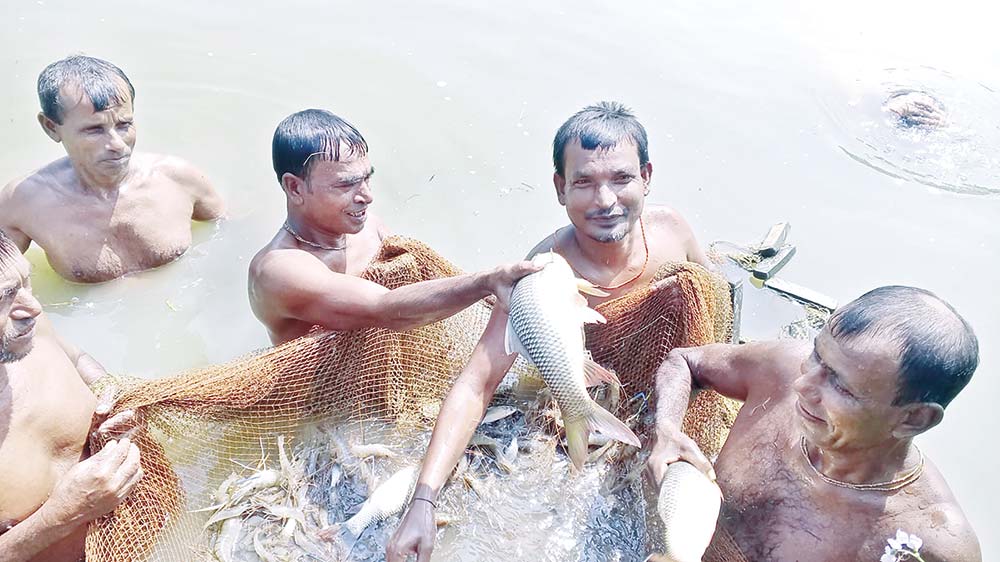 DUMURIA, KHULNA, Oct 6: Members of the Gonali Adarsha Fishermen Village Association in Dumuria Upazila have been gradually improving their financial condition by using loans for income-generating activities and maintaining regular savings and instalment payments.
Once struggling with financial insecurity and uncertain incomes, many members now run fish farms, make fishing nets, rear cattle and poultry, operate small businesses, sell fish or drive vans and easy-bikes.
The association currently has 85 members, many of whom are involved in different income-generating activities using loans. Of them, 20 have taken loans for fish farming, 20 for cattle rearing, five for fish trading, six for small businesses, three for grocery shops, 18 for vans and easy-bikes, seven for net making and seven for duck and poultry farming.
Around 25-30 fishermen from the association still go fishing in the sea and the Sundarbans. Others have gradually shifted to alternative livelihoods with support from loans.
According to officials concerned, the association is among the top-performing groups out of around 450 fishermen village associations across the country. Proper use of loans, regular monitoring and timely repayment have contributed to its performance.
Prashanta Sarker, a member of the association, previously went to sea after taking loans from informal lenders. He now earns through fish farming and cattle rearing and occasionally drives a van.
Chitta Sarker, another member, makes fishing nets, rents them out and uses them at fish enclosures. Biswajit Sarker now drives a van and works at fish enclosures instead of going to sea.
Swapna Biswas took a loan of Tk 80,000 to make fishing nets, while Akram Sardar borrowed Tk 40,000 for fish farming. Several other members have also taken loans for cattle rearing, poultry farming and buying easy-bikes.
Kakoli Biswas, Coordinator of the Dumuria Upazila Fisheries Federation, said the association was performing very well and was among the top five of the around 450 village associations.
“Members use loans for the purposes for which they take them. The committees also perform their responsibilities properly,” she said.
She said regular monitoring and guidance from the upazila fisheries office had helped members repay instalments on time and maintain a 100 percent savings rate.
Anjana Sarker, currently representing the association's president Prashanta Sarker, said none of the 85 members had overdue loans.
She herself has a 50-decimal fish enclosure and has taken loans twice�"Tk 40,000 the first time and Tk 50,000 the second. She used the money for fish farming, creating employment for herself and contributing to her family's income.
“Our fisheries officer regularly checks on us and monitors our activities. He asks whether monthly and quarterly meetings are being held regularly and checks deposit slips and collection sheets when we visit the office,” she said.
Palash Kumar Sen, a field assistant at the Dumuria fisheries office, said members were using loans for the intended purposes and regularly depositing instalments and savings.
“Loan use and members' activities are regularly monitored in the field. If any problem arises, we provide necessary advice,” he said.
Kamala Biswas, President of the Upazila Fisheries Federation, said loan applicants' needs and capacity were assessed before loans were disbursed and their use was monitored afterwards.
“Disbursing loans alone is not enough. Their use in productive activities, regular instalment payments and savings habits must also be monitored,” she said.
Senior Upazila Fisheries Officer Sohel Md Zillur Rahman Regan said regular monitoring was being conducted to help fishermen become self-reliant.
“We are focusing on ensuring that loans are used for the intended purposes and that instalments and savings are deposited regularly. We also assess applicants' needs and capacity before providing loans and give necessary advice on recovering overdue payments,” he said.
The experience of the Gonali Adarsha Fishermen Village Association shows how proper loan management, savings, accountability and regular supervision can help fishing families diversify their livelihoods and strengthen their financial capacity.

Loading...
Loading...
Also read



Editor : Iqbal Sobhan Chowdhury
Published by the Editor on behalf of the Observer Ltd. from Globe Printers, 24/A, New Eskaton Road, Ramna, Dhaka.
Editorial, News and Commercial Offices : Aziz Bhaban (2nd floor), 93, Motijheel C/A, Dhaka-1000.
Phone: PABX- 41053001-06; Advertisement: 41053012; 01793317829, 01550707291, 01550707296
E-mail: [email protected], [email protected]. [email protected], [email protected], [email protected], [email protected], Online-email: [email protected]


