



| HEADLINE |

|

Grassland shrinkage threatens existence of tricolour munia birds
Published : Friday, 9 October, 2026 at 12:00 AM
MR Alam


 MEHERPUR, Oct 8: About two kilometres from Meherpur town along the Kushtia highway, the vast catkin grassland has become a popular gathering place for people and birds. But the grassland is slowly shrinking as urban development encroaches on the area.
With the arrival of autumn, Bangladesh’s landscape takes on a new look. Cotton-like clouds drift across the blue sky, while birds move among the catkin flowers. In the afternoon, visitors gather to photograph the white blooms, creating a scene where people and birds share the same habitat.
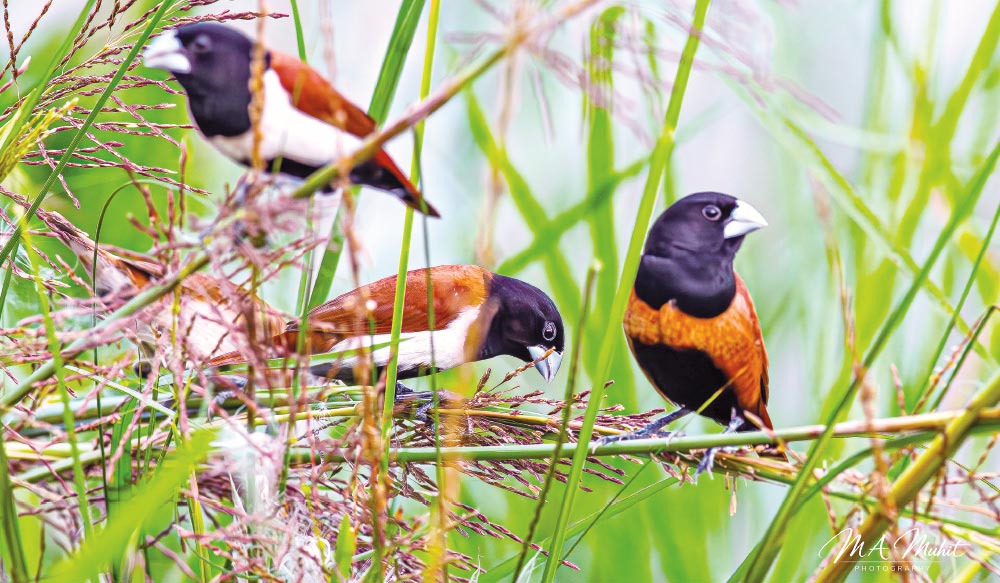
This year, four species of munia and one species of babui have been spotted in the catkin grassland. Among them is the tricoloured munia, a resident bird that was once known as the black-headed munia. The birds are now classified as two separate species: the tricoloured munia and the black-headed munia.
The tricolored munia, whose scientific name is Lonchura malacca, is a small bird in the Estrildidae family. Its name comes from its combination of white, black and brown plumage.
The species can be found in different parts of Bangladesh and often gathers in groups in grasslands during autumn. The birds are frequently seen with black-breasted babui and other munias, reflecting their social nature.
MA Muhith, President of the Meherpur Bird Club, said he noticed an increase in the number of tricoloured munias this year while photographing birds near the Meherpur Technical Training Centre. But he expressed concern about the shrinking grasslands.
“Munia birds generally prefer grassy areas. If grasslands decrease, the birds that depend on them will be threatened,” Muhith said, adding “The birds primarily feed on weed seeds and insects, helping maintain the ecological balance of farmland.
Enamul Azim, an environmentalist and retired college teacher who advises the Meherpur Bird Club, said munias help spread grass seeds while feeding and control harmful insects in agricultural fields. “Farmers need to become more aware of protecting grasslands,” he said.
Masud Reza, an adviser to the bird club and a geography teacher at Pouro College, said some people capture munias and keep them in cages as pets.
The birds are also sold in some bird shops. “People from all walks of life need to be aware of protecting these birds and preserving nature,” he said.
Moinul Alam, Executive Director of Subah, a local environmental organisation, said the Meherpur Bird Club is working to protect birds and nature through observation, research and awareness programmes among villagers.

Loading...
Loading...
Also read



Editor : Iqbal Sobhan Chowdhury
Published by the Editor on behalf of the Observer Ltd. from Globe Printers, 24/A, New Eskaton Road, Ramna, Dhaka.
Editorial, News and Commercial Offices : Aziz Bhaban (2nd floor), 93, Motijheel C/A, Dhaka-1000.
Phone: PABX- 41053001-06; Advertisement: 41053012; 01793317829, 01550707291, 01550707296
E-mail: [email protected], [email protected]. [email protected], [email protected], [email protected], [email protected], Online-email: [email protected]


