



| HEADLINE |

|

IMF cuts BD growth forecast to 3.2pc, projects inflation at 10.9pc
Published : Wednesday, 14 October, 2026 at 12:00 AM
Mizanur Rahman from Bangkok


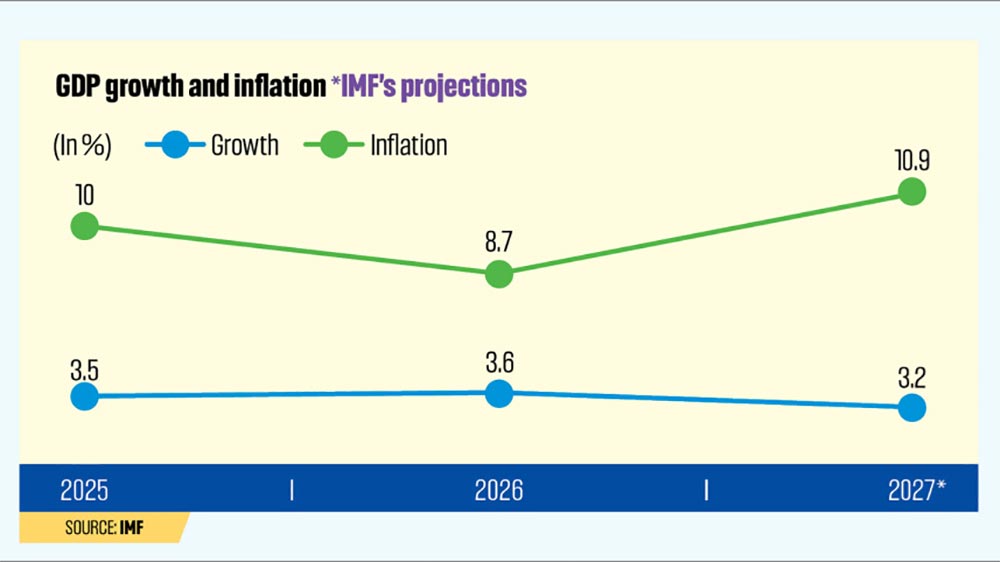 The World Economic Outlook (WEO), released on Tuesday, shows the IMF cut Bangladesh’s growth forecast by 1.1 percentage points from its previous projection of 4.3 per cent. The Asian Development Bank (ADB) has projected 4 per cent growth, while the World Bank forecast 3.4 per cent for the country.
The IMF also warned that inflation could rise to 10.9 per cent in the current fiscal year, suggesting that households, particularly low-income groups, may continue to face pressure from high living costs.
Bangladesh has set a GDP growth target of 6.5 per cent for the fiscal year 2026-27, substantially higher than the IMF’s latest projection.
Meanwhile, Finance Minister Amir Khasru Mahmud Chowdhury has sought stronger support from the International Monetary Fund (IMF) and the World Bank to address Bangladesh’s economic challenges, saying the government is working to achieve its growth targets while pursuing reforms in line with the country’s economic realities.
The minister held meetings with IMF officials, including Urjit Patel, and World Bank Managing Director Anna Bjerde on the sidelines of the World Bank-IMF Annual Meeting in Bangkok on Tuesday, as the IMF lowered Bangladesh’s growth forecast for the current fiscal year to 3.2 per cent and projected average inflation at 10.9 per cent.
The meetings focused on development assistance, economic reforms, financing needs and cooperation with international development partners. Bangladesh is also seeking additional World Bank assistance and discussing a proposed $4.5 billion loan programme with the IMF. However, the financing proposals and the terms of any new programme have yet to be finalised.
Responding to questions about the differing forecasts, the finance minister said the government did not want to engage in disputes over estimates produced by international institutions. Each organisation SEE
prepared its projections based on its own analysis, he said, adding that the government remained focused on achieving its budget targets.
The World Bank has also been discussing additional financing of around $10 billion over the next two to three years, alongside the preparation of a three-year Country Partnership Framework. The proposed assistance could help Bangladesh address economic pressures, including higher energy costs and the burden of subsidies amid the conflict in the Middle East. The proposal remains under discussion, with further talks expected in Dhaka.
On the IMF front, discussions are continuing over a proposed $4.5 billion loan programme, including the pace of reforms and the conditions attached to financing. Revenue mobilisation, banking sector reform, rationalisation of energy and agricultural subsidies, and inflation control are among the policy areas likely to receive attention. Bangladesh wants reforms to be implemented gradually, taking account of domestic priorities and economic conditions.
An IMF mission may visit Bangladesh within the next month for further discussions, according to a source at the finance ministry.
The latest WEO painted a mixed picture of the global economy. The IMF projected global growth at 3.1 per cent in 2026 and 3.4 per cent in 2027, while global inflation could reach 4.7 per cent in 2026 before easing to 4.1 per cent in 2027.
The report said the global economy had demonstrated resilience, but maintaining that resilience was becoming increasingly costly. The Middle East conflict has pushed up energy and food prices, weighing on economic activity, while investment in artificial intelligence (AI) has helped offset some of the negative effects.
The IMF warned that risks to the global outlook remained tilted to the downside, including the possibility of an escalation in the Middle East conflict and a reassessment of expectations surrounding AI. On the upside, sustained AI investment, faster productivity growth, improved trade arrangements and greater investment in energy security could strengthen the outlook.
The Fund identified restoring public finances, strengthening energy security, improving preparedness for AI adoption and keeping trade and international cooperation channels open as key policy priorities.
Separately, the IMF’s October 2026 Global Financial Stability Report warned that apparently stable financial markets were accumulating vulnerabilities. Risks include disappointing returns on AI investments, renewed inflation, concerns over government debt and rising cyber threats.
A sharp fall in AI-related asset valuations could spread beyond the technology sector, particularly where investment is concentrated and heavily debt-financed. Rising inflation or fiscal concerns could push up government bond yields, increase borrowing costs and put pressure on businesses, governments and financial institutions.
The report also highlighted liquidity mismatches at insurance companies and pension funds, vulnerabilities at some banks, leverage in private credit markets and risks associated with hedge funds. Cyberattacks could disrupt interconnected financial systems, while tokenised assets may introduce additional leverage, liquidity and technological risks. The IMF called for greater transparency, stronger risk management and improved financial resilience.
The World Bank-IMF Annual Meetings began on October 12 and will continue through October 18. Bangladesh’s delegation is seeking international assistance to stabilise the economy, strengthen the financial sector and sustain investment while pursuing reforms tailored to the country’s development priorities.

Loading...
Loading...
Also read



Editor : Iqbal Sobhan Chowdhury
Published by the Editor on behalf of the Observer Ltd. from Globe Printers, 24/A, New Eskaton Road, Ramna, Dhaka.
Editorial, News and Commercial Offices : Aziz Bhaban (2nd floor), 93, Motijheel C/A, Dhaka-1000.
Phone: PABX- 41053001-06; Advertisement: 41053012; 01793317829, 01550707291, E-mail: [email protected], [email protected] Online: email: [email protected] 41053014; 01550707297 Advertisement: 01550707296
Published by the Editor on behalf of the Observer Ltd. from Globe Printers, 24/A, New Eskaton Road, Ramna, Dhaka.
Editorial, News and Commercial Offices : Aziz Bhaban (2nd floor), 93, Motijheel C/A, Dhaka-1000.
Phone: PABX- 41053001-06; Advertisement: 41053012; 01793317829, 01550707291, E-mail: [email protected], [email protected] Online: email: [email protected] 41053014; 01550707297 Advertisement: 01550707296


