



| HEADLINE |

|

Pottery wheel keeps turning at Palpara
Around 20 families cling to the traditional craft amid falling demand
Published : Saturday, 17 October, 2026 at 12:00 AM
Our Correspondent


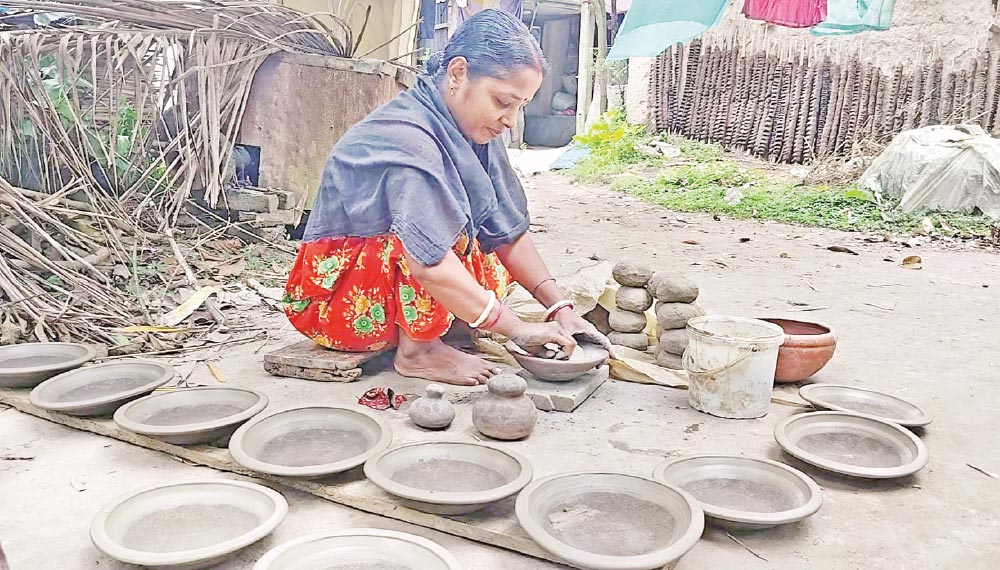 BAGMARA, RAJSHAHI, Oct 16: The coming winter will mark 70 years of Monoranjan Chandra Pal. Age has left visible marks on his face and weakened his body, but it has failed to stop his work.
Every day, the needs of his family and his deep attachment to clay bring him back to the spinning pottery wheel. Day and night, he shapes clay into pots, cooking vessels, pitchers, lids, lamps and other household items.
Under his skilled hands, ordinary clay takes on a new life, turning into one piece of pottery after another as the wheel spins.
Monoranjan quietly works from a corner of the last earthen house in Birkuche Palpara, a Village at the easternmost end of Bagmara Upazila in Rajshahi.
Around 20 families in the neighbourhood are still keeping the traditional craft alive, carrying it on from one generation to the next.
Once, almost everyone in the neighbourhood was involved in pottery. But the picture has changed significantly with time. The widespread use of plastic, aluminium and steel products has steadily reduced demand for earthenware.
As a result, many families facing financial hardship have abandoned their ancestral profession and moved into other occupations. Yet some families continue to preserve the tradition despite numerous challenges.
Swapna Rani Pal came to her husband's family three years ago. In that short time, she learned from her mother-in-law how to make different household items from clay.
Like other members of the family, she now regularly works in pottery, shaping clay into various forms to make both everyday and decorative items.
“My husband and I both do this work. This is how we run our family. It is difficult, but we have no other option,” she said.
Sunil Chandra Pal started working with clay when he was 10. Now 50, he says he has been unable to leave the profession because he does not know any other trade.
He complained that he had received neither training nor financial assistance to continue the craft. He believes government support is needed to preserve the traditional industry.
Age has also made the work increasingly difficult for him. The clay no longer responds to his hands as easily as it once did, so he now prepares the clay for his wife, Anna Rani Pal, who makes more than 100 pots a day on average.
Anna said she had been working with clay since childhood. She used to make pottery at her father's home before marriage and continued the same work after moving to her husband's family.
Years of working with clay have created a deep bond between her and the craft.
Bagmara Upazila Social Services Officer Matinur Rahman said pottery artisans are being brought under training programmes aimed at improving the livelihoods of marginalised communities.

Loading...
Loading...
Also read



Editor : Iqbal Sobhan Chowdhury
Published by the Editor on behalf of the Observer Ltd. from Globe Printers, 24/A, New Eskaton Road, Ramna, Dhaka.
Editorial, News and Commercial Offices : Aziz Bhaban (2nd floor), 93, Motijheel C/A, Dhaka-1000.
Phone: PABX- 41053001-06; Advertisement: 41053012; 01793317829, 01550707291, 01550707296
E-mail: [email protected], [email protected]. [email protected], [email protected], [email protected], [email protected], Online-email: [email protected]


