



| HEADLINE |

|

A Unified Framework for Restoring Macroeconomic and Financial Resilience in Bangladesh
Published : Saturday, 17 October, 2026 at 12:00 AM
Md Kamrul Bari FIPA FFA; Dr Mohammad Rashedul Hoque; Dr Saad Hasan


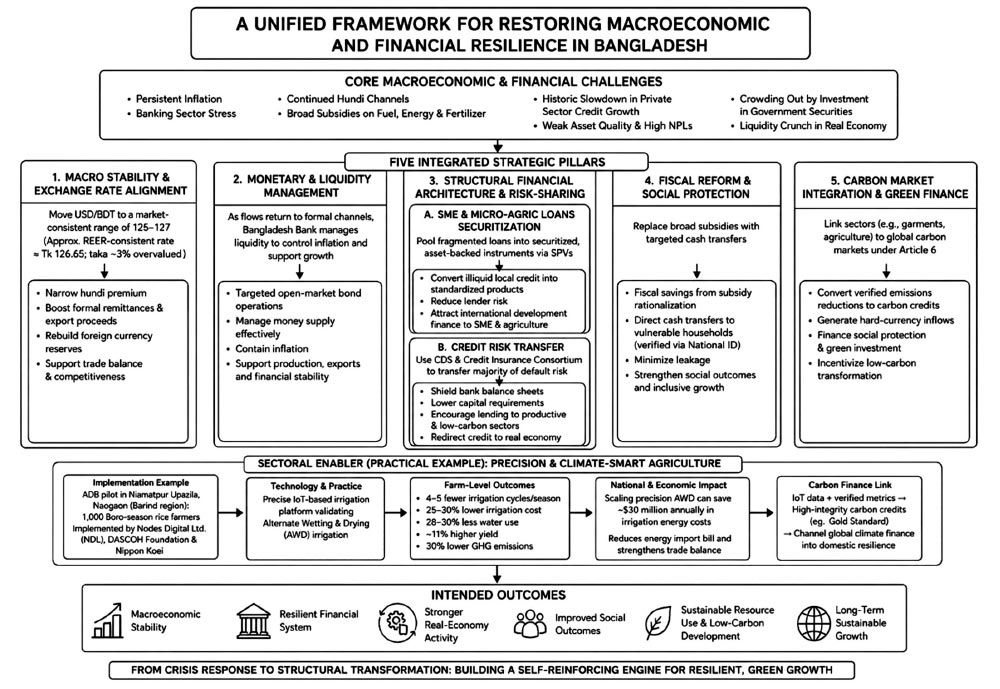 Bangladesh is at a pivotal macroeconomic juncture. Persistent inflation, banking sector stress, the continued draw of informal hundi channels, broad subsidies on fuel, energy and fertiliser, and a historic slowdown in private sector credit growth form the core challenges of the moment. Weakening asset quality, mounting non-performing loans, and increasingly cautious lending have choked capital flow. Commercial banks are consequently retreating into low-risk government securities and lending, crowding out real-economy investment and leaving both small enterprises and large industrial projects starved of liquidity.
To offer relevant solutions to these concerns, we are offering an integrated multidimensional macroeconomic framework in this write-up, which is organised hierarchically as follows:
Our proposed framework examines these issues through five integrated strategic pillars, using precision and climate-smart agriculture as practical examples of production-level application. It combines multidimensional interventions to promote macroeconomic stability, financial resilience, real-economy activity, improved social outcomes, sustainable resource use and long-term growth.
However, the model does not encompass all socioeconomic and innovation-economy dimensions, such as Schumpeterian creative destruction. It should therefore be viewed as a broad macroeconomic tool for understanding the bigger picture, with future researchers and thought leaders encouraged expanding it towards a more comprehensive framework covering all relevant economic dimensions.
Let us at first look at the first pillar of the framework, i.e. the exchange rate realignment. Since “Taka” is now overvalued, a central task of the time is to move the USD-to-BDT exchange rate towards a more consistent range of approximately 125�"127. Bangladesh’s REER rose to a seven-month high of 103.93 in July 2026, implying that the BDT remained approximately 4 per cent overvalued; the REER-consistent USD/BDT rate was estimated at around Tk127.84 versus the prevailing weighted average rate (WAR) of around Tk123.03. The overvaluation suppresses formal remittance flows and discourages export earnings arriving in the country through formal channels, feeding directly into the informal market. Aligning the exchange rate to the 125�"127 range, therefore, intends to narrow the hundi premium and pull remittances and export proceeds back to formal banking channels, helping rebuild foreign currency reserves.
Exchange-rate realignment is closely linked to monetary and liquidity management, leading to the framework’s second pillar. As remittances and export proceeds return to formal banking channels, Bangladesh Bank can strengthen foreign currency reserves while controlling inflation through targeted open-market bond operations to absorb excess liquidity. At the same time, it must support production and export recovery and safeguard financial stability by directing funds towards productive sectors through appropriate policy interventions.
The framework’s third pillar proposes using structured financial instruments to unlock commercial credit and reverse the credit freeze. By pooling SME and micro-agricultural loans into Special Purpose Vehicles (SPVs), banks can transform illiquid loans into standardised, tradable, asset-backed securities. Securitisation involves pooling similar loans from one or more banks and issuing bonds to investors, who receive periodic returns from borrowers’ repayments. This provides banks with immediate liquidity before loans mature and can reduce credit and balance-sheet risks.
It also creates a channel for international development finance institutions (DFIs) to support small businesses and farmers without the prohibitive costs of lending individually to thousands of borrowers. For instance, an SPV could pool thousands of loans and issue US$50�"100 million in bonds. DFIs could purchase the riskiest tranches to absorb initial losses, guarantee bonds to improve their credit ratings, or provide foreign-currency co-financing and local-currency guarantees. These interventions could make senior bonds more attractive to commercial banks, pension funds and foreign institutional investors, expanding access to finance for SMEs and agriculture.
For high-value corporate and agricultural loans, Credit Default Swaps (CDS) and a Credit Insurance Consortium can be used to transfer a majority of the structural default risk to international reinsurers. This layered risk-sharing approach shields domestic bank balance sheets from systemic non-performing-loan shocks, lowers capital requirements, and encourages banks to lend more freely. The resulting risk relief is intended to channel commercial lending toward sustainable, low-carbon economic activity.
In the next pillar, our framework proposes replacing broad subsidies with direct cash transfers to the vulnerable households. The resulting fiscal savings can be redirected toward targeted social protection, with transfers verified in real time through National ID systems to minimise leakage. In this way, fiscal reform is connected directly to protection of vulnerable households and improved social outcomes. The question is how to arrange funds for such an activity? The answer is laid out in the last pillar.
The framework’s final pillar links manufacturing sectors, including garments and agriculture, to global carbon markets under Article 6 of the Paris Agreement. Verified emissions reductions can generate carbon credits and foreign-currency inflows to support social protection, green investment and financial resilience. Precision agriculture illustrates this approach. In drought-prone Niamatpur Upazila of Naogaon, an Asian Development Bank pilot involving 1,000 Boro rice farmers was implemented by Nodes Digital Limited (NDL), DASCOH Foundation and Nippon Koei to validate Alternate Wetting and Drying (AWD) irrigation.
Farmers reported four to five fewer irrigation cycles per season, lower input and pumping costs, stronger root growth and approximately 11 per cent higher yields. AWD can reduce irrigation costs by 25�"30 per cent and water use by 28�"30 per cent, while NDL’s precision-irrigation platform has reported 30 per cent lower greenhouse-gas emissions. Researchers estimate that nationwide adoption could save around US$30 million annually in irrigation energy costs. By combining IoT data with verified environmental outcomes, precision agriculture can generate high-integrity carbon credits through mechanisms such as Gold Standard, attract climate finance and reduce energy imports, strengthening the trade balance and fiscal resilience.
Taken together, the framework is designed to move from immediate crisis response toward lasting structural transformation. Exchange-rate realignment supports formal remittance and export flows and reserve rebuilding; liquidity management helps contain inflation; structured risk-sharing unlocks commercial credit; targeted transfers improve social protection; and carbon-market integration creates hard-currency inflows from verified environmental outcomes. Combined with precision agriculture and green export initiatives, these mechanisms are intended to reverse credit stagnation while building a self-reinforcing engine for resilient, green growth.
Md Kamrul Bari FIPA FFA is the CFO and Director of Projects, Dr Mohammad Rashedul Hoque is the Managing Director, and Dr Saad Hasan is the Chairman and CEO of Nodes Digital Limited

Loading...
Loading...
Also read



Editor : Iqbal Sobhan Chowdhury
Published by the Editor on behalf of the Observer Ltd. from Globe Printers, 24/A, New Eskaton Road, Ramna, Dhaka.
Editorial, News and Commercial Offices : Aziz Bhaban (2nd floor), 93, Motijheel C/A, Dhaka-1000.
Phone: PABX- 41053001-06; Advertisement: 41053012; 01793317829, 01550707291, E-mail: [email protected], [email protected] Online: email: [email protected] 41053014; 01550707297 Advertisement: 01550707296


