



| HEADLINE |

|

Bangladesh Expects October Verdict on Three-Year LDC Delay
Published : Tuesday, 20 October, 2026 at 12:00 AM
Business Correspondent


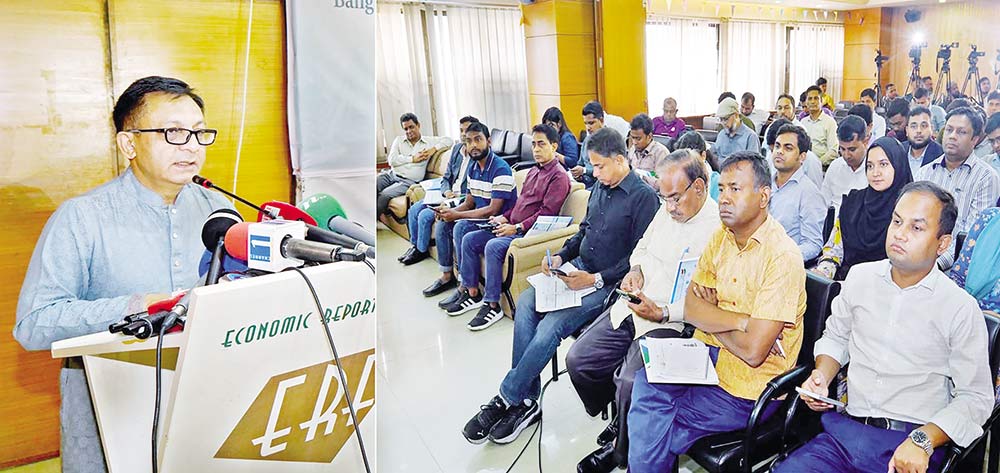 Bangladesh expects a decision within October on its request for a three-year delay in graduating from the least developed country (LDC) category, with just weeks left before the November 24 deadline to avert a potentially costly loss of trade preferences and buy time for an economy the commerce minister admits is inadequately prepared for the transition.
Commerce Minister Khandaker Abdul Muktadir said on Monday that the European Union (EU) and other relevant stakeholders had agreed to give Bangladesh more time, expressing optimism that a decision would come next week or the week after.
“I am very optimistic that we will see a resolution of the matter next week or the week after,” he said at a seminar on “Challenges and Way Forward for Bangladesh’s LDC Graduation”, organised jointly by the Economic Reporters Forum (ERF) and the Bangladesh Foreign Trade Institute (BFTI).
The minister acknowledged that graduation had been politically glorified without sufficient attention to its economic and financial challenges, leaving Bangladesh ill-prepared to manage the risks.
Bangladesh began its graduation process in 2018 and was originally due to leave the LDC category in 2024. A two-year extension following the Covid-19 pandemic pushed the deadline to November 24, 2026.
The BNP-led government, which took office on February 17, sought a further three-year postponement from the United Nations. Prime Minister Tarique Rahman also sought the UN secretary-general’s personal support in a letter sent on April 6.
Bangladesh has passed the stage of the UN Committee for Development Policy (CDP) and submitted its request to the UN Economic and Social Council (ECOSOC). Although the finance ministry announced on June 2 that the CDP had responded positively, a final decision remains pending.
The stakes are high for exporters, particularly garment manufacturers, who benefit from duty-free and quota-free access to major markets under LDC preferences. Losing those advantages could raise costs and weaken Bangladesh’s export competitiveness.
Muktadir said the government had submitted a time-bound action plan to the EU detailing how it would use the additional period if the deferral were granted.
Dhaka also aims to conclude a free trade agreement (FTA) with the EU before graduation. A chief negotiator has been appointed, and preparations for the first round of technical talks are under way, although no date has been fixed.
The government will pursue the EU’s Generalised Scheme of Preferences Plus (GSP+) facility in parallel as an alternative to preserve preferential access. “I hope we will not have to take the GSP+ option, as we will complete the FTA before that,” the minister said.
Bangladesh aims to conclude comprehensive economic partnership agreements or FTAs with eight to 10 countries in 2026 and 2027. It is also pursuing membership of the Regional Comprehensive Economic Partnership, a major Asia-Pacific trade bloc, after securing in-principle policy approval, he added.
However, Muktadir stressed that trade deals alone would not secure investment without reliable energy supplies, simpler business procedures and transparent mechanisms for resolving commercial disputes.
Entrepreneurs can spend an average of 355 days completing the procedures to start a business, from obtaining a trade licence and opening a bank account to securing clearances, registering to import and arranging a letter of credit for machinery, he said.
The government plans to introduce a single online portal for trade licences, bring the services of the Registrar of Joint Stock Companies and Firms fully online, extend licence validity to three to five years and replace separate inspections by multiple agencies with coordinated checks. Muktadir hopes the reforms will reduce licensing delays by 2027.
ERF President Daulat Akhtar Mala chaired the seminar. BFTI Chief Executive Officer Dr Mostafa Abid Khan presented the keynote paper, while ERF Executive Committee member SSM Moinul Haque moderated the discussion.

Loading...
Loading...
Also read



Editor : Iqbal Sobhan Chowdhury
Published by the Editor on behalf of the Observer Ltd. from Globe Printers, 24/A, New Eskaton Road, Ramna, Dhaka.
Editorial, News and Commercial Offices : Aziz Bhaban (2nd floor), 93, Motijheel C/A, Dhaka-1000.
Phone: PABX- 41053001-06; Advertisement: 41053012; 01793317829, 01550707291, E-mail: [email protected], [email protected] Online: email: [email protected] 41053014; 01550707297 Advertisement: 01550707296


