



| HEADLINE |

|

Where Is Bangladesh Bank’s Tk 60,000cr Stimulus Going?
Published : Saturday, 24 October, 2026 at 12:00 AM
Shaon Arafat


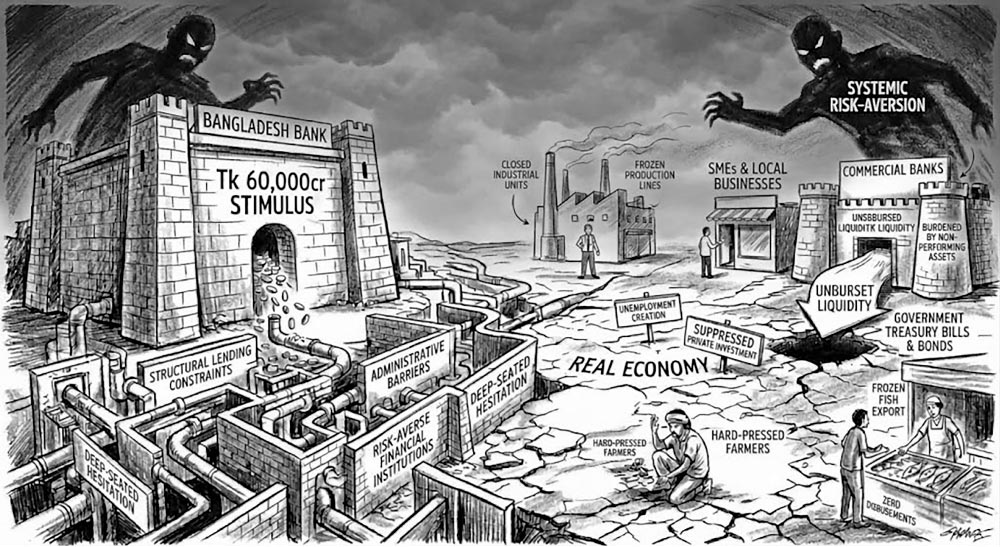
 It is both deeply concerning and deeply unfortunate that nearly five months after Bangladesh Bank announced its ambitious Tk 60,000 crore stimulus package with great fanfare, the vast majority of these vital funds has yet to reach the businesses and productive sectors for which it was intended. According to a recent report published in this newspaper, the central bank had disbursed a meagre Tk 11,959.82 crore, representing roughly 20 per cent of the total allocation, by mid-October, with an additional Tk 2,559.97 crore languishing in administrative pipelines under processing. These alarming figures raise a fundamental and pressing question: where is this money actually going, and why has a package designed as an economic lifeline failed so decisively to deliver promised relief to struggling industries, hard-pressed farmers and key market enterprises? The answer to this conundrum lies in a troubling mix of structural lending constraints within the banking sector and insurmountable administrative barriers that continue to prevent eligible borrowers from accessing capital.
The alarming slowness of disbursement becomes even more stark and concerning when we examine individual refinancing schemes under the umbrella package. Refinancing initiatives meant to revitalise small and medium enterprises, revive closed industrial units and boost local agricultural production have collectively disbursed less than 3 per cent of their allocated amounts. Meanwhile, key schemes designated for export diversification, rural economic expansion, and the frozen fish export sector have recorded zero disbursements, releasing no funds whatsoever
to date.
This inertia stems from deep-seated hesitation within commercial banks. Risk-averse financial institutions, already burdened by historically high levels of defaulted loans and non-performing assets, are deeply reluctant to take on additional credit exposure. Instead of channelling capital into private sector enterprises, commercial banks have increasingly chosen to park their excess liquidity in safe-haven government instruments, particularly Treasury bills and bonds. The broader consequence of this systemic risk-aversion is painfully clear, as private sector credit growth has slowed to an anaemic rate of around 4.7 per cent. Together, these structural bottlenecks reveal not only why liquidity has failed to flow where our policymakers originally intended, but also why urgent reform is required to dismantle the obstacles stifling the package.
The longer these allocated funds remain locked behind institutional inaction, the heavier the economic toll will be on the country’s recovery trajectory. Without timely access to affordable credit, factory owners are forced to freeze expansion plans, cut production lines and struggle simply to cover fixed operational costs. Small and medium enterprises, which form the primary engine of domestic employment, face severe cash-flow crises that imperil their ability to retain workers and meet payroll. Farmers deprived of concessionary financing, miss crucial seasonal windows to invest in high-yield seeds, fertiliser and modern agricultural equipment. Left unchecked, these compounding setbacks threaten to stall broader private investment, suppress employment creation and severely undermine the momentum of nationwide economic recovery. In short, the persistent failure to deliver prompt financial liquidity threatens to neutralise the very purpose of the stimulus package itself.
To prevent this initiative from becoming a meaningless paper exercise, Bangladesh Bank must step beyond periodic announcements of multi-billion-taka allocations and systematically address why disbursement remains so sluggish. The central bank should regularly publish detailed, scheme-by-scheme operational reports disclosing exactly how much money participating banks have disbursed, how much remains available, and the specific bottlenecks stalling specific credit lines. Furthermore, policy directives must be backed by clear, enforceable disbursement targets for commercial banks, coupled with strict progress monitoring and quarterly accountability reviews. Application procedures must be streamlined, approval processes expedited, and targeted credit guarantee schemes established to give financial institutions the confidence to lend to creditworthy, viable enterprises. At the same time, the government must simultaneously address real-economy bottlenecks, such as chronic natural gas shortages, escalating energy tariffs, and inadequate industrial infrastructure, which continue to discourage enterprise investment regardless of credit availability.
We expect Bangladesh Bank and the government to bridge the gap between policy announcements and on-the-ground execution by transforming promised support into accessible, real-world financing for enterprises and farmers alike. Commercial banks must fulfil reasonable lending commitments through balanced, responsible credit assessments, while regulating authorities must actively resolve operational delays rather than allowing tens of thousands of crores to sit idle in central bank vaults. Ultimately, the true success of any stimulus package is measured not by the headline figure announced in press releases, but by the actual liquidity delivered to the real economy and the jobs, industrial capacity and economic activity that funding creates. Until regulatory authorities resolve these structural delays and account for every unspent allocation, the question will continue to loom large over the nation’s economic planning: if this money was intended to stimulate the economy, why has so little of it reached those who need it most?
The writer is Editorial Assistant, The Daily Observer

Loading...
Loading...
Also read





Editor : Iqbal Sobhan Chowdhury
Published by the Editor on behalf of the Observer Ltd. from Globe Printers, 24/A, New Eskaton Road, Ramna, Dhaka.
Editorial, News and Commercial Offices : Aziz Bhaban (2nd floor), 93, Motijheel C/A, Dhaka-1000.
Phone: PABX- 41053001-06; Advertisement: 41053012; 01793317829, 01550707291, E-mail: [email protected], [email protected] Online: email: [email protected] 41053014; 01550707297 Advertisement: 01550707296


