



| HEADLINE |

|

Climate change, disasters reshape farming at coastal Amtali
Published : Monday, 26 October, 2026 at 12:00 AM
Our Correspondent


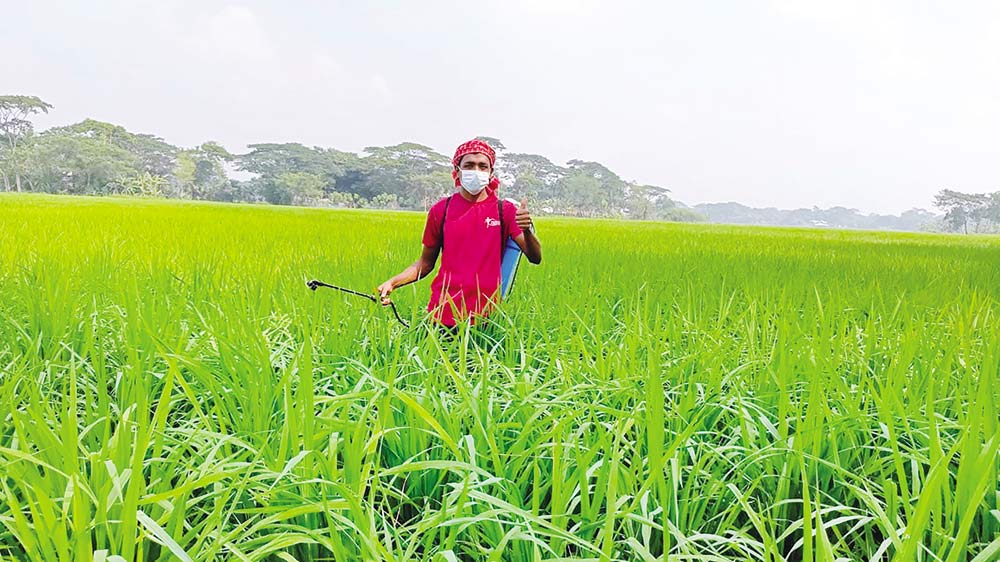 AMTALI, BARGUNA, Oct 25: Climate change and natural disasters are transforming agriculture in coastal Amtali Upazila of Barguna, forcing farmers to grow multiple crops on land that once produced only Aman rice.
Farmer Jamin Mia said that in the past, farmers would plough their fields, sow seeds and return home, with little need for daily fieldwork. Now, they have to work in their fields almost every day and apply large amounts of chemical fertilisers and pesticides.
Producing a maund of paddy now costs Tk 400�"450, he said, adding that farmers often fail to receive a fair price for their harvest.
He also expressed concern that farmers' growing reliance on hybrid rice varieties was gradually reducing soil productivity.
Veteran farmers said the increased use of chemical fertilisers and hybrid varieties was causing many traditional rice varieties to disappear. Varieties once widely cultivated in Amtali and elsewhere in the country included Rajasail, Chikon, Sitabhog, Kajalsail, Gopalbhog, Kalijira, Binnidhan and Swarnamusuri, among others.
According to the Department of Agricultural Extension (DAE) in Amtali, the upazila has 34,170 farming households and around 23,550 hectares of cultivable land. Of this, 1,770 hectares are single-crop land, 1,250 hectares produce two crops a year, and 9,360 hectares support three crops.
However, recurring natural disasters and population growth have reduced the total area of cultivable land by around 0.05 percent over recent years, according to the report. Rising land prices have also prompted some farming families to sell their land and move into other occupations.
Agriculture office data show that most of the upazila's farmland is moderately elevated, with soil types including non-saline, non-calcareous and saline non-calcareous soils. Low organic matter content is contributing to declining crop yields.
Organic matter accounts for only 0.1 to 5 per cent in much of the soil, while harmful levels of sulphur, iron and manganese are present in some areas. Nitrogen, an essential nutrient for crops, is also in short supply.
A shortage of irrigation water and the intrusion of saline water are damaging thousands of acres of seedbeds and cropland every year. Locals said leasing nearby canals for fish farming had restricted farmers' access to fresh water for irrigation and storage.
Erratic rainfall, storms and prolonged water-logging linked to climate change also destroy crops worth crores of taka annually. As a result, many low-income farmers are leasing out their land rather than cultivating it themselves.
Amtali Upazila Agriculture Officer Russell said salinity remained a major challenge for agriculture in the area. He added that fresh water was not being stored in many places, while the leasing of canals for fish farming had made it difficult for farmers to preserve and access freshwater.
He said farmers continued to grow hybrid rice varieties because of their higher yields, although repeated cultivation of the same hybrid varieties on the same land could reduce productivity over time.

Loading...
Loading...
Also read



Editor : Iqbal Sobhan Chowdhury
Published by the Editor on behalf of the Observer Ltd. from Globe Printers, 24/A, New Eskaton Road, Ramna, Dhaka.
Editorial, News and Commercial Offices : Aziz Bhaban (2nd floor), 93, Motijheel C/A, Dhaka-1000.
Phone: PABX- 41053001-06; Advertisement: 41053012; 01793317829, 01550707291, E-mail: [email protected], [email protected] Online: email: [email protected] 41053014; 01550707297 Advertisement: 01550707296


