



| HEADLINE |

|

Ashraful's removal raises questions over BCB's coaching decisions
Published : Tuesday, 27 October, 2026 at 12:00 AM
Sports Reporter


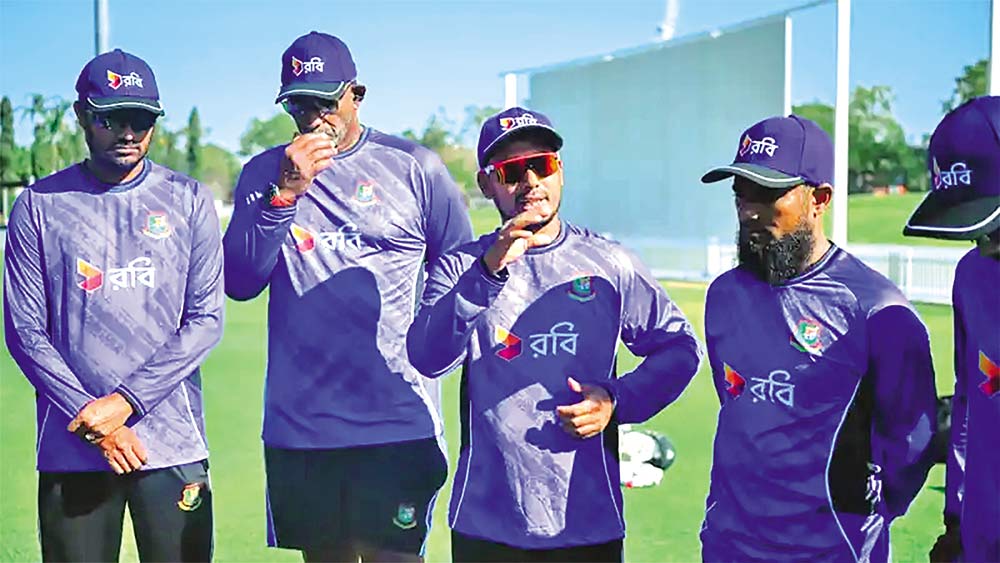 Bangladesh Cricket Board's decision to remove Mohammad Ashraful as national team batting coach has sparked debate over the timing of the move, the assessment of his performance and the board's broader approach to addressing the team's longstanding batting problems.
Ashraful was informed of the decision on Saturday, October 24, after working with the national batters during a practice session ahead of the two-Test series against West Indies. The timing drew attention, with the opening Test scheduled to begin in Mirpur on October 28.
The BCB has since confirmed that Ashraful will be reassigned to another role within the board, while Mohammad Salahuddin will oversee the national team's batting on an interim basis during the West Indies series. The board has not publicly disclosed a specific reason for the change.
The decision has divided opinion because Ashraful's record presents a mixed picture. Bangladesh won five of the eight Tests played during his tenure, drew one and lost two. The team also recorded notable results in the longer format, including Test series victories over Ireland and Pakistan.
Ashraful has defended his work, pointing to the team's Test results and the consistency of its batting performances. Those figures provide a legitimate basis for questioning whether his overall contribution should be judged primarily on recent struggles in limited-overs cricket.
"Since I joined, we have won five of eight Tests and drawn one," he told reporters, adding that the team's batters had scored nine centuries and 22 or 23 half-centuries during that period.
He also acknowledged the board's authority to reassign him but said the BCB was best placed to explain the decision. His comments add another dimension to the debate, as Bangladesh's encouraging Test results contrast with the batting struggles that marked the team's recent white-ball campaign.
However, the board also has to consider performance across formats. Bangladesh's batting came under scrutiny following disappointing displays in the recent Asian Games and the UAE tri-series. Those struggles increased pressure on the coaching setup, although the BCB has not confirmed that they were the direct reason for Ashraful's removal.
Questions had also been raised about his coaching experience when he was appointed in November 2025. While his international playing career gives him an understanding of the demands of elite cricket, concerns about his preparation for a major coaching role were part of the discussion surrounding his appointment.
The latest change is also part of a wider pattern of turnover in Bangladesh's batting department. Previous coaches have included Neil McKenzie, Ashwell Prince, Jamie Siddons and David Hemp. Yet the team's recurring difficulty in building substantial totals has remained a concern.
Salahuddin's interim appointment offers continuity ahead of the West Indies Tests, but it also raises a question of consistency: he was previously involved with the national setup when Bangladesh experienced batting problems in other competitions. That does not establish that the change will fail, but it underlines the need for clear objectives and a long-term plan.
The BCB is exploring options for a foreign batting coach after the West Indies series, with former South African batter Hashim Amla among the names reported to be under discussion. No final appointment has been announced.
Ultimately, Ashraful's departure cannot be assessed solely through the team's Test victories or its recent white-ball failures. The more important test for the BCB will be whether it can explain its coaching decisions, establish measurable expectations and provide enough stability for a new batting coach to make a lasting impact.

Loading...
Loading...
Also read



Editor : Iqbal Sobhan Chowdhury
Published by the Editor on behalf of the Observer Ltd. from Globe Printers, 24/A, New Eskaton Road, Ramna, Dhaka.
Editorial, News and Commercial Offices : Aziz Bhaban (2nd floor), 93, Motijheel C/A, Dhaka-1000.
Phone: PABX- 41053001-06; Advertisement: 41053012; 01793317829, 01550707291, E-mail: [email protected], [email protected] Online: email: [email protected] 41053014; 01550707297 Advertisement: 01550707296


