



| HEADLINE |

|

BD losing billions in freight charges amid shortage of domestic ships
Published : Wednesday, 28 October, 2026 at 4:18 PM
Toriqul Islam Sumon


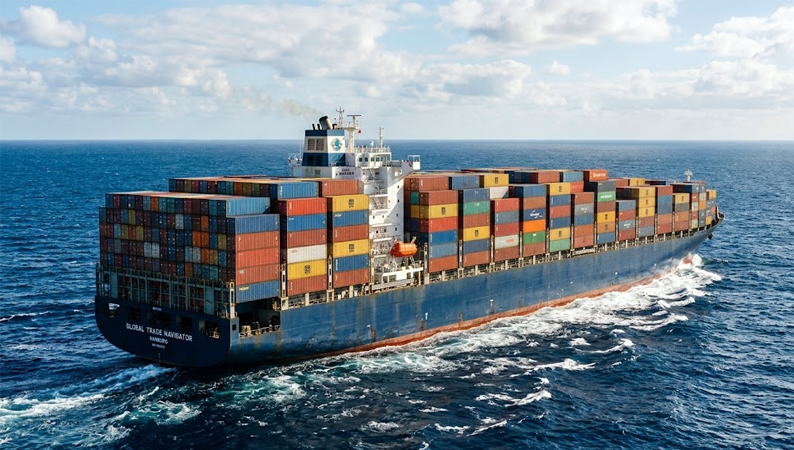
AI Illustration
• $14-15 billion spent annually on goods transport
• Foreign vessels carry bulk of imports and exports
• Huge foreign currency outflow reported in transport sector
• Experts urge expansion of domestic merchant fleet
• Bangladeshi ships carry only 8–10 per cent of import cargo
• Local share remains minimal under Flag Vessel Act; strategic vision needed
• NOC process for cargo clearance to be amended: Commerce Minister
While Bangladesh spends between $14 billion and $15 billion annually on freight charges for importing goods, the vast majority of these funds go to foreign ship owners due to a shortage of domestic vessels.
Experts have urged the government to urgently boost the capacity and size of the national merchant fleet to curb foreign currency outflows.
Bangladesh imports large volumes of fuel, food grains, edible oil, cotton, chemicals, machinery, and industrial raw materials by sea. However, Bangladeshi ship owners receive only $1 billion to $1.5 billion of the total freight charges, while the rest flows abroad in foreign currency to international shipping lines.
Data from Bangladesh Bank shows that imports stood at approximately $71.14 billion in the 2025-26 fiscal year. Imports were recorded at $61 billion to $67.44 billion in FY 2024-25, $73.45 billion in FY 2023-24, and $77.97 billion in FY 2022-23.
According to the World Bank and the Dhaka Chamber of Commerce and Industry (DCCI), Bangladesh spends an average of $32.92 billion annually on logistics and goods transport, accounting for 15 to 20 per cent of national GDP. While developed nations spend only 6 to 8 per cent of GDP on transport, costs in Bangladesh remain significantly higher due to inadequate infrastructure and traffic congestion.
Commerce Minister Khandker Abdul Muktadir stated that under the Flag Vessel Act, Bangladesh holds the legal right to carry 50 per cent of its import-export cargo using domestic flag vessels.
However, local ships currently transport only 10 to 15 per cent of total trade. "Between Bangladesh Shipping Corporation, the Ministry of Shipping, and private companies, we have only 12 ocean-going vessels handling cargo transport," the minister noted, highlighting the lack of a long-term strategic vision.
Additionally, regulatory hurdles exist surrounding No Objection Certificates (NOC) and mandatory cargo clearance deadlines under the Fish Quarantine Act 2018 and customs regulations. The European Union (EU) views these NOC requirements as barriers to free trade. The Commerce Minister confirmed that legislative amendments will be introduced soon to resolve these issues.
Captain Anam Chowdhury, President of the Merchant Marine Officers' Association, citing UNCTAD guidelines, explained that international open trade frameworks allow 40 per cent of cargo to be carried by domestic vessels, 40 per cent by foreign vessels, and the remaining 20 per cent under joint or buffer arrangements, as no nation can carry 100 per cent of its maritime trade exclusively on its own ships.
According to the Mercantile Marine Office, Bangladesh currently has 122 registered ocean-going vessels. Bangladesh Shipping Corporation owns seven vessels, while the rest belong to private entities, including 28 owned by Meghna Group, 27 by KSRM, 11 by Akij Group, and 8 by HR Lines. The fleet comprises 87 bulk carriers, 5 tankers, 5 oil tankers, 2 gas carriers, and 8 container ships.
Captain Sheikh Jalal Uddin Gazi, Principal Officer of the Mercantile Marine Office in Chittagong, and Captain Md Salah Uddin Chowdhury, President of the Bangladesh Shipping Agents Association, emphasized that exercising the 50 per cent cargo reservation right would keep foreign currency within the country while generating chartering income and employment for marine academy graduates.
Shipping Minister Sheikh Robiul Alam informed Parliament on September 7, 2026, that foreign flag vessels carried 89 per cent of import containers and 84 per cent of export containers at Chittagong Port during the first six months of 2026.
He assured that the government is actively incentivizing new vessel investments and offering policy support to increase the national fleet's share in international trade.
-TIS/SA

Loading...
Loading...
Also read








Editor : Iqbal Sobhan Chowdhury
Published by the Editor on behalf of the Observer Ltd. from Globe Printers, 24/A, New Eskaton Road, Ramna, Dhaka.
Editorial, News and Commercial Offices : Aziz Bhaban (2nd floor), 93, Motijheel C/A, Dhaka-1000.
Phone: PABX- 41053001-06; Advertisement: 41053012; 01793317829, 01550707291, 01550707296
E-mail: [email protected], [email protected]. [email protected], [email protected], [email protected], [email protected], Online-email: [email protected]


