



| HEADLINE |

|

Gen-Z protests turn violent in Germany, shops looted in Frankfurt
Published : Sunday, 1 November, 2026 at 9:57 AM
Observer Online Report


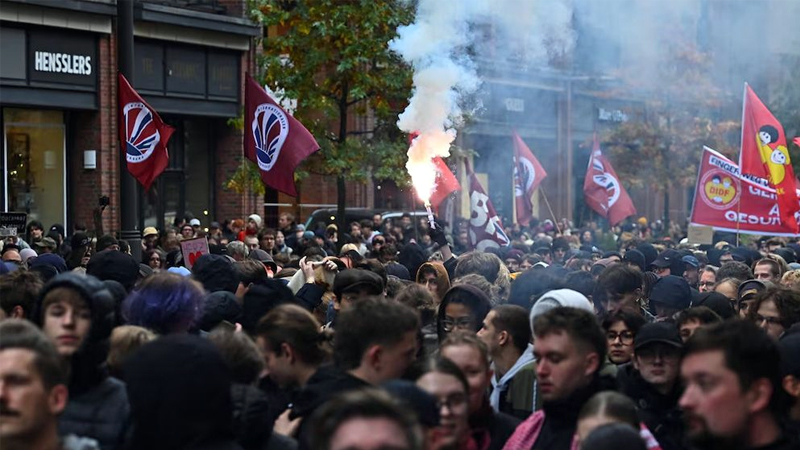
Collected Photo
Thousands of young demonstrators took to the streets across Germany to demand improved education standards and lower living costs, but the Gen-Z-led protests turned violent on Saturday (October 31) night as masked rioters looted shops and vandalized businesses in Frankfurt.
According to Reuters, at least two stores were looted in Frankfurt's central area while several others suffered damage, prompting a heavy response from law enforcement agencies.
Frankfurt police stated via social media platform X that violence persisted in the city center, with rioters smashing shop windows and hurling petrol bombs at emergency service personnel, leading to advisories for the public to avoid the downtown district.
Organized by the "Gen-Z Regelt" campaign group, demonstrations took place across 34 German cities including Berlin, Munich, and Frankfurt, centering on demands to oppose mandatory military service, increase educational funding, and ease the rising cost of living.
While turnout fell short of initial organizer projections of 182,000 participants—with police estimating around 18,000 demonstrators across major cities—the rallies coincided with Halloween celebrations and saw scattered incidents such as burning barricades in Hamburg.
Speaking at a Berlin rally, "Gen-Z Regelt" spokesperson Lena Friedrich emphasized that the protesters marched for peace and social support rather than conflict, calling for fair burden-sharing and enhanced welfare and education investments.
German Interior Ministry officials and state leaders, including Hesse Interior Minister Roman Posek, had previously warned that extremist factions might hijack the protests, pointing to the risk of destructive unrest witnessed during recent demonstrations in France.
Ahead of the protests, several businesses in upscale shopping districts such as Berlin's Kurfurstendamm took precautionary measures by barricading windows and closing early, reflecting widespread economic and systemic pressures felt by Germany's younger generation.
Participants and analysts noted that mounting financial strains, aging demographics, and deteriorating campus infrastructure have fueled youth frustration across Europe, mirroring similar student-led movements in Serbia and France over the past year.
-EM

Loading...
Loading...
Also read







Editor : Iqbal Sobhan Chowdhury
Published by the Editor on behalf of the Observer Ltd. from Globe Printers, 24/A, New Eskaton Road, Ramna, Dhaka.
Editorial, News and Commercial Offices : Aziz Bhaban (2nd floor), 93, Motijheel C/A, Dhaka-1000.
Phone: PABX- 41053001-06; Advertisement: 41053012; 01793317829, 01550707291, 01550707296
E-mail: [email protected], [email protected]. [email protected], [email protected], [email protected], [email protected], Online-email: [email protected]


