



| HEADLINE |

|

RMG workers run amok in Mirpur, Gazipur, Ashulia
Published : Monday, 2 November, 2026 at 12:00 AM
Saver, Gazipur Correspondents


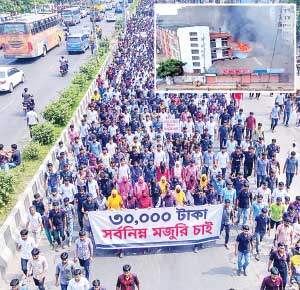 Garment workers’ agitation over demands for a minimum monthly wage of Tk 30,000, an end to blacklisting and arbitrary dismissals continued for the second consecutive day on Sunday, disrupting factory activities in Mirpur in the capital, Ashulia in Savar and several industrial areas in Gazipur.
Clashes between workers and police, vandalism and arson were reported in different areas. Over 300 garment factories in Savar and Gazipur declared holidays amid the unrest. A police vehicle was also set on fire in Mirpur. Police detained at least 28 people in connection with the incidents there.
Workers at Al-Muslim Apparels, New Age Group and Trouser Line Limited in Nishchintapur, Ashulia, began a work stoppage after reporting to their factories on Sunday morning. They later came out of the factories and took to the streets. Workers from several nearby factories also joined the demonstration creating unrest and anarchy in the area.
At around 10:45am, workers gathered in front of Sharmin Group's factory in Narsinghpur and staged a demonstration on the Abdullahpur-Baipail road. Although they moved to one side of the road following requests from industrial police, tensions continued to escalate.
Later, more than 170 factories in the area, including those of Sharmin Group, Ha-Meem Group and New Age, declared holidays.
Superintendent of Police of Ashulia Industrial Police-1 Mohammad Mominul Islam Bhuiyan said more than 200 factories had declared general holidays due to the labour unrest. Police were trying to bring the situation under control through discussions with workers.
Khairul Mamun, legal affairs secretary of the Bangladesh Garments and Sweaters Workers Trade Union Centre, told the media that workers on work stoppage had complained that factory authorities were not discussing their demands with them. This had created agitation, frustration and uncertainty among the workers, he said.
A garment factory's waste-material warehouse and a pickup van were set on fire amid workers' protests in Gazipur’s Kaliakair. The incidents took place between 11:30am and 12:30pm in the Chandra Palli Bidyut area.
In the morning, workers from several factories, including Karni Knit Composite and Knit Asia in the Ratanpur area, refused to join work and took position on the highway near Safipur Bazar. The protests later spread to neighbouring areas.
Amzad Hossain, Superintendent of Police of Gazipur Industrial Police, said that police were working to bring the situation under control. Many factories in different areas had declared holidays amid the unrest.
According to eyewitnesses, a pickup van was set on fire first, followed by an arson attack on the waste-material warehouse of a garment factory named Tropical.
Kaliakair Fire Service Station Officer Md Tarikul Islam said firefighters initially could not reach the spot due to obstruction by protesters.
He later said two fire service units, escorted by members of the Border Guard Bangladesh (BGB), had set out for the Tropical Knitex Limited factory's waste-material warehouse in Chandra Palli Bidyut, travelling against the direction of traffic on the highway. However, the cause of the fire could not immediately be confirmed.
Garment workers blocked the Mirpur-10 roundabout around 9am on Sunday. The protest later spread to Mirpur-11, Mirpur-12 and adjoining areas. Clashes broke out around 11:15am when police attempted to remove the workers from the roads.
Police used tear gas, sound grenades and water cannons to disperse the protesters. Several shops and the glass panels of a Jamuna Bank branch were vandalised during the clashes.
Workers later blocked roads again in Mirpur-11 and set fire to a police vehicle parked beneath the metro rail tracks. The situation came under control around 2pm after police action forced the protesters to leave the roads.
The Detective Branch (DB) and Mirpur division police detained a total of 28 people in connection with the clashes.
Road blockades and clashes brought traffic in Mirpur to a halt for nearly five hours. Mirpur-10, Mirpur-11 and Pallabi metro rail stations were also temporarily closed.
Office-goers, students and other commuters faced severe difficulties, with many forced to walk to their destinations. Traffic congestion also spread to alternative routes as vehicles were diverted from the affected areas.
Workers said rising prices had made it increasingly difficult for them to manage their living expenses on existing wages. They warned that their movement would continue unless a decision was taken to increase their wages.
Meanwhile, labour leaders and workers called for factory authorities to initiate discussions with workers without delay, saying the lack of clear responses to their demands was fuelling further frustration and agitation.

Loading...
Loading...
Also read



Editor : Iqbal Sobhan Chowdhury
Published by the Editor on behalf of the Observer Ltd. from Globe Printers, 24/A, New Eskaton Road, Ramna, Dhaka.
Editorial, News and Commercial Offices : Aziz Bhaban (2nd floor), 93, Motijheel C/A, Dhaka-1000.
Phone: PABX- 41053001-06; Advertisement: 41053012; 01793317829, 01550707291, 01550707296
E-mail: [email protected], [email protected]. [email protected], [email protected], [email protected], [email protected], Online-email: [email protected]


