



| HEADLINE |

|

HSC results expose deep-rooted flaws in education system
Published : Wednesday, 4 November, 2026 at 12:00 AM
Tanvir Raihan


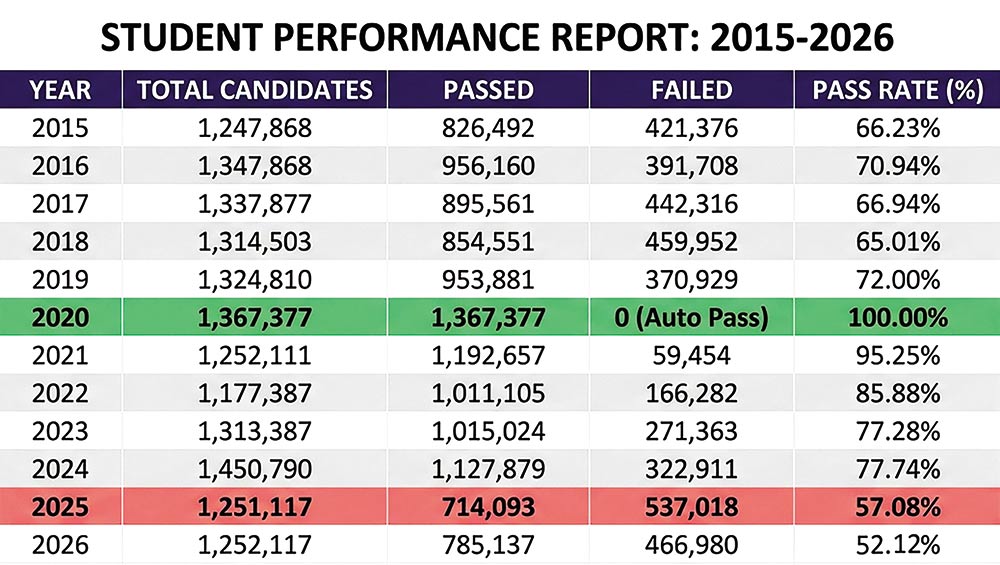 The sharp fluctuations in Higher Secondary Certificate (HSC) and equivalent examination results over the past decade have exposed longstanding weaknesses in the country's assessment system, raising questions about classroom teaching, students' learning gaps and the credibility of public examinations.
While pass rates remained relatively high in some years, they declined sharply after the Covid-19 pandemic, with the number of students securing the highest grade also varying considerably. However, educationists and researchers caution that the figures cannot be compared directly without accounting for changes in examination formats, syllabuses and assessment methods.
They say that although these changes partly explain the fluctuations, persistent weaknesses in classroom instruction, rote learning and the failure to address learning gaps have also affected educational outcomes.

In 2015, the HSC pass rate stood at around 66 per cent. It rose to more than 72 per cent in 2016 before falling to approximately 67 per cent in 2017 and 65 per cent in 2018. The rate recovered to nearly 72 per cent in 2019.
The most dramatic shift came in 2020, when the HSC and equivalent examinations were not held due to the Covid-19 pandemic. Instead, all registered candidates were declared successful through an alternative assessment system based on their previous Secondary School Certificate (SSC) and equivalent examination results.
As a result, the pass rate reached 100 per cent. Of the 1,367,377 candidates, 161,807 secured GPA-5, representing 11.83 per cent of the total.
In 2021, examinations were held under a shortened syllabus, producing a pass rate of 95.26 per cent. A total of 189,169 students achieved GPA-5, including 178,522 under the nine general education boards.
The following year, examinations were again conducted under a shortened syllabus. The pass rate fell to 85.95 per cent, while 176,282 students secured GPA-5 among 1,177,387 candidates.
The downward trend continued in 2023, when the average pass rate dropped by 7.31 percentage points to 78.64 per cent. GPA-5 achievers also fell sharply to 92,595 under the 11 education boards, 83,687 fewer than the previous year.
The 2024 examinations were disrupted by the July mass uprising, forcing the cancellation of several subject examinations. The authorities subsequently prepared results for the affected subjects through subject mapping, using corresponding SSC subject results. The pass rate stood at 77.78 per cent, while 145,911 students secured GPA-5, up 53,546 from the previous year.
The decline became more pronounced in 2025, when the pass rate fell to 57.12 per cent.
In 2026, examinations returned to the full syllabus, with full marks and regular examination duration. The authorities also abandoned the practice of awarding additional concessionary marks.
A total of 1,251,111 students registered for the examinations under 11 education boards, including 618,015 boys and 633,096 girls. Examinations were held at 2,797 centres across the country, with around 27,000 candidates remaining absent.
This year, 40,084 students secured GPA-5, compared with 69,097 in 2025 before re-evaluation. Another 3,079 students received GPA-5 following scrutiny of their answer scripts.
Educationist and researcher Samir Ranjan Nath told The Daily Observer that the fluctuations should be examined against the country's examination system since independence.
“Public examinations are not being conducted according to consistent standards. Students may score 30 marks in one examination, 24 in another and, in some cases, 80. The assessment system is not standardised,” he said.
Nath argued that curriculum changes alone would not bring meaningful improvements unless students' language skills and practical competencies were properly developed. He also expressed concern over declining classroom teaching standards and teachers' increasing involvement in private tuition.
“Classroom teaching has declined considerably, while private tuition has increased. As a result, dependence on rote learning continues to grow,” he said.
He added that fluctuations in results over the past 55 years, including those coinciding with changes in government, made it necessary to review and compare the country's examination standards.
Professor Dr T M Niaz Asadullah of the Department of Economics at the University of Dhaka said two issues needed to be distinguished when explaining the decline: changes in assessment methods and actual learning deficits among students.
He noted that examination syllabuses, subject coverage and assessment procedures had varied considerably over the period. Comparing results from shortened-syllabus examinations or the subject-mapping system used in 2024 directly with those from full-syllabus examinations could therefore lead to misleading conclusions.

Loading...
Loading...
Also read



Editor : Iqbal Sobhan Chowdhury
Published by the Editor on behalf of the Observer Ltd. from Globe Printers, 24/A, New Eskaton Road, Ramna, Dhaka.
Editorial, News and Commercial Offices : Aziz Bhaban (2nd floor), 93, Motijheel C/A, Dhaka-1000.
Phone: PABX- 41053001-06; Advertisement: 41053012; 01793317829, 01550707291, 01550707296
E-mail: [email protected], [email protected]. [email protected], [email protected], [email protected], [email protected], Online-email: [email protected]


