



| HEADLINE |

|

November 7: The People’s Revolt That Redefined Bangladesh
Published : Saturday, 7 November, 2026 at 12:00 AM
FARUK AHMED


 When power becomes deaf to the people, the streets become the voice of history. Bangladesh has witnessed this more than once.
Bangladesh's political history is punctuated by popular uprisings against repression, exclusion and the abuse of power. From the dramatic upheaval of November 7, 1975, to the mass uprising of July 2024, one message resonates across generations: no government can suppress the people's aspirations for freedom, justice and democracy indefinitely.
National Revolution and Solidarity Day is more than a historical commemoration. It recalls a defining moment when soldiers and civilians rose together, freed Major General Ziaur Rahman from house arrest and dramatically altered the country's political course. Nearly five decades later, the July 2024 uprising echoed that spirit of resistance, exposing once again the limits of political power without public consent.
The euphoria of independence in 1971 soon gave way to mounting disillusionment. Political repression, economic collapse, famine and escalating violence eroded public confidence in the fledgling state. The introduction of the one-party BAKSAL system in 1975, allegations of abuses by the Rakkhi Bahini and growing political confrontation deepened the crisis. The democratic aspirations for which millions had fought appeared increasingly distant.
The assassination of Sheikh Mujibur Rahman on August 15, 1975, plunged the country into further turmoil. Political intrigue and military rivalries intensified, culminating in the November 3 massacre of four national leaders-Syed Nazrul Islam, Tajuddin Ahmad, M. Mansur Ali and A. H. M. Qamaruzzaman-inside Dhaka Central Jail.
Amid the escalating power struggle, Brigadier Khaled Mosharraf's November 3 coup placed Ziaur Rahman under house arrest. The move triggered resentment among sections of the armed forces and civilians who regarded the decorated Liberation War commander as a symbol of national independence and military professionalism.
Then came November 7. Soldiers and civilians poured into the streets of Dhaka, chanting “Sepoy-Janata Zindabad!”Soldiers freed Zia, and the country's political balance shifted dramatically. What followed was a defining, though deeply contested, chapter in Bangladesh's history. The uprising represented a remarkable convergence of military discontent and popular mobilisation, but its aftermath also brought further bloodshed and political uncertainty.
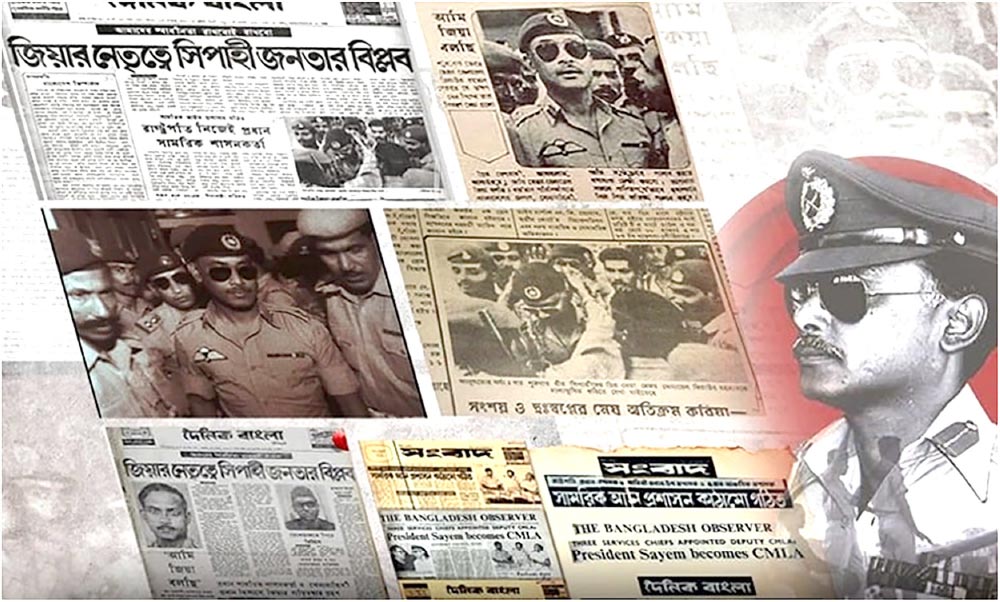 For the Bangladesh Nationalist Party (BNP), founded by Zia in 1978, November 7 remains central to its political heritage. Yet the significance of the day extends beyond party history. It raises a fundamental question about the ownership of political power: does it belong to those who govern or to the people they represent?
Zia's subsequent leadership sought to restore political order and establish a new national direction based on Bangladeshi nationalism, self-reliance and grassroots participation. His administration restored multi-party political competition and pursued rural development, agricultural productivity, decentralisation and greater private-sector participation. His emphasis on overseas employment and economic self-reliance also helped shape important elements of Bangladesh's development trajectory.
The spirit of popular resistance returned with extraordinary force in July 2024. A student-led movement against the government's job-quota arrangements expanded into a nationwide uprising, drawing support from diverse sections of society. The fall of Sheikh Hasina's government on August 5 marked another watershed in Bangladesh's political history.
November 7 and July 2024 emerged from different circumstances and cannot be treated as identical. Yet both underline the consequences of political exclusion and the limits of authority when public trust collapses. Their enduring lesson is that popular sovereignty cannot be indefinitely subordinated to the interests of those in power.
Today, with the BNP forming a new government under Prime Minister Tarique Rahman, son of late President Ziaur Rahman, the historical legacy of November 7 enters a new phase. The challenge is to translate that inheritance into a forward-looking national agenda-not simply through political commemoration, but through democratic governance, institutional reform and economic transformation.
Tarique Rahman's government will face public scrutiny over its ability to revive investment, create jobs, strengthen independent institutions, protect press freedom and ensure accountability. The country's pressing economic challenges make this task even more urgent. Banking-sector fragility, unemployment, inequality, corruption and weak investor confidence demand decisive policy action. Political stability alone cannot secure prosperity without institutional credibility, a predictable business environment and equal economic opportunities.
The generation that helped drive the July 2024 uprising expects more than a change of government. It wants accountable institutions, equal citizenship, justice and opportunities for a better future. These expectations also provide a contemporary test of Zia's emphasis on nationalism, self-reliance and grassroots development.
November 7 must therefore carry a message for every government: political power is a public trust, not a permanent possession. Its legitimacy rests on respecting citizens' rights, protecting democratic institutions and delivering tangible improvements in people's lives.
Bangladesh has paid dearly for its recurring struggles over power and democracy. The greatest tribute to the sacrifices of 1975 and 2024 would be a state where institutions are stronger than individuals, accountability prevails over impunity and citizens never again have to risk their lives to reclaim their democratic rights.
That is the unfinished promise of November 7-and the enduring test of its legacy.
The writer is Consulting Editor of The Daily Observer

Loading...
Loading...
Also read



Editor : Iqbal Sobhan Chowdhury
Published by the Editor on behalf of the Observer Ltd. from Globe Printers, 24/A, New Eskaton Road, Ramna, Dhaka.
Editorial, News and Commercial Offices : Aziz Bhaban (2nd floor), 93, Motijheel C/A, Dhaka-1000.
Phone: PABX- 41053001-06; Advertisement: 41053012; 01793317829, 01550707291, 01550707296
E-mail: [email protected], [email protected]. [email protected], [email protected], [email protected], [email protected], Online-email: [email protected]


