



| HEADLINE |

|

HATE CRIMES
Anatomy of Communal Violence



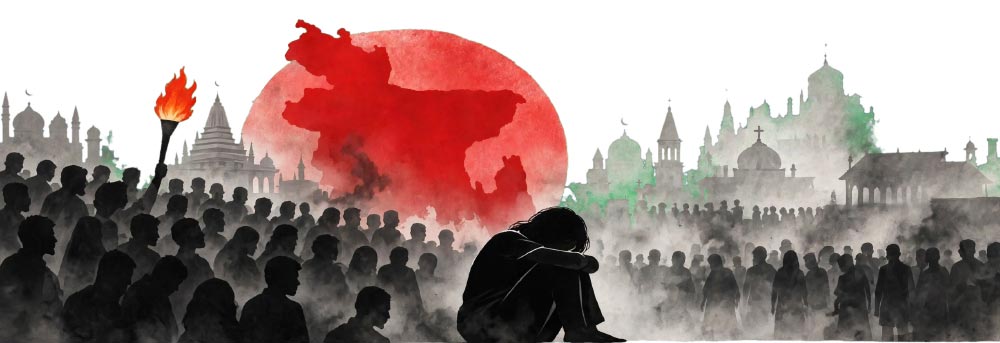 Hate crimes are turning identity into a source of fear in Bangladesh. Burnt homes, desecrated temples, fabricated blasphemy allegations, mob attacks and selective prosecution expose the gap between constitutional guarantees and equal citizenship. When minorities face persecution while perpetrators enjoy impunity, prejudice flourishes and justice fails.
Hate crimes often begin with slurs, religious insults and fabricated online allegations before escalating into mob attacks, arson, desecration of places of worship and killings. Targeting people for their religion, ethnicity, gender or identity, such violence threatens social cohesion and equal citizenship. Despite constitutional safeguards, minorities in Bangladesh remain vulnerable to intimidation, dispossession and discrimination.
The machinery of hatred
False allegations provoke hostility, while denying genuine attacks compounds victims' suffering. Responsibility must remain individual, not collective.
Political actors may exploit prejudice to consolidate support, settle scores or deflect criticism. Violence after August 5, 2024, involved overlapping political, religious and personal motives amid inadequate security.
A Development Policy Centre study linked attacks on minorities to historical discrimination, instability and weak accountability. Human Rights Watch warned in January 2026 that leaders exploit hostility towards marginalised communities to deflect governance and economic criticism.
Evidence must distinguish political retaliation from communal persecution. Blanket communal labelling and dismissing attacks as political both undermine justice. Sufi, indigenous, transgender, female and sexual minority communities also face hostility.
A minority rights coalition recorded 2,184 incidents between August 4 and December 31, 2024; Ain o Salish Kendra documented 926 violations against minorities and indigenous communities that year. Police classified 1,234 of 1,769 attacks examined between August 4 and 20 as political and 20 as communal. The UN human rights office identified overlapping motives, including political revenge, land disputes and religious prejudice, but found no evidence of orchestration by national party leaderships.
The Bangladesh Hindu Buddhist Christian Unity Council recorded 2,442 incidents between August 2024 and June 2025; the Human Rights Congress for Bangladesh Minorities reported 505 across 62 districts from January to April 2026. Different periods and methodologies make these figures incomparable.
The sentiment trap
Religious sentiment has sometimes become an instrument of prosecution rather than protection.
Srimangal's Pritom Das was detained under the Digital Security Act for sharing a sentence by Urdu storyteller Saadat Hasan Manto, forcing minorities to watch their words, according to his brother, Piyas.
Section 28 criminalised online content deemed offensive to religious beliefs. Though the Act was repealed in September 2023, the provision largely survived in the Cyber Security Act. Amnesty International criticised it for exceeding international standards. Article 20(2) of the ICCPR prohibits religious hatred inciting discrimination, hostility or violence, not mere offence.
The High Court quashed Poritosh Sarkar's conviction over an allegedly offensive post in May 2024, after eight months in solitary confinement. It found the case sought to conceal police failure to protect Hindu homes, while none of the 74 people arrested over the arson was convicted. Titu Ray, however, received a 10-year sentence over a social media post preceding a village attack.
Rumour as a weapon
Digital misinformation can turn unverified allegations into triggers for mob violence. In Narail's Dighalia, an alleged Facebook post by a teenager preceded attacks on Hindu homes. In Sunamganj's Dowarabazar in December 2024, a deleted post circulated as a screenshot, prompting a crowd to attempt to seize its alleged author from police custody.
Minority representatives allege that fake accounts were created in poor villagers' names to provoke attacks, and such misinformation and institutional distrust work as catalysts of communal violence.
The Tech Global Institute documented Facebook networks amplifying anti-Ahmadiyya hostility. At a Dhaka gathering on November 15, 2025, protesters demanded that Ahmadiyyas be declared non-Muslim and their religious, social and economic activities restricted.
Impunity is the real multiplier
Unequal enforcement allows perpetrators to evade accountability. In Satkhira's Agardari, artisan Bhaskar Ranjan Pal found 53 unfinished clay idols smashed at his workshop after 35 years of craftsmanship. Despite a police case, nobody was arrested. The Bangladesh Puja Udjapan Parishad recorded attacks on at least 22 Hindu religious establishments in 2022, with no reported arrests or convictions.
The 2012 attacks on Buddhist monasteries in Ramu remain without a final judicial reckoning. The March 2023 attack on an Ahmadiyya convention in Panchagarh also raised accountability concerns. The UN human rights office later recorded no known accountability for a related killing during the 2024 unrest.
Political influence, administrative negligence and religious mobilisation can obstruct investigations, intimidate witnesses and pressure victims into compromise. Such impunity erodes public confidence in the justice system.
A legal framework with gaps
Bangladesh's Constitution guarantees equality (Articles 27-28), legal protection (Article 31) and religious freedom (Article 41). Article 12 rejects communalism and religious persecution, Article 39 protects expression, while Article 2A recognises Islam as the state religion alongside equal rights for other faiths.
Penal Code 1860 Sections 153A, 295, 295A, 296 and 298 address religious hatred, attacks on places of worship and offences against religious sentiments, but lack provisions treating discriminatory motives as an aggravating factor.
Section 26 of the Cyber Security Act 2026 criminalises online religious or communal hatred causing violence, alarm or disorder, punishable by up to two years' imprisonment or a Tk 10 lakh fine. Enforcement must distinguish incitement from legitimate criticism and peaceful expression.
An effective response demands comprehensive anti-discrimination laws, tougher penalties and a national hate-crime database. Police must verify allegations, preserve digital evidence and identify organisers and financiers. Complicit or negligent officials must face disciplinary or criminal action. Victims and witnesses need protection, legal aid and timely justice. Social media platforms must curb harmful content and assist investigations. Enforcement must be impartial, regardless of religion or political affiliation.
The test of equal citizenship
During periods of unrest, ordinary citizens who protected minority homes and places of worship demonstrated the power of solidarity. Yet constitutional protection cannot depend on neighbours' goodwill.
Religious leaders, teachers and public officials must challenge narratives that turn communities into enemies. Education, political accountability and community engagement are essential to building a culture in which diversity is respected and violence is neither tolerated nor rewarded.
Bangladesh's democratic credibility ultimately rests on translating constitutional promises into practical protection. No citizen should have to conceal an identity or fear persecution for exercising a fundamental right. The rule of law must extend equally to all, regardless of numerical strength or political influence.

Loading...
Loading...
Also read





Editor : Iqbal Sobhan Chowdhury
Published by the Editor on behalf of the Observer Ltd. from Globe Printers, 24/A, New Eskaton Road, Ramna, Dhaka.
Editorial, News and Commercial Offices : Aziz Bhaban (2nd floor), 93, Motijheel C/A, Dhaka-1000.
Phone: PABX- 41053001-06; Advertisement: 41053012; 01793317829, 01550707291, 01550707296
E-mail: [email protected], [email protected]. [email protected], [email protected], [email protected], [email protected], Online-email: [email protected]


