



| HEADLINE |

|

Global south urges developed nations to fulfil climarmte obligations
Published : Tuesday, 10 November, 2026 at 8:54 PM
Staff Correspondent


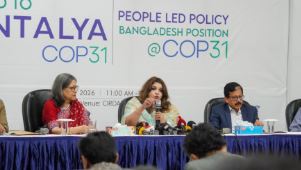
Civil society leaders from the Global South have urged developed countries to fulfil their climate finance obligations under Article 9.1 of the Paris Agreement, calling for predictable, accessible and grant-based public funding for climate-vulnerable nations.
They made the call at a side event titled “Investment, Imperatives & Prospects for Climate Finance: Perspectives from Global South” at the COP31 venue in Antalya, Türkiye, on Tuesday.
The speakers stressed that the Global Goal on Adaptation (GGA) must go beyond setting indicators and political commitments, ensuring adequate finance, technology and institutional capacity to translate targets into action and deliver resources directly to affected communities.
They also demanded substantially increased funding for the Fund for Responding to Loss and Damage, simplified access procedures and faster disbursement, according to a press release received in Dhaka.
Warning against rising debt burdens, the leaders said loans and private investment must not replace developed countries' obligations to provide public climate finance. They called for greater financial contributions from countries and institutions most responsible for the climate crisis, including through fair taxation of major polluters.
Lidy Nacpil, coordinator of the Asian Peoples' Movement on Debt and Development (APMDD), said climate finance must move beyond promises and reach affected countries through international funding mechanisms quickly and effectively. She also urged Global South governments to prioritise climate finance in their national budgets and policies.
Wanun Permpibul of Climate Watch Thailand said adopting 59 indicators under the GGA would not be enough without adequate resources to strengthen resilience in livelihoods, food security, water and ecosystems. She called for clear funding sources, timelines and terms for the commitment to triple adaptation finance by 2035.
Mariana of Oxfam emphasised the importance of scientific research, local languages and cultures in developing effective climate solutions, while calling for regular reviews of climate plans and evidence-based implementation.
M A Hasan of COAST Foundation, Bangladesh, said climate finance should be assessed not by pledges alone but by who provides the money, when and how it is delivered, and what tangible benefits it brings.
“Countries of the Global South are not asking for charity; they are demanding climate justice,” he said, warning that vulnerable nations should not be forced into further debt to protect their people from climate impacts.
The event was jointly organised by APMDD, COAST Foundation, LDC Watch and Climate Watch Thailand. Reshma Shakya of LDC Watch moderated the discussion, which also featured Allen John Carpio of APMDD.

Loading...
Loading...
Also read








Editor : Iqbal Sobhan Chowdhury
Published by the Editor on behalf of the Observer Ltd. from Globe Printers, 24/A, New Eskaton Road, Ramna, Dhaka.
Editorial, News and Commercial Offices : Aziz Bhaban (2nd floor), 93, Motijheel C/A, Dhaka-1000.
Phone: PABX- 41053001-06; Advertisement: 41053012; 01793317829, 01550707291, 01550707296
E-mail: [email protected], [email protected]. [email protected], [email protected], [email protected], [email protected], Online-email: [email protected]


