



| HEADLINE |

|

Record 37 ships attacked in Strait of Hormuz in October
Published : Wednesday, 11 November, 2026 at 1:22 PM
Observer Online Report


Collected Photo
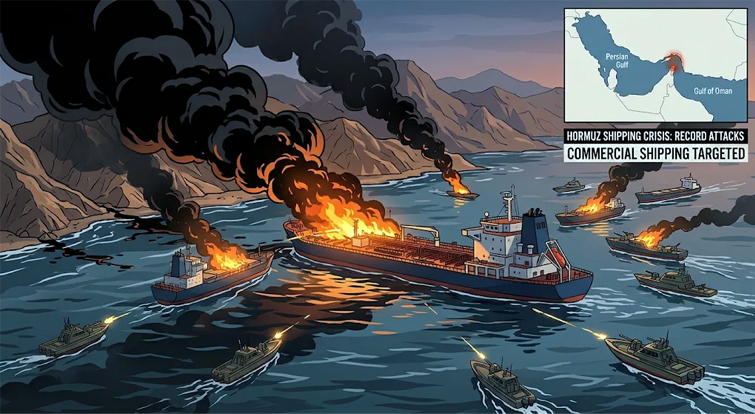
Even as the United States and Iran maintain a relative pause in direct mutual strikes, commercial shipping through the vital Strait of Hormuz continues to face unprecedented security threats, with October recording a historic high in attacks on merchant vessels and oil tankers.
According to a statement released Tuesday (November 10) by the Washington Institute for Near East Policy (WINEP), a US-based think tank, 37 commercial and tanker ships came under attack in the strategic waterway throughout the month of October.
Hostilities between Washington and Tehran erupted on February 28. On the opening day of the conflict, the Islamic Revolutionary Guard Corps (IRGC)—an elite branch of the Iranian military—imposed a blockade on foreign shipping through the strait. Since then, commercial vessels attempting to transit the corridor without IRGC clearance have been targeted repeatedly.
While the IRGC has targeted unauthorized commercial traffic with drones and missiles since March, October marked the first time that monthly attacks in the strait exceeded 30 incidents.
The sustained assaults have triggered severe environmental concerns due to oil spills spreading across regional waters. Satellite imagery and verified social media footage reviewed by Reuters on Monday confirmed that oil slicks have reached the coast of Oman, with additional dispersion detected near the maritime boundaries of Oman and the United Arab Emirates. Omani authorities have not yet responded to requests for comment regarding the spill.
Spanning 167 kilometers, the Strait of Hormuz connects the Persian Gulf and the Gulf of Oman, serving as one of the world's most critical oil transit chokepoints, through which roughly one-fifth of global energy supplies pass.
The ongoing blockade and regular attacks on tanker traffic have severely disrupted global energy supply chains, triggering daily surges in international oil and gas prices.
Footage verified by Reuters on Sunday (November 8) depicted flames engulfing the Singapore-flagged medium-range refined product tanker 'Navig8 Merida' near the Omani coast following an attack in the strait. European Union 'Copernicus Sentinel-2' satellite imagery subsequently captured massive plumes of black smoke billowing from the site.
Quoting the IRGC Navy, Iranian state broadcaster IRIB confirmed that three tankers, including the 'Navig8 Merida', were targeted on Sunday for utilizing "unauthorized routes" through the strait.
Data from the International Maritime Organization (IMO), a specialized UN agency, indicates that 133 confirmed attacks on commercial vessels have been logged in the region through November 10. The conflict has claimed the lives of 25 mariners to date, leaving thousands of crew members stranded on immobilized vessels across the Persian Gulf in critical danger.
The 'Navig8' vessel is largely owned and operated by ADNOC Logistics and Services, which, alongside ADNOC, has declined to comment on the incident.
Meanwhile, US forces maintain a naval blockade outside Iranian ports. According to the US Central Command, a St. Kitts-flagged cargo ship was disabled after being fired upon by US military aircraft on Saturday as it attempted to exit an Iranian port and depart regional waters.
-EM

Loading...
Loading...
Also read








Editor : Iqbal Sobhan Chowdhury
Published by the Editor on behalf of the Observer Ltd. from Globe Printers, 24/A, New Eskaton Road, Ramna, Dhaka.
Editorial, News and Commercial Offices : Aziz Bhaban (2nd floor), 93, Motijheel C/A, Dhaka-1000.
Phone: PABX- 41053001-06; Advertisement: 41053012; 01793317829, 01550707291, 01550707296
E-mail: [email protected], [email protected]. [email protected], [email protected], [email protected], [email protected], Online-email: [email protected]


