



| HEADLINE |

|

From Diwali in Delhi to New Year in Dhaka: The pollution paradox
Published : Wednesday, 11 November, 2026 at 2:07 PM
Evan Mollah


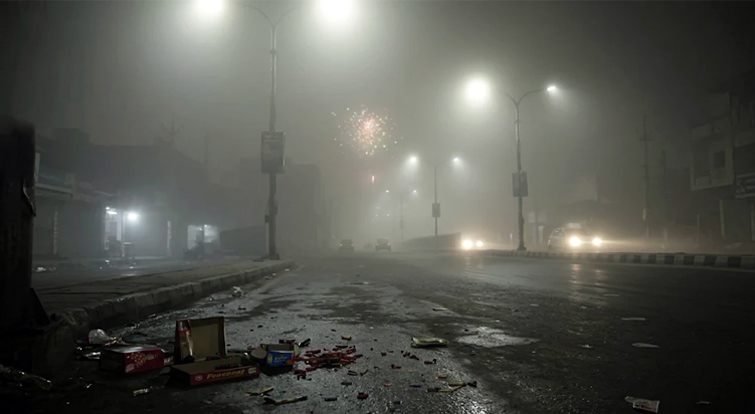
Collected Photo
Every winter, as cold air settles over South Asia and traps toxic pollutants close to the ground, a familiar script unfolds across the region.
It begins with environmental pleas and public warnings, escalates into social media outrage and cross-border finger-pointing, and ends in a familiar haze of hazardous smog as festive defiance triumphs over public health.
The cycle is played out in two major seasonal acts: first during Diwali across India, and again weeks later on New Year’s Eve (31st Night) in Bangladesh.
Despite a shared geography vulnerable to severe thermal inversions, the discourse surrounding these celebrations reveals a troubling pattern of selective environmental concern and regional hypocrisy.
The Diwali Catalyst: Appeals, Defiance, and Political Weaponisation
In India, the weeks leading up to Diwali are routinely marked by urgent appeals from environmental activists, public health experts, and digital commentators like YouTuber Dhruv Rathee urging citizens to forego firecrackers.
However, these health advisories routinely encounter severe political and social pushback that devolves into intense partisan warfare. Rather than treating atmospheric toxicity as a neutral scientific concern, political actors across party lines frequently weaponise these warnings, framing environmental restrictions through an ideological lens as selective targeting of traditional cultural practices.
This political posturing creates a culture of permission. When political figures validate non-compliance, public participation in firecracker bans drops precipitously, with segments of the urban populace deliberately increasing pyrotechnic use as an act of cultural assertion.
The consequences are immediate and severe. During Diwali 2026, air quality monitoring stations in Delhi-NCR recorded Air Quality Index (AQI) levels between 376 and 483, pushing regional air into the "Severe" category.
Across the border in Bangladesh, political commentators, news reports, and social media users routinely observe these spikes with sharp criticism, condemning the severe health hazards inflicted on the shared regional airshed.
The Mirror Effect: Dhaka’s New Year’s Eve
Yet, as the calendar turns to December 31, the same regional dynamic replays itself in Bangladesh with striking similarity.
Ahead of New Year’s Eve, the Ministry of Environment, Forest and Climate Change, alongside law enforcement agencies, issues strict directives banning fireworks, sky lanterns, and excessive noise.
Public health advocates explicitly warn of the dangers posed to infants, the elderly, and hospital patients.
Despite these regulations, midnight celebrations across Dhaka routinely see widespread non-compliance. Thousands of unauthorized pyrotechnics and firecrackers light up the capital’s skyline, sending noise levels and particulate matter surging.
Data from the Centre for Atmospheric Pollution Studies (CAPS) reveals that sound and air pollution in Dhaka spike by over 30 per cent in the first hour of the New Year alone, pushing the capital’s winter AQI past the hazardous 300 mark. Emergency hotlines receive hundreds of noise and disturbance complaints within hours.
The Shared Environmental Reality and Political Imperative
The parallel behavior in both nations underscores a broader issue: the regional air quality crisis cannot be compartmentalized by national borders or moral posturing. Both India and Bangladesh share the Indo-Gangetic Plain's winter meteorological trap—where low wind speeds, falling temperatures, and stagnant atmospheric conditions turn localized emissions into lingering toxic smog. When public defiance overrides environmental guidelines—whether framed as preserving tradition during Diwali or celebrating modern festivities on New Year's Eve—the outcome remains identical.
Environmental policy experts emphasize that political leadership across South Asia must step up as primary responders to this annual emergency, rather than acting as passive observers or active enablers. As primary responders, political leaders hold the institutional mandate to treat seasonal pollution with the same urgency as a natural disaster or security threat.
Achieving this requires elected officials to de-politicise public health by ceasing to frame environmental science as a partisan or cultural debate, instead providing clear, unified political messaging that signals air quality regulations are non-negotiable safety measures. Furthermore, political leaders must drive proactive inter-agency coordination to ensure executive bans issued by environmental ministries are actively backed by local law enforcement long before midnight celebrations begin. Finally, because pollution across the Indo-Gangetic Plain respects no sovereign borders, political leaders in Dhaka and New Delhi must establish joint regional airshed management frameworks, shifting the diplomatic dynamic from finger-pointing to collaborative policy enforcement.
Until regional discourse shifts from selective outrage to collective enforcement, and political leadership takes active ownership of the environmental crisis, seasonal festivities on both sides of the border will continue to compromise public health under a cloud of political negligence.
-EM

Loading...
Loading...
Also read






Editor : Iqbal Sobhan Chowdhury
Published by the Editor on behalf of the Observer Ltd. from Globe Printers, 24/A, New Eskaton Road, Ramna, Dhaka.
Editorial, News and Commercial Offices : Aziz Bhaban (2nd floor), 93, Motijheel C/A, Dhaka-1000.
Phone: PABX- 41053001-06; Advertisement: 41053012; 01793317829, 01550707291, 01550707296
E-mail: [email protected], [email protected]. [email protected], [email protected], [email protected], [email protected], Online-email: [email protected]


