



| HEADLINE |

|

A Critique of Islamic Economics, Finance, and Banking (Part-1)
Published : Thursday, 12 November, 2026 at 12:00 AM
Prof Dr Masudul Alam Choudhury


 Intellectual oblivion has deeply marked Islamic social sciences as also the Islamic physical sciences. Immanuel Kant’s type heteronomous divide between deductive and inductive reasoning can be found between Imam Ghazali on the one side, and Imam Shatibi and Ibn Taimiyyah on the other side. Imam Ghazali was the prime deductive philosopher even in the case when he applied his peripatetic thought to worldly artifacts. An example of this is his explanation of the fairness and authenticity of the meaning of money in terms of its level of the gold content. The analytical implications of such a dichotomy between deductive and inductive reasoning in social science are substantive. These early Islamic scholastics dichotomized the outlook of economic and social activities between microeconomics and macroeconomics, between individual preferences and institutional regulations.
An example is the role of individual behavior in human consciousness by Imam Ghazali. This perspective had a microeconomics and psychological meaning. On the other hand, Ibn Taimiyyah’s idea of social regulation was an institutional form which had a macroeconomic implication. Imam Shatibi formulated his theory of the purpose and objective of the shari’ah (Islamic law), known as maqasid as-shari’ah, which too was largely a macroeconomic social behavior recommended upon institutions. This kind of early dichotomy in social thought regarding micro and macro socioeconomic categories was a sign of heteronomy contrary to the otherwise needed unity of knowledge as the epistemic reality unifying the micro and macro world-systems into an organically interactive holism -- mesoscience. This latter delineation of the unified world-system is a manifest sign of the ontological Law of Tawhid (qur’anic monotheism) in intellection of the primacy of unity of knowledge. This substantive methodological worldview overarched all the transdisciplinary areas of meta-scientific thought.
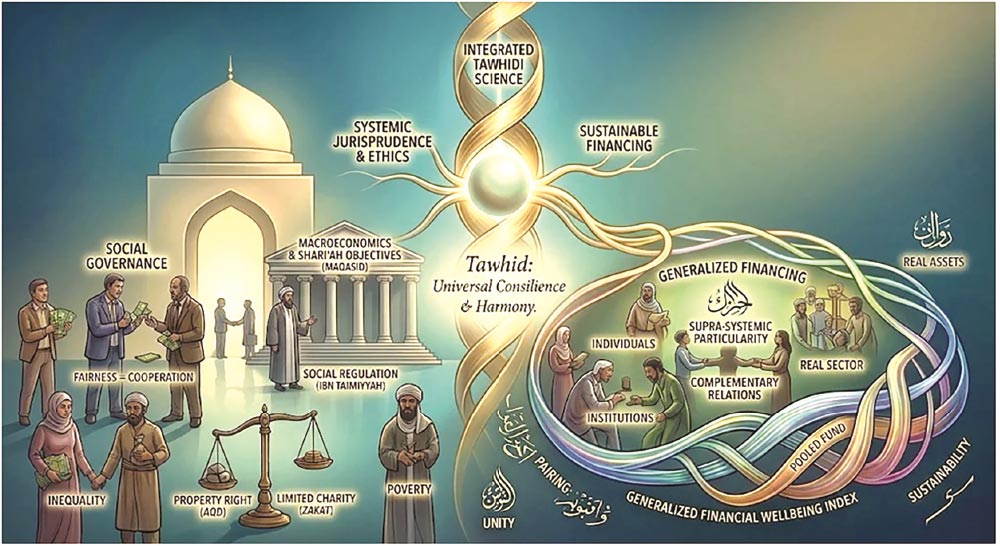 The result of such an analytical remiss among the Islamic scholastics and the modern days’ scholarly Islamicists in various categories of the sciences has been to carry through the heteronomy of the otherwise unified reasoning in the light of Tawhid as universal consilience. Such a differentiated approach to studying the otherwise organically unified qur’anic science conveying the ontological Law of Tawhid, has most sorrowfully been the project of Islamicization of knowledge or education. The demeaning implications have extended into so-called Islamic economics and finance.
The Muslim scholarship to date has failed in contributing a generalized systemic worldview and explain the sub-systemic particulars by the general theory. Yet this is the master Tawhidi worldview of the Qur’an. It remains to be emulated. An attempt is seen as a hopeful glimmer to emulate in modern times. Jasser Auda writes in that hopeful tone: “ ‘Islamic systems philosophy’ is an idea to propose with its promises. The proposed new Islamic philosophy could benefit from system philosophy’s critique of both modernism and postmodernism, in order to critique the Islamic versions of modernism and postmodernism.”
The Qur’an (67:3) presents this grand design of the universe in terms of its abstraction and physicalism in the following verse understood by exegesis: “Who hath created seven heavens in harmony. Thou (Muhammad) canst see no fault in the Beneficent One's creation; then look again: Canst thou see any rifts?” The Qur’an (65:12) declares regarding the overarching domain of Allah’s command, the primal ontological Law of Tawhid across the generality of ‘everything’: “God is He Who created seven Firmaments and of the earth a similar number. Through the midst of them (all) descends His Command: that you may know that God has power over all things, and that God comprehends all things in (his) Knowledge.” Furthermore, the place of the Prophetic teachings is certified by the Qur’an (65:11): “An Apostle, who rehearses to you the Signs of God containing clear explanations, that he may lead forth those who believe and do righteous deeds from the depths of Darkness into Light…”
Some examples of incorrect Islamic economic view among many
Much of the erroneous understanding on Islamic economic matters arise from the absence of understanding Islamic jurisprudential interpretation (fiqh) from its generalized organic relational viewpoint that characterizes the manifestation of Tawhid in the order of things. Such manifestation according to the system viewpoint of organically relational unity of knowledge and its Tawhidi implication gives a dichotomous view of self-acquisition.
The interactive dynamics of property right in maqasid as-shari’ah
For instance, one of the elements of maqasid as-shari’ah is property right. Using this permissibility, a shareholder can legitimize his acquisition of inordinate wealth within the narrow limits of charity. Consequently, inequality of wealth in society is not resolved even by the marginal use of limited charity (zakat, sadaqah). Besides, as in Saudi Arabia today, there is no organized institution of the charity of zakat to form a grassroots development fund. Poverty alleviation, income generating ability, human resource development, and microentrepreneurial activities do not evolve. The productive objective of charity is lost even as the element of property right is upheld with only a marginal use of charity as poor due.
Generalized Islamic financial wellbeing index contra individual contracts (aqd)
Another example of the generalized formalism of activities in the light of their pairing possibility cannot be found in so-called Islamic financing. The legitimate condition of a realized permissible asset by ownership, as of the contract of property right is called aqd. Aqd can be attained by holding individual financing instruments for earning profits and wealth.
The formalism of the pooled fund financing index simulated by interaction, integration, and evolutionary advance between all the instruments taken together conveys the Tawhidi implication of sustainability of the financial and real sectors and for each and all of the instruments. The functioning of the pooled fund or the financial wellbeing index is characterized by all the features of system science approach. These comprise cognitive feature represented by the functionality of unity of knowledge as Tawhidi pairing by organic interrelationships between the financing instruments. The holism of the system approach is reflected in the totality of the Tawhidi epistemic unity by complementary pairing (deep exegesis of Qur’an 36:36). Interrelated hierarchy of the system approach is reflected in the inter-causality of organic relations of complementarities between the financing and real sector variables. The evolutionary learning processes of simulacra of the financial wellbeing index conveys the sustainability meaning of the knowledge-induced systemic openness in its holism.
(To be continued)
The writer is a retired Professor of Economics, Cape Breton University, Nova Scotia, Canada

Loading...
Loading...
Also read



Editor : Iqbal Sobhan Chowdhury
Published by the Editor on behalf of the Observer Ltd. from Globe Printers, 24/A, New Eskaton Road, Ramna, Dhaka.
Editorial, News and Commercial Offices : Aziz Bhaban (2nd floor), 93, Motijheel C/A, Dhaka-1000.
Phone: PABX- 41053001-06; Advertisement: 41053012; 01793317829, 01550707291, 01550707296
E-mail: [email protected], [email protected]. [email protected], [email protected], [email protected], [email protected], Online-email: [email protected]


