



| HEADLINE |

|

5 teachers keep struggling school running without pay


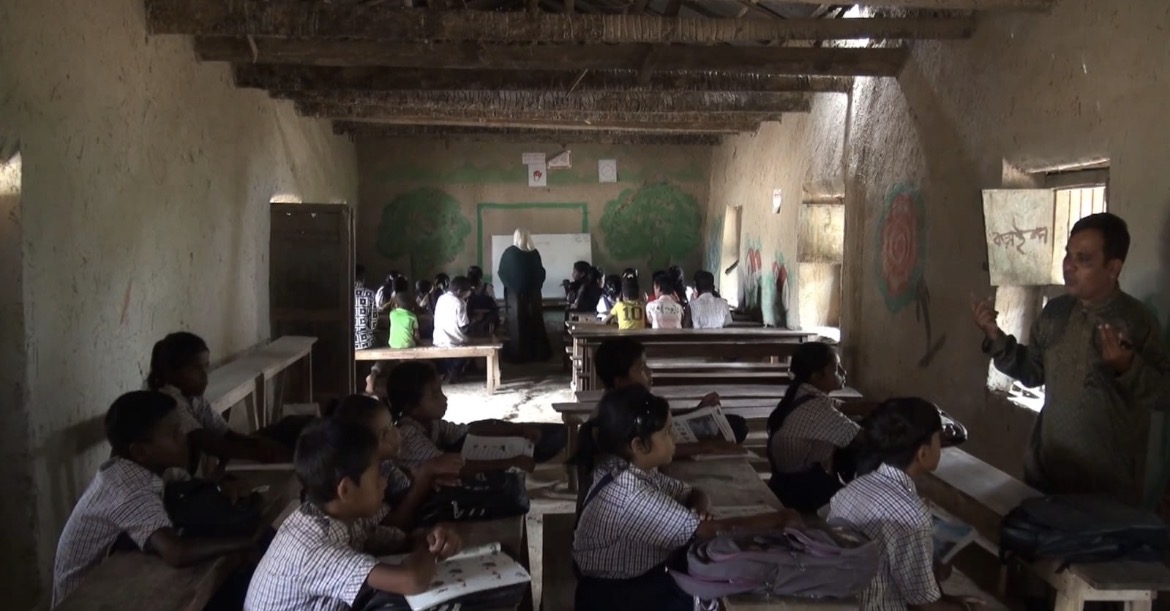
Around 120 children are continuing their primary education in a dilapidated school in Gomostapur upazila of Chapainawabganj, where five teachers are providing lessons without salaries despite a severe shortage of basic facilities.
The students have no access to safe drinking water and reportedly have to drink water from a drain when thirsty. The school also lacks electricity, hygienic toilets, adequate classroom furniture and a safe learning environment.
The situation at Barail Non-Government Primary School in Barail village under Parbatipur union has raised concerns over the education of children from indigenous and small ethnic communities living in the area.
The school building is made of mud walls and has a rusted tin roof riddled with holes.The institution has no electricity connection or hygienic toilet facilities. The absence of safe drinking water is particularly concerning, exposing children to potential health risks.
According to local sources, the school began its journey in 1985 as Barail Mission School. Its educational activities were suspended after the missionaries left the area. The institution was reopened under a new name in 2008 and has continued operating despite persistent challenges.
Around 120 students are currently enrolled at the school. Most residents of Barail village belong to indigenous and small ethnic communities, and many families are financially disadvantaged. The institution serves as one of the main sources of primary education for their children.
Students from seven to eight surrounding villages also attend the school. There is no alternative educational institution within a five-kilometre radius, making it particularly important for children in the area. Local residents fear that many children, especially those from indigenous communities, could be deprived of primary education if the school closes.
Despite these conditions, five teachers continue teaching without receiving any salaries or allowances. They are keeping the institution running through their own efforts and commitment to the children’s education.
Students said the lack of safe drinking water was one of their biggest concerns. They also complained about the damaged roof, inadequate benches, lack of electricity and poor toilet facilities.
Headteacher Pranab Kumar Barman said the teachers were continuing their work with dedication despite the lack of facilities and financial support.
He said the dilapidated building, shortage of safe drinking water and inadequate educational materials were affecting teaching activities.
Barman called for government recognition and infrastructure development, saying these would improve the learning environment and benefit both students and teachers.
Gomostapur Upazila Nirbahi Officer Md Zillur Rahman said the authorities were aware of the school’s poor condition and would visit the institution to assess the situation.
He said the issues, including the lack of safe drinking water and the damaged building, were being taken seriously. Necessary steps would be considered in coordination with the relevant departments to ensure a safe learning environment for the children.
Assistant District Primary Education Officer Md Abdur Razzak said officials had already inspected the school and identified its longstanding infrastructure problems, including the damaged building, inadequate classrooms and lack of safe drinking water.
He said efforts would be made to take initiatives for constructing a new building and improving facilities for students.
Regarding government recognition, he said the matter would have to be considered in accordance with the relevant policies and regulations.
They also called for the government to consider the situation of the five unpaid teachers and ensure that children from indigenous and small ethnic communities in the area are not deprived of education.





Published by the Editor on behalf of the Observer Ltd. from Globe Printers, 24/A, New Eskaton Road, Ramna, Dhaka.
Editorial, News and Commercial Offices : Aziz Bhaban (2nd floor), 93, Motijheel C/A, Dhaka-1000.
Phone: PABX- 41053001-06; Advertisement: 41053012; 01793317829, 01550707291, 01550707296
E-mail: [email protected], [email protected]. [email protected], [email protected], [email protected], [email protected], Online-email: [email protected]


