



| HEADLINE |

|

Woman physician's fight to revive a dying river
Her solo initiative inspires volunteers to clear water hyacinth from the Bhairab River
Published : Thursday, 12 November, 2026 at 12:00 AM
Sakirul Kabir Riton


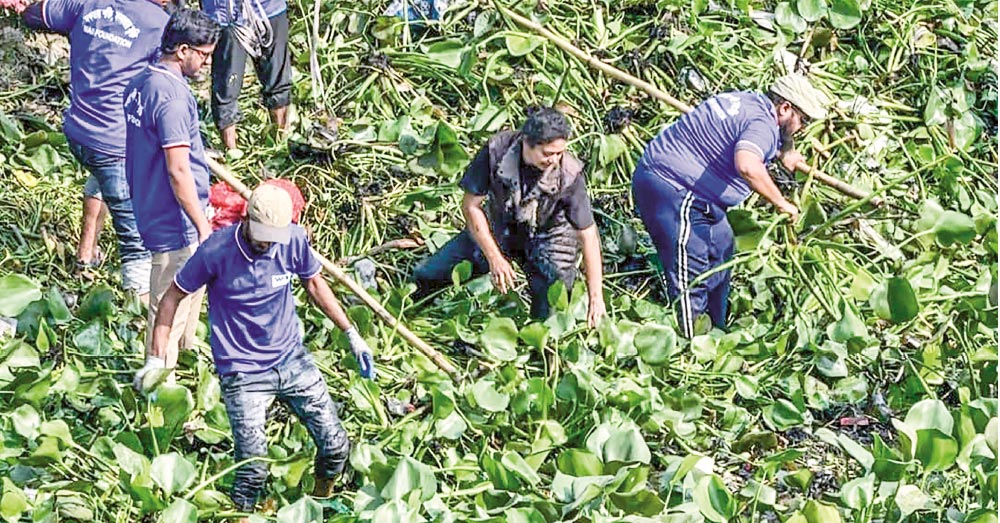 JASHORE, Nov 11: Once a vibrant waterway where boats sailed across clear waters reflecting the sky, the historic Bhairab River in Jashore is now struggling to survive under a thick blanket of water hyacinth and waste, including medical refuse.
Determined to restore its lost beauty and vitality, physician Dr Sadia Manowara Usha has taken the initiative to clear the river of water hyacinth, inspiring volunteers and social organisations to join her campaign.
Inspired by Prime Minister Tarique Rahman's recent initiative to excavate canals and rivers across the country, Dr Usha initially started the cleanup operation on her own.
She spent the first two days removing water hyacinth before appealing for public participation through Facebook. Her call soon drew members of several voluntary organisations to the initiative.
A cleanup drive began at 9am on Monday near Daratana Bridge in Jashore town, with members of We Are Bangladesh Foundation, BD Clean and SASS joining the effort. They spent around two to three hours clearing water hyacinth from the river.
"Bangladesh is a riverine country. Our relationship with rivers is as deep as our relationship with our mothers. When rivers smile, we smile; when rivers survive, we survive," Dr Usha said.
Expressing concern over the deteriorating condition of the Bhairab, widely regarded as the lifeline of Jashore, she said it was unacceptable to see a historically significant river gradually lose its character and natural beauty.
She recalled that the river once served as an important waterway for the movement of kings and rulers. The shrine of Hazrat Garib Shah, a prominent disciple of Hazrat Khan Jahan Ali (RA), is also situated along its banks, adding to the river's historical and cultural significance.
Participants said a previous government had taken initiatives to excavate the river, expressing hope that the present government would undertake a comprehensive restoration plan and ensure its proper implementation.
The organisers initially planned to continue the cleanup drive daily, depending on the availability of manpower and support. They hope to expand the initiative by bringing more individuals and organisations on board.
However, volunteers expressed disappointment over what they described as the lack of effective action by relevant authorities, including the municipality, district administration and Water Development Board.
They said protecting rivers should primarily be the responsibility of government agencies, but the lack of visible action had compelled ordinary citizens to take matters into their own hands.
According to the volunteers, they have already approached several relevant authorities seeking assistance, but have yet to receive any definite assurance of support.
They stressed that voluntary efforts alone would not be enough to save the Bhairab. A coordinated initiative involving the administration, local government bodies, environmental organisations and residents is essential to restore the river's natural flow and maintain its ecological balance.
For the people of Jashore, restoring the Bhairab means more than clearing water hyacinth. It is about reclaiming a part of their history, environment and collective identity.
The volunteers hope that sustained public participation, backed by meaningful government intervention, will eventually restore the river's lost beauty and vitality, allowing boats to sail through its waters once again and residents to enjoy the refreshing breeze along its banks.

Loading...
Loading...
Also read



Editor : Iqbal Sobhan Chowdhury
Published by the Editor on behalf of the Observer Ltd. from Globe Printers, 24/A, New Eskaton Road, Ramna, Dhaka.
Editorial, News and Commercial Offices : Aziz Bhaban (2nd floor), 93, Motijheel C/A, Dhaka-1000.
Phone: PABX- 41053001-06; Advertisement: 41053012; 01793317829, 01550707291, 01550707296
E-mail: [email protected], [email protected]. [email protected], [email protected], [email protected], [email protected], Online-email: [email protected]


