



| HEADLINE |

|

Info Commission unveils 100-day roadmap
Published : Friday, 13 November, 2026 at 12:00 AM
Staff Correspondent


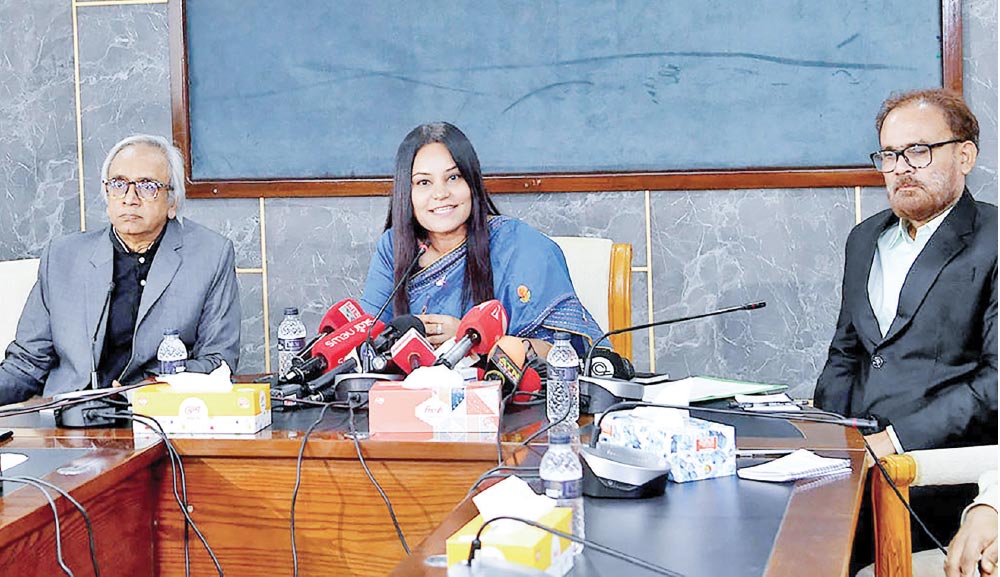 The Information Commission has announced a 100-day plan to become an independent and stronger institution after remaining largely inactive for more than two years.
The plan includes hearing pending complaints, holding Right to Information (RTI) fairs at schools and universities, training journalists and content creators, and monitoring the use of public and foreign aid funds.
Hearing of 917 pending complaints begins from Nov 16
The newly appointed Chief Information Commissioner, Dr. Nahreen Islam Khan, announced the plan at a press briefing at the Information Commission's office in Agargaon, Dhaka, on Thursday.
She said hearings on complaints pending with the commission would begin on 16 November. A total of 917 complaints were filed over the past two years. More than 200 new complaints have also been received since she took office on 18 October.
Nahreen said the commission would remain neutral and work for neither the government nor any political group.
"The Information Commission will not be on the side of the people or the government; it will remain neutral," she said.
She described the Right to Information Act as a law that allows citizens to question the government and demand accountability.
As part of the plan, the commission will organise RTI fairs at seven universities in Dhaka, including three public and four private universities, in late November.
The week-long programme will help students learn how to use the law to raise their demands through legal means.
Similar fairs will be held at schools from next week with support from non-government organisations working on access to information.
The commission also plans to train journalists, content creators and political leaders on the right to information and the importance of following legal ways to raise public demands.
Nahreen said the commission was monitoring whether government and foreign-funded organisations publish their budget information on their websites. Organisations that fail to disclose such information may be asked to explain their spending.
"Every single taka spent belongs to you and me. We have the right to know where our money is being spent," she said.
She also said the commission would work to introduce information disclosure policies at universities.
The commission is facing a staff shortage. Although its approved structure allows for 76 officials and employees, only 22 are currently working there.
After completing the 100-day plan, the commission hopes to open offices at district level next year. It also plans to introduce digital services so that applicants automatically receive confirmation when their complaints are submitted.
Information Commissioner S A M Mahfuzur Rahman said the media had a key role in ensuring people's right to information.
He urged journalists to seek the commission's help if they faced barriers while collecting information for investigative reports.
Another commissioner, Khan Mohammad Abul Hossain, said the right to information was an important part of freedom of speech.
The government recently appointed Dr. Nahreen Islam Khan, a professor at Jahangirnagar University, as chief information commissioner, along with journalists S A M Mahfuzur Rahman and Khan Mohammad Abul Hossain as information commissioners, bringing the commission back into operation after more than two years.

Loading...
Loading...
Also read



Editor : Iqbal Sobhan Chowdhury
Published by the Editor on behalf of the Observer Ltd. from Globe Printers, 24/A, New Eskaton Road, Ramna, Dhaka.
Editorial, News and Commercial Offices : Aziz Bhaban (2nd floor), 93, Motijheel C/A, Dhaka-1000.
Phone: PABX- 41053001-06; Advertisement: 41053012; 01793317829, 01550707291, 01550707296
E-mail: [email protected], [email protected]. [email protected], [email protected], [email protected], [email protected], Online-email: [email protected]


