



| HEADLINE |

|

How did Friday get its name?
The history behind the seven-day week
Published : Friday, 13 November, 2026 at 12:47 PM
Abida Jannat Mohima


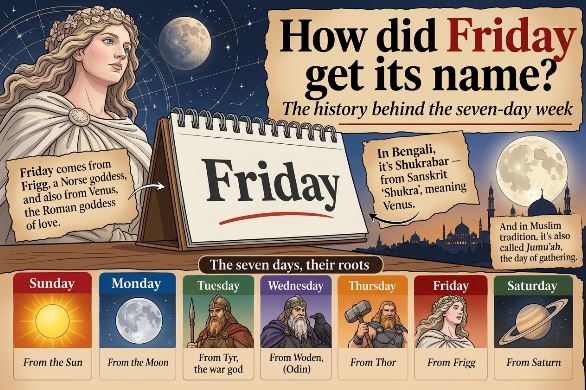
The names of the seven days of the week are so familiar that people rarely stop to think about their origins. However, each name carries a history shaped by ancient civilisations, astronomy, mythology and religious traditions. Friday, in particular, has an interesting connection to Norse mythology, while its Bengali name, Shukrabar, comes from the Sanskrit word for the planet Venus.

The system later spread through the Roman Empire, where each day was named after a celestial body or a Roman deity. Over time, Germanic and Anglo-Saxon cultures adapted the Roman naming system by replacing several Roman gods with their own deities.
How did Friday get its name?
The English word Friday originated from the Old English word Frīgedæg, meaning 'Day of Frigg'. Frigg was an important goddess in Norse mythology and the wife of Odin, the chief god. She was associated with marriage, family, motherhood and love.
In ancient Rome, Friday was known as Dies Veneris, meaning 'Day of Venus'. Venus was the Roman goddess of love and beauty. When Germanic people adopted the Roman system of naming days, they associated Venus with their own goddess Frigg. This adaptation eventually gave rise to the English name Friday.
There is also some debate over whether Friday was named after Frigg or Freyja, another prominent goddess in Norse mythology. Both were associated with love and other aspects of life, making their historical connections difficult to distinguish.
How did the other days get their names?
The remaining six days of the week also have links to ancient gods and celestial bodies.

Tuesday was named after Tiw, a Germanic god of war, who was associated with the Roman god Mars. Wednesday comes from Wodnesdæg, meaning the day of Woden, another name for Odin in Anglo-Saxon tradition.
Thursday originated from Þunresdæg, meaning the day of Thor, the Norse god of thunder. Saturday comes from the Roman god Saturn and was originally known as Sæternesdæg in Old English.
Thus, the English names of the week reflect a combination of Roman and Germanic traditions, with the Sun and Moon also influencing the naming system.
Why is Friday called Shukrabar in Bengali?
Unlike the English name, the Bengali word Shukrabar has its roots in Sanskrit. The word is formed from 'Shukra', meaning the planet Venus, and 'bar', meaning day.

In ancient Indian astronomy, each day of the week was associated with a particular celestial body. Accordingly, Friday became Shukrabar, or the day of Venus.
The same naming tradition can be seen in other Bengali days. Sunday is Robibar, Monday is Sombar, Tuesday is Mongolbar, Wednesday is Budhbar, Thursday is Brihospotibar and Saturday is Shonibar.
Why is Friday also called Jumu'ah?
In Muslim communities, Friday is also known as Jumu'ah or Jumabar. The Arabic word Jumu'ah means gathering or assembly.

Friday holds special religious significance in Islam because Muslims gather at mosques to perform the weekly congregational Jumu'ah prayer. The Quran's Surah Al-Jumu'ah instructs believers to leave business activities and respond to the call to prayer.
As a result, Jumabar is widely used alongside Shukrabar in Bangladesh and other Muslim communities.
Why does a week have seven days?
The seven-day week developed through a combination of ancient astronomical observations and religious traditions. The Babylonians associated the number seven with celestial bodies, while the Jewish tradition established the seventh day as a day of rest, known as the Sabbath.
The seven-day cycle later became widely established across the Roman Empire and was adopted by different religious and cultural communities. Christianity and Islam also incorporated the seven-day week into their traditions.
Today, the seven-day week is used almost universally, although the starting day varies across countries and calendar systems. Under the international ISO 8601 standard, Monday is considered the first day of the week, while many calendars place Sunday first.
What appears to be an ordinary name on the calendar is therefore the result of thousands of years of cultural exchange, religious beliefs and astronomical traditions.
The seven-day week has roots in ancient Babylonian civilisation, where people attached significance to seven celestial bodies visible in the sky: the Sun, Moon, Mars, Mercury, Jupiter, Venus and Saturn. These bodies were associated with the seven days of the week.
The system later spread through the Roman Empire, where each day was named after a celestial body or a Roman deity. Over time, Germanic and Anglo-Saxon cultures adapted the Roman naming system by replacing several Roman gods with their own deities.
How did Friday get its name?
The English word Friday originated from the Old English word Frīgedæg, meaning 'Day of Frigg'. Frigg was an important goddess in Norse mythology and the wife of Odin, the chief god. She was associated with marriage, family, motherhood and love.
In ancient Rome, Friday was known as Dies Veneris, meaning 'Day of Venus'. Venus was the Roman goddess of love and beauty. When Germanic people adopted the Roman system of naming days, they associated Venus with their own goddess Frigg. This adaptation eventually gave rise to the English name Friday.
There is also some debate over whether Friday was named after Frigg or Freyja, another prominent goddess in Norse mythology. Both were associated with love and other aspects of life, making their historical connections difficult to distinguish.
How did the other days get their names?
The remaining six days of the week also have links to ancient gods and celestial bodies.
Sunday comes from the Old English Sunnandæg, meaning the day of the Sun. Monday originated from Monandæg, meaning the day of the Moon.
Tuesday was named after Tiw, a Germanic god of war, who was associated with the Roman god Mars. Wednesday comes from Wodnesdæg, meaning the day of Woden, another name for Odin in Anglo-Saxon tradition.
Thursday originated from Þunresdæg, meaning the day of Thor, the Norse god of thunder. Saturday comes from the Roman god Saturn and was originally known as Sæternesdæg in Old English.
Thus, the English names of the week reflect a combination of Roman and Germanic traditions, with the Sun and Moon also influencing the naming system.
Why is Friday called Shukrabar in Bengali?
Unlike the English name, the Bengali word Shukrabar has its roots in Sanskrit. The word is formed from 'Shukra', meaning the planet Venus, and 'bar', meaning day.
The same naming tradition can be seen in other Bengali days. Sunday is Robibar, Monday is Sombar, Tuesday is Mongolbar, Wednesday is Budhbar, Thursday is Brihospotibar and Saturday is Shonibar.
Why is Friday also called Jumu'ah?
In Muslim communities, Friday is also known as Jumu'ah or Jumabar. The Arabic word Jumu'ah means gathering or assembly.
As a result, Jumabar is widely used alongside Shukrabar in Bangladesh and other Muslim communities.
Why does a week have seven days?
The seven-day week developed through a combination of ancient astronomical observations and religious traditions. The Babylonians associated the number seven with celestial bodies, while the Jewish tradition established the seventh day as a day of rest, known as the Sabbath.
The seven-day cycle later became widely established across the Roman Empire and was adopted by different religious and cultural communities. Christianity and Islam also incorporated the seven-day week into their traditions.
Today, the seven-day week is used almost universally, although the starting day varies across countries and calendar systems. Under the international ISO 8601 standard, Monday is considered the first day of the week, while many calendars place Sunday first.
What appears to be an ordinary name on the calendar is therefore the result of thousands of years of cultural exchange, religious beliefs and astronomical traditions.

Loading...
Loading...
Also read









Editor : Iqbal Sobhan Chowdhury
Published by the Editor on behalf of the Observer Ltd. from Globe Printers, 24/A, New Eskaton Road, Ramna, Dhaka.
Editorial, News and Commercial Offices : Aziz Bhaban (2nd floor), 93, Motijheel C/A, Dhaka-1000.
Phone: PABX- 41053001-06; Advertisement: 41053012; 01793317829, 01550707291, 01550707296
E-mail: [email protected], [email protected]. [email protected], [email protected], [email protected], [email protected], Online-email: [email protected]


