



| HEADLINE |

|

Steel Industry in Meltdown: 25pc of Factories Shut, Demand Crashes 38pc
Published : Sunday, 15 November, 2026 at 12:00 AM
Shamsul Huda


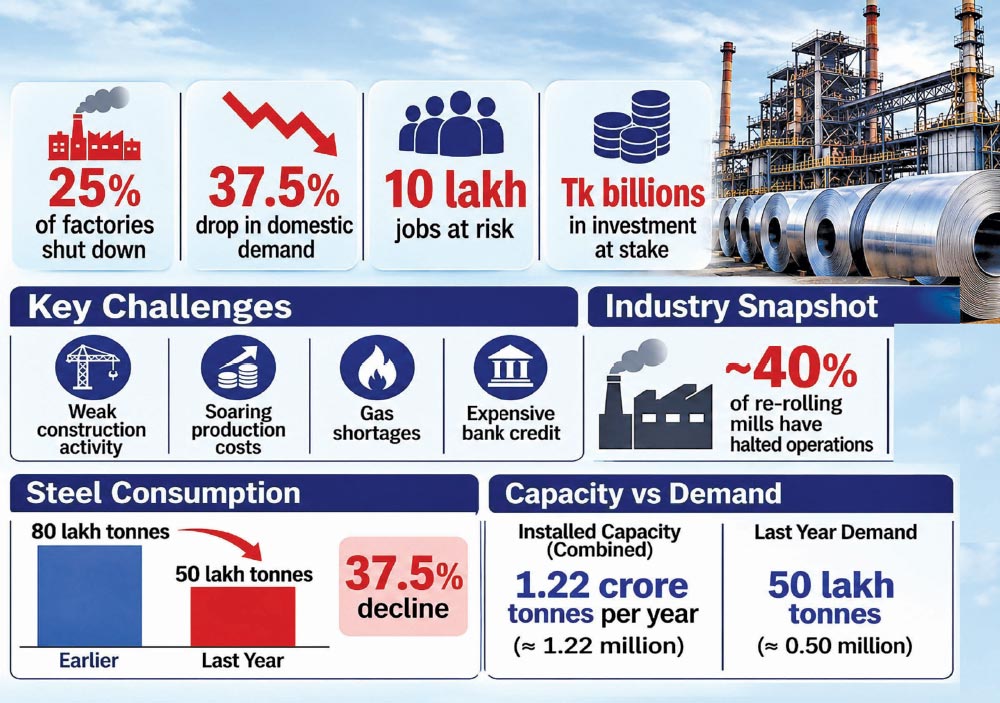 Bangladesh's steel industry is facing a deepening crisis, with nearly 25 per cent of factories shut down and domestic demand plunging 37.5 per cent, leaving billions in investment and around 10 lakh jobs at risk amid weak construction activity, soaring production costs, gas shortages and expensive bank credit.
Nearly 40 per cent of re-rolling mills have suspended operations, while even major producers such as BSRM have been forced to slash output as manufacturers struggle with shrinking orders and mounting operational costs.
Bangladesh Steel Manufacturers Association (BSMA) President Mohammad Jahangir Alam said annual domestic steel consumption fell to around 50 lakh tonnes last year from nearly 80 lakh tonnes previously.
He, however, sees early signs of recovery as government fund disbursements resume and the peak construction season approaches.
"Demand is recovering. It was slow during the off-season, but now the market is picking up. The government has started disbursing funds, and we expect better business this year. The peak season normally starts in December," he told The Observer.
The industry's structural weaknesses, however, remain largely unresolved.
Bangladesh has around 40 modern steel mills and more than 150 re-rolling mills, with a combined annual installed capacity of approximately 1.22 crore tonnes, according to the BSMA. But consumption of just 50 lakh tonnes last year left a huge volume of production capacity idle.
Jahangir Alam said around 25 per cent of factories were completely shut, while operational mills had a combined estimated capacity of 80 lakh tonnes, still far exceeding market demand.
The sharp decline in public development spending has been a major factor behind the demand slump. Government infrastructure projects, which previously accounted for around 60 per cent of domestic steel consumption, now contribute only about 20 per cent, according to industry estimates.
Delays in roads, bridges, railways, flyovers, power plants and other infrastructure projects have directly reduced demand for steel rods, billets and other construction materials.
The Annual Development Programme (ADP) implementation rate stood at only 67.52 per cent in FY26, the lowest in five years. Government agencies spent Tk1.41 lakh crore against a revised allocation of Tk2.09 lakh crore.
The slowdown continued in the first quarter of FY27, when ministries and divisions spent just Tk12,018 crore, or 3.89 per cent of the annual ADP allocation, during July-September, against 5.09 per cent in the corresponding period a year earlier.
Weak private investment and sluggish property development have further constrained sales, leaving manufacturers heavily dependent on a recovery in public infrastructure spending.
The government has approved 12 development projects worth Tk1,68,780 crore through the Executive Committee of the National Economic Council (ECNEC), raising hopes of fresh orders. However, manufacturers say actual fund releases and construction work, rather than project approvals alone, will determine whether demand recovers.
Meanwhile, rising energy costs are squeezing profit margins. The government increased electricity tariffs for industrial consumers by around 17.86 per cent in June 2026, adding an estimated Tk1,800 to Tk2,000 per tonne to steel production costs, according to industry estimates.
Frequent power disruptions, inadequate gas pressure, expensive imported scrap metal and higher transportation costs have compounded the pressure.
"Many mills have excess capacity, but the problem is not only demand. Existing factories are also not getting the gas they need," Jahangir Alam said.
Access to bank financing has emerged as another major obstacle. He said only around 20 banks were currently in a strong position to provide financing to the steel industry.
High borrowing costs and limited working capital are restricting manufacturers' ability to import raw materials, sustain production and meet operating expenses, even when orders become available.
Higher market prices have offered little relief. According to the Trading Corporation of Bangladesh, 60-grade mild steel rods sold for Tk92,500 to Tk94,500 per tonne in early October, up from Tk83,500 to Tk86,000 a year earlier.
Manufacturers, however, say rising production and financing costs, coupled with discounts offered to secure orders, are eroding their margins.
Industry leaders expect demand to improve in the coming months as government spending resumes and construction activity gathers pace during the peak season.
But a seasonal recovery alone may not be enough to reverse the downturn. Sustained infrastructure spending, reliable energy supplies and affordable financing will be essential to revive production, protect investment and safeguard the industry's 10 lakh direct and indirect jobs.

Loading...
Loading...
Also read



Editor : Iqbal Sobhan Chowdhury
Published by the Editor on behalf of the Observer Ltd. from Globe Printers, 24/A, New Eskaton Road, Ramna, Dhaka.
Editorial, News and Commercial Offices : Aziz Bhaban (2nd floor), 93, Motijheel C/A, Dhaka-1000.
Phone: PABX- 41053001-06; Advertisement: 41053012; 01793317829, 01550707291, 01550707296
E-mail: [email protected], [email protected]. [email protected], [email protected], [email protected], [email protected], Online-email: [email protected]


