



| HEADLINE |

|

Milk without the milk
Fake dairy trade puts consumers at serious health risks
Published : Sunday, 15 November, 2026 at 12:00 AM
Arifur Rahman Rabbi


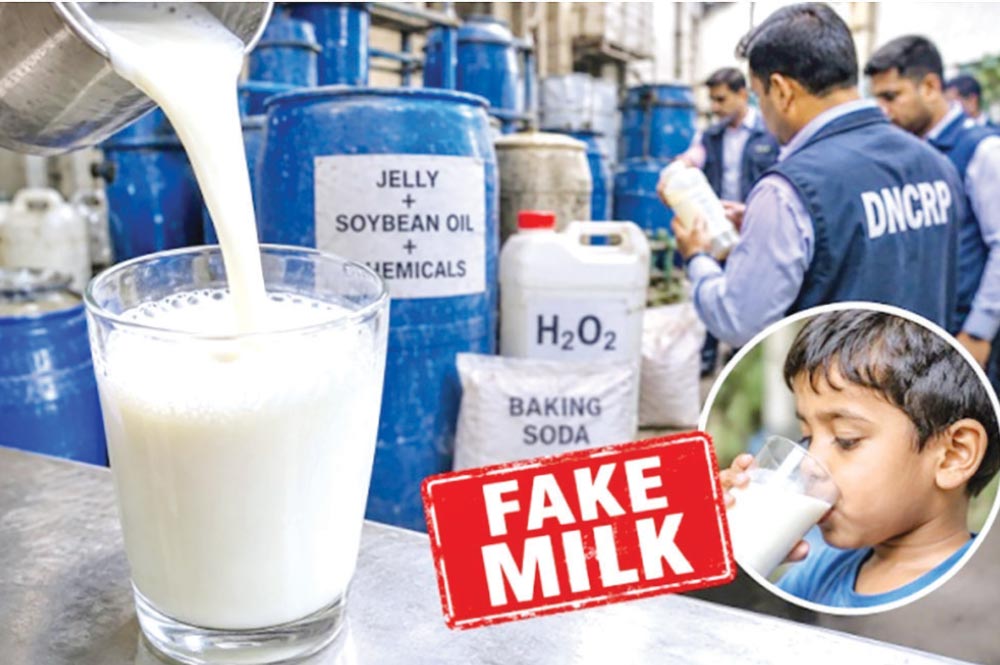 It looks like milk, pours like milk and even produces the familiar layer of foam when shaken or poured into a container. But behind its white appearance and creamy consistency may be a disturbing mix of jelly, soybean oil, palm oil and industrial chemicals, with little or no genuine cow's milk.
The production of such counterfeit milk has emerged as a serious food safety concern, with recent raids exposing several illegal manufacturing facilities in Pabna, where officials seized fake milk and ingredients allegedly used to produce it.
The administration and the Directorate of National Consumer Rights Protection (DNCRP) have uncovered several such facilities in Bhangura, Bera and Faridpur, raising concerns about how much adulterated milk may have entered the country's supply chain.
During the drives, officials seized fake milk, jelly, edible oils, bleaching powder, baking soda and other substances, including hydrogen peroxide.
According to media reports, raids on two establishments in Faridpur, Pabna, on October 10 uncovered evidence of hydrogen peroxide being mixed with milk at one facility and equipment used to manufacture milk-like liquid from jelly and edible oil at another. The establishments were fined Tk 1 lakh, one was temporarily sealed, and an individual was sentenced to 15 days in jail.
Earlier, on the night of September 29, officials seized palm oil, bleaching powder and other ingredients in Bera and fined an individual Tk1 lakh.
Another raid in Bhangura on October 30 resulted in the seizure of 320 litres of fake milk, 2,700 kilogrammes of jelly and 200 kilogrammes of soybean oil.
Two people were fined a total of Tk2.5 lakh and sentenced to jail.
Local sources and factory workers said one or two factories in the area supply 300 to 500 litres of adulterated milk daily to sweet shops and packaged milk manufacturers in different parts of the country.
The revelations are particularly alarming because Pabna, Sirajganj and neighbouring areas are major milk-producing regions, supplying raw milk for the manufacture of ghee, sweets and other dairy products across the country.
Sources familiar with the process described different methods of producing the counterfeit liquid. In one method, half a litre of milk is mixed with soybean oil and diluted with white water. Sugar is then added to increase the lactose reading, reportedly pushing it above 30, higher than the level found in genuine cow's milk.
Another process involves mixing leftover whey from chhana (curd cheese) production with cream, salt, baking soda, sugar, caustic soda, skimmed milk powder and palm oil before blending them into a milk-like liquid. Formalin is allegedly added to preserve freshness, while skimmed milk powder increases its density, making adulteration difficult to detect through conventional lactometer tests.
The alleged practice has raised alarm among parents, who fear that even an essential food like milk may no longer be safe for their children.
Speaking to The Daily Observer, several parents, including Afsana Akter, an employee of a private company, expressed anger and frustration over the production of fake milk. They questioned what they should feed their children if milk, like many other food products, could also be adulterated.
They said fines and short jail terms would not deter those involved and called for exemplary punishment.
Public health experts have also warned of potentially serious consequences, particularly for children.
Dr Zakia Ferdousi Khanam told this correspondent that children were especially vulnerable to harmful chemicals because their organs, immune systems and digestive systems were still developing. Prolonged exposure could damage liver and kidney functions and lead to other health complications, she said.
Dr Mahfuza Mubarak, a professor of the Department of Public Health and Informatics at Jahangirnagar University, said chemicals such as caustic soda and urea used in fake milk could cause digestive problems and stomach infections in the short term.
Long-term consumption could increase the risk of liver and kidney damage, fatty liver and liver cirrhosis, she warned, calling for regular and surprise testing of milk and stronger market surveillance.
Adding to the food safety concerns, a study by Jashore University of Science and Technology found microplastics in every sample of raw milk, packaged liquid milk, powdered milk and other dairy products available in the Bangladeshi market.
Researchers said the findings presented a new challenge to food safety and public health, with children potentially facing greater exposure because of their higher milk consumption.
Experts said stronger coordination was needed among the Bangladesh Food Safety Authority, Bangladesh Standards and Testing Institution (BSTI), DNCRP, Department of Livestock Services, local administration and testing laboratories to curb the trade.
They stressed that monitoring should cover the entire supply chain, from production and processing to distribution and marketing.
Md Zahirul Islam, director general of the DNCRP, said that fines alone would not be sufficient to stop the production and sale of fake milk.
He said the directorate was preparing an action plan in coordination with upazila administrations to identify factories and areas involved in the business and assess the problems.
The plan includes awareness campaigns, meetings and rallies at the upazila level, alongside regular raids. Those found producing fake milk despite these measures would face strict legal action, he added.

Loading...
Loading...
Also read



Editor : Iqbal Sobhan Chowdhury
Published by the Editor on behalf of the Observer Ltd. from Globe Printers, 24/A, New Eskaton Road, Ramna, Dhaka.
Editorial, News and Commercial Offices : Aziz Bhaban (2nd floor), 93, Motijheel C/A, Dhaka-1000.
Phone: PABX- 41053001-06; Advertisement: 41053012; 01793317829, 01550707291, 01550707296
E-mail: [email protected], [email protected]. [email protected], [email protected], [email protected], [email protected], Online-email: [email protected]


