



| HEADLINE |

|

Ctg Port becoming a ‘landlord port’
Foreign operators to handle all its operations
Published : Sunday, 15 November, 2026 at 12:00 AM
Nurul Amin


 CHATTOGRAM, Nov 14: The main sea port of the country, Chattogram Port, is going to become a ‘Landlord Port’ handing over all its operational activities to the private and foreign operators.
According to Chattogram Port Authority (CPA) sources, the process of all operational activities of the Chattogram Port to privatise to operators of home and abroad has already started.
Under this model, the port authority acts as regulatory body and as a landlord, while port operations (especially cargo handling) are carried out by private companies.
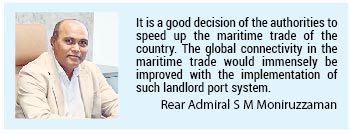
“It is a good decision of the authorities to speed up the maritime trade of the country,” said CPA chairman Rear Admiral S M Moniruzzaman.
Talking to the Daily Observer he added that the global connectivity in the maritime trade would immensely be improved with the implementation of such landlord port system.
He further said that the competitiveness in the trade would be expedited with the system introduced by the CPA in the international trade.
M Amirul Haque, President of Chattogram Chamber of Commerce and Industry (CCCI) praised the decision of the government and proposed to involve local operators along with the foreign operators.
Examples of landlord ports are Rotterdam, Antwerp, New York and Singapore. The port authority acts as the landlord, and is a regulatory body responsible for the technical management of the port area and several public authority functions.
Landlord ports can leverage private investments from terminal operators/stevedores, to enhance their ability to maintain the port’s basic infrastructure (berths, quays, and access roadways) and to ensure resources to fund both environmental and security initiatives.
Under this model, a port authority manages assets. Its activities range from operational to strategic issues. The operational issues are obviously related to the day-to-day management of port activities.
In contrast, the strategic issues pertain to infrastructure development, customer interactions, managing its real estate, and the relations with regulatory and stake-holding agencies and organizations.
The CPA management has already taken steps to transform the Chattogram Port into a Landlord Port, by handing over the operational activities of the most important Container teminals of the Port.
The Landlord Port Model is the most popular and common port management model in the world today. In this model, the Port Authority does not directly handle cargo or conduct commercial activities, but rather acts as the land owner and regulator. It owns and develops the port’s land and key infrastructure (such as berths, basins, breakwaters, channels, dredging).
This model maintains the port’s strategic planning, legal oversight, and overall safety and environmental regulations. Various terminals are rented to private organizations through long-term concessions or leases.
It constructs superstructures (e.g. warehouses, yards, office buildings) with their own funds or through contracts. It also purchases and installs cranes, forklifts, and modern handling equipment.
Having multiple private operators improves the quality of service and keeps costs under control. The port authority receives regular revenue in the form of lease or concession fees without risk.
As a gesture of such a step, the CPA has already handed over the operation of Patenga Container Terminal (PCT), and New Mooring Container Terminal (NCT) to foreign operators.
Of them, agreement for the PCT was signed with Saudi Arabia’s Red Sea Gateway Terminal International (RSGTI) in December 2023 for 22 years. The company began operations in June 2024.
Another agreement was signed with DP World to operate the NCT for 15 years. The agreement allows for an extension, subject to the consent of both parties.
This terminal handles 44 percent of the port’s total container traffic. CPA and DP World signed the agreement in Dhaka on 8 October 2026 under a public-private partnership framework. The operations of the NCT will be handed over to DP world by March.
Besides, CPA in 2025, signed an agreement with APM Terminals, a subsidiary of Denmark’s Maersk, to build and operate the Laldia Terminal.
The company is expected to construct the terminal within three years and operate it for the following 30 years. If the conditions are met, the operating term may be extended by a further 15 years.
According to CPA sources, a total of four container terminals are currently operational at the port. These are, NCT, PCT. Others two-- Chattogram Container Terminal (CCT) and the General Cargo Berth (GCB) are operated by domestic companies.
The process of leasing the CCT is also underway. Saudi Arabia’s RSGT and Bangladesh’s MGH Group have submitted proposals to operate the terminal.

Loading...
Loading...
Also read



Editor : Iqbal Sobhan Chowdhury
Published by the Editor on behalf of the Observer Ltd. from Globe Printers, 24/A, New Eskaton Road, Ramna, Dhaka.
Editorial, News and Commercial Offices : Aziz Bhaban (2nd floor), 93, Motijheel C/A, Dhaka-1000.
Phone: PABX- 41053001-06; Advertisement: 41053012; 01793317829, 01550707291, 01550707296
E-mail: [email protected], [email protected]. [email protected], [email protected], [email protected], [email protected], Online-email: [email protected]


