



| HEADLINE |

|

Vanilla farming in Jashore kindles export potential
Published : Thursday, 19 November, 2026 at 12:00 AM
Shakirul Kabir Riton


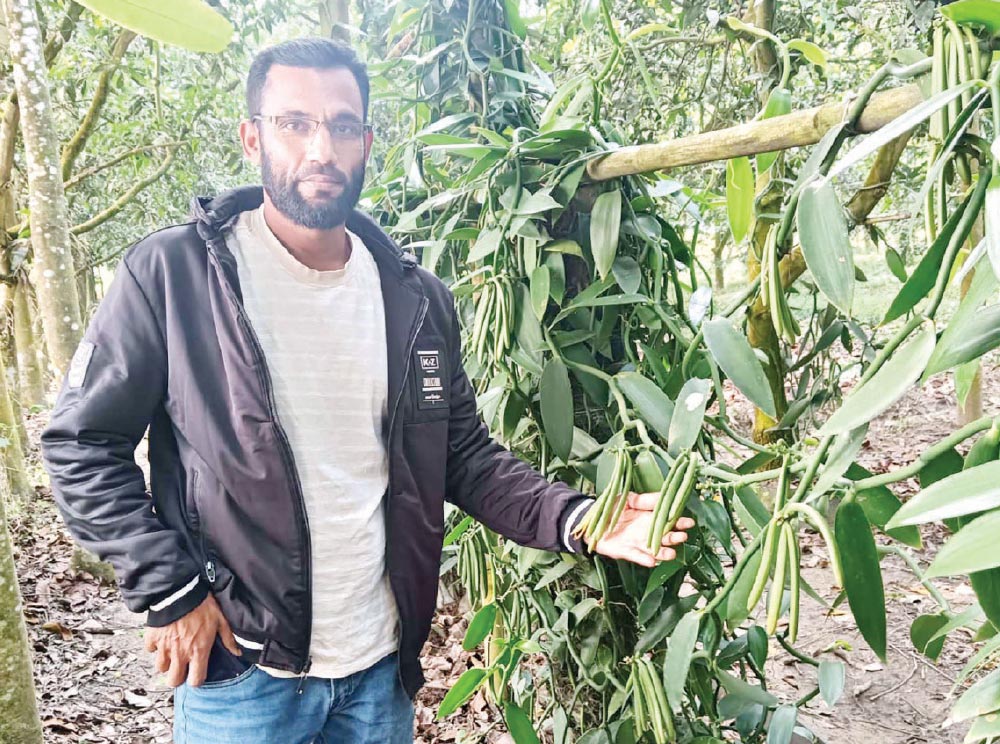 JASHORE, Nov 18: Beneath the natural shade of mango trees in a village in Jashore, rows of vanilla plants are growing on raised beds. Some are flowering, while others are bearing clusters of pods, offering a glimpse of the commercial potential of one of the world's most expensive spices in Bangladesh.
Sarowar Hossain, an entrepreneur from Swarparajpur village in Chaugachha upazila, has adopted an unconventional approach to vanilla cultivation by using his mango orchard instead of investing in costly artificial shade structures.
His five-decimal plot now has around 150 to 160 vanilla plants, many of which have started bearing fruit. After nearly three years of cultivation, he has achieved encouraging results this year.
Sarowar began experimenting with vanilla in 2019 alongside dragon fruit cultivation. Initially, he planted 50 saplings, but 25 died due to his lack of experience. He later collected new saplings and resumed cultivation.
* Vanilla is being cultivated under mango shade instead of artificial structures
* Buyers from Qatar, Japan and US have shown interest in importing this spice
He first tried the Tahitensis variety but later imported Vanilla planifolia saplings from India. According to him, the former variety could not survive Bangladesh's climatic conditions.
Vanilla requires controlled sunlight, humidity and temperature. Excessive rainfall and high temperatures are major challenges. Sarowar believes the natural shade of mango trees provides a cost-effective alternative to artificial structures.
"Before planting the cuttings, I prepare each raised bed using eight different materials. I have invested around Tk 4 lakh in developing the plantation," he said.
He hopes to earn Tk 5 lakh annually from the small orchard if production reaches the expected level.
Sarowar believes vanilla cultivation could be expanded across Bangladesh. "If 100 farmers receive sufficient saplings, we can produce 1,000 kilograms of exportable vanilla within four to five years. International buyers will then come to Bangladesh," he said.
Al-Amin Hossain, who works at the orchard, said the plants require relatively little daily care, although regular monitoring is necessary to prevent fungal infections. Occasional watering is generally sufficient, while the raised beds help reduce weed growth.
Vanilla is considered the world's second-most expensive spice after saffron. Its distinctive aroma and flavour make it popular in food, beverages and processed products. International prices have varied considerably, with some market estimates currently putting the price at around $250 per kilogram.
Sarowar said several buyers from Qatar, Japan and the United States had already contacted him regularly to purchase vanilla. However, he expressed concern over the lack of proper processing and marketing facilities in Bangladesh.
Jashore Senior Agricultural Marketing Officer Kishore Kumar Saha said vanilla required proper processing before being sold. "If farmers contact us, we will assist them with processing and finding buyers in domestic and international markets," he said.
Jashore DAE Acting Deputy Director Zahidul Islam Biswas said a team of agricultural scientists would visit the plantation to assess its cultivation methods.
"Vanilla is a new crop in Bangladesh, and we do not yet have sufficient technical knowledge about its cultivation," he said, adding that the possibility of expanding cultivation would be discussed at the Regional Agricultural Technology Extension Committee based on the scientists' recommendations.
Sarowar's experiment has already attracted interest from local entrepreneurs, highlighting the potential of vanilla as a high-value agricultural crop in Bangladesh.

Loading...
Loading...
Also read



Editor : Iqbal Sobhan Chowdhury
Published by the Editor on behalf of the Observer Ltd. from Globe Printers, 24/A, New Eskaton Road, Ramna, Dhaka.
Editorial, News and Commercial Offices : Aziz Bhaban (2nd floor), 93, Motijheel C/A, Dhaka-1000.
Phone: PABX- 41053001-06; Advertisement: 41053012; 01793317829, 01550707291, 01550707296
E-mail: [email protected], [email protected]. [email protected], [email protected], [email protected], [email protected], Online-email: [email protected]


