



| HEADLINE |

|

Myanmar committed genocide against Rohingyas: ICJ
Published : Friday, 20 November, 2026 at 12:00 AM


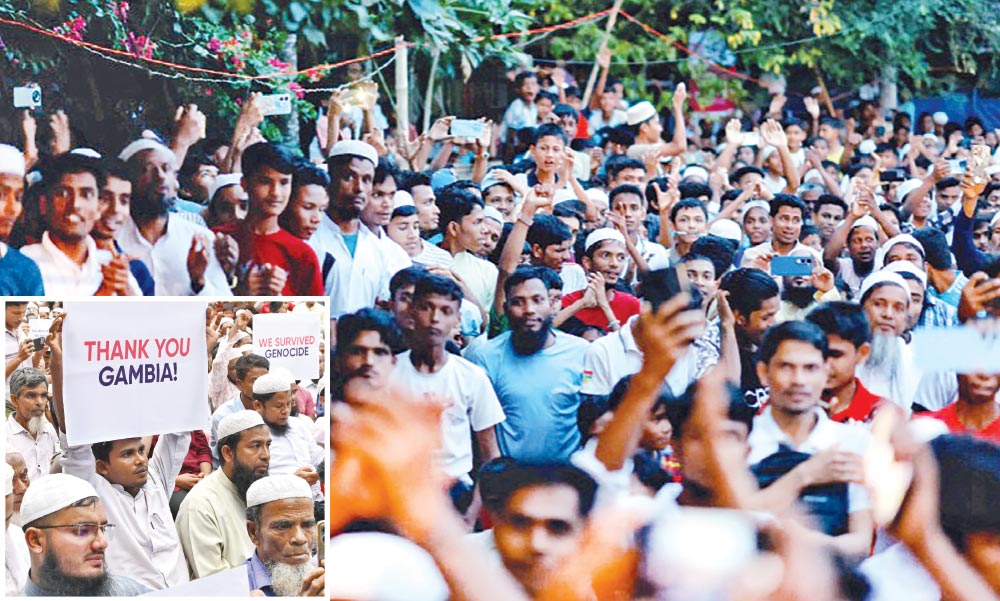 THE HAGUE, Nov 19: The United Nations' highest court on Thursday ruled that Myanmar committed genocide against the Rohingya minority during its brutal military crackdown in 2017, marking a historic development in the international effort to secure justice for the persecuted community.
Reading out the judgment, ICJ President Yuji Iwasawa said Myanmar's security forces killed thousands of Rohingya civilians, committed widespread sexual violence, perpetrated extreme acts of brutality against children and attacked people fleeing the violence.
The 15-member judicial panel also rejected Myanmar's argument that the 2017 military campaign was a legitimate operation against insurgents. The ruling marks the first time the ICJ has found a state responsible for committing genocide.
The court said the only reasonable conclusion from evidence of widespread atrocities was that Myanmar's security forces intended to destroy a substantial part of the Rohingya community. Under international law, the intention to destroy a national, ethnic, racial or religious group, in whole or in part, is a fundamental requirement for establishing genocide.
* Dhaka welcomes ICJ verdict on Rohingya genocide
* UN adopts Rohingya repatriation resolution
* HRW hails ICJ verdict
* ICJ verdict unlikely to change Rohingya lives soon: Crisis Group
* 'ICJ verdict gives fresh hope to Rohingya cause'
* A verdict of hope for Rohingyas in exile
The court also ordered Myanmar to allow and facilitate the safe, voluntary and dignified return of Rohingya refugees to their places of residence and ensure family reunification. President Iwasawa said the Rohingya had been displaced within Myanmar and abroad as a result of wrongful acts by Myanmar's forces.
The case was filed by The Gambia in 2019, accusing Myanmar of violating the 1948 Genocide Convention. The West African country sought an order requiring Myanmar to stop genocidal acts and ensure accountability for those responsible. It also pursued reparations, including measures to secure the Rohingya's citizenship rights and safe return.
Myanmar has consistently denied the genocide allegations, maintaining that its military operation was a counterterrorism campaign against insurgents.
In August 2017, Myanmar's military launched what it called a clearance operation in northern Rakhine following attacks by a Rohingya insurgent group.
The offensive was accompanied by allegations of mass killings, sexual violence and the burning of thousands of homes, forcing more than 700,000 Rohingya to flee to Bangladesh.
Around 1.2 million Rohingya refugees are now living in Bangladesh, mainly in overcrowded camps in Cox's Bazar. They face inadequate sanitation, disease outbreaks, fire hazards, monsoon landslides and restrictions on employment.
Many more remain displaced inside Myanmar, where conflict between the military and the Arakan Army has further complicated their situation.
BANGLADESH WELCOMES VERDICT
State Minister for Foreign Affairs Humaiun Kobir welcomed the landmark judgment, describing it as a significant development for justice and resolving the protracted refugee crisis.
"We welcome the ICJ verdict and we are satisfied," he told journalists in Dhaka, giving the government's initial reaction.
He said the ruling was historic because, for the first time, the ICJ had held a state responsible for genocide.
"The state of Myanmar has been condemned for genocide against the Rohingya communities," he said.
Kobir expressed optimism that the judgment would have positive implications not only for the Rohingya but also for countries affected by their persecution and displacement, particularly Bangladesh.
Asked about compensation, he said the judgment could create opportunities for redress for Rohingya victims and affected countries. He said the government would provide a more detailed assessment of the ruling and its implications at a briefing on Friday.
UN URGES REPATRIATION
Meanwhile, the United Nations General Assembly (UNGA) on Wednesday adopted a joint resolution sponsored by the Organisation of Islamic Cooperation (OIC) and the European Union (EU), calling for the repatriation of Rohingya Muslims and other minorities to Myanmar.
The resolution received 128 votes in favour, six against and 33 abstentions.
Addressing the assembly on behalf of Bangladesh, the country's Charge d'Affaires to the UN, Ambassador Shanchita Haque, stressed the urgency of resolving the protracted crisis.
She said nine years after the mass displacement, no meaningful progress had been made on repatriation, leaving Bangladesh and host communities facing mounting social, economic, environmental and security pressures.
The resolution highlights serious human rights violations by both the Myanmar military and the Arakan Army. It calls for an immediate end to violence, unhindered humanitarian assistance and accountability for perpetrators.
It also urges adequate funding for humanitarian operations, including the 2026 Joint Response Plan, restoration of the Rohingya's political and voting rights, and the creation of conditions for their voluntary, safe, dignified and sustainable return and reintegration.
RIGHTS GROUPS, EXPERTS HAIL RULING
Human Rights Watch welcomed the judgment, describing it as long-awaited recognition of the suffering endured by the Rohingya.
Maria Elena Vignoli, senior international justice counsel at the organisation, said the ruling established an important precedent for victims of genocide and other grave crimes worldwide.
She urged Myanmar to comply with the judgment and end its oppression of the Rohingya, calling on governments to support accountability and press for the refugees' safe and voluntary return.
Richard Horsey, senior adviser for Asia at the International Crisis Group, also described the verdict as historic, noting that Myanmar's President Min Aung Hlaing had commanded the military operations against the Rohingya.
He said the judgment would place the atrocities firmly on the legal record despite continued denial by Myanmar's authorities. However, he cautioned that the ruling would not immediately change conditions for the community without sustained international pressure.
The ICJ has no direct enforcement mechanism. Although its judgments are final and legally binding, non-compliance can be referred to the UN Security Council, where veto powers may complicate action.
Horsey said the practical significance of the verdict would depend on whether governments dealing with Myanmar were prepared to impose consequences for ignoring it.
He also warned that the judgment could make Naypyitaw more defensive in its dealings with the United Nations as it seeks to regain its seat at the organisation.
He pointed out that much of the territory from which Rohingya fled is now controlled by the Arakan Army, an ethnic Rakhine armed group fighting Myanmar's authorities. The treatment of Rohingya still living in Rakhine would therefore be crucial to any prospect of return.
Horsey hoped the judgment would also remind international donors of the refugees' plight and encourage increased humanitarian assistance, particularly as food rations in Bangladesh's camps have been reduced following funding cuts.
Independent migration and refugee expert Asif Munir said the verdict had opened a new chapter in the pursuit of justice, providing fresh legal and diplomatic grounds for protecting Rohingya rights and securing their eventual return.
He said the court's recognition of the Rohingya as an ethnic group directly challenged Myanmar's longstanding denial of their identity and affirmed their protection under the Genocide Convention.
Munir noted that the court had considered testimonies from victims, survivors and eyewitnesses, along with UN reports, validating evidence despite Myanmar's denial and restrictions on direct access.
He said provisions concerning reparation and compensation could provide grounds for further claims, although securing compliance would remain difficult. Myanmar has no avenue to appeal the judgment, but enforcement could face obstacles at the Security Council.
"Nothing can be achieved very soon, but at least it gives a new strength and impetus," he said.
ROHINGYA HOPE FOR HOMECOMING
For nearly a decade, Rohingya refugees have endured displacement, uncertainty and memories of violence. Thursday's judgment rekindled hopes of justice and a return to their homeland.
Thousands gathered at different refugee camps in Ukhiya, Cox's Bazar, to watch the proceedings live on large screens. Arrangements were made at several locations, including Camps 1, 13 and 15, drawing men, women, children and elderly people.
Many became emotional as the verdict was delivered, while others raised their hands in prayer for justice for relatives killed during the military operations and an end to their prolonged exile.
Chairman of the Arakan Rohingya Society for Peace and Human Rights, Dr Mohammad Zubair, said the community welcomed the ruling but remained primarily concerned about returning home.
"Our prime expectation is to return to our homeland. We want to go back to Myanmar now. If a safe and suitable environment is created for us to live there with dignity, we will return voluntarily on our own responsibility," he said.
He also thanked Bangladesh for sheltering the Rohingya during their difficult times.
Former president of the United Council of Rohingya Syed Ullah said the community had waited nearly a decade for justice and hoped the ruling would strengthen international pressure on Myanmar.
Rohingya Relief and Repatriation Commissioner Mohammad Mizanur Rahman said the judgment would play an important role in establishing the community's identity and rights.
For the refugees watching from the camps, the ruling was more than a legal milestone. It renewed their hope that international accountability could eventually lead to justice, dignity and a safe return to the land they still call home.

Loading...
Loading...
Also read



Editor : Iqbal Sobhan Chowdhury
Published by the Editor on behalf of the Observer Ltd. from Globe Printers, 24/A, New Eskaton Road, Ramna, Dhaka.
Editorial, News and Commercial Offices : Aziz Bhaban (2nd floor), 93, Motijheel C/A, Dhaka-1000.
Phone: PABX- 41053001-06; Advertisement: 41053012; 01793317829, 01550707291, 01550707296
E-mail: [email protected], [email protected]. [email protected], [email protected], [email protected], [email protected], Online-email: [email protected]


